I was at a rural clinic in Sichuan when a patient went into anaphylactic shock from an antibiotic injection. The clinic had a crash cart — a full-size unit that weighed eighty kilograms loaded and was stored in a supply room two corridors away because there wasn’t space for it in the treatment area. The nurse who ran to get it was five-foot-two, and by the time she wrestled the cart through two doorways and down the hall, the physician had already administered epinephrine from his pocket kit. The cart was irrelevant to the outcome. The ET700-1 was designed so that never happens.
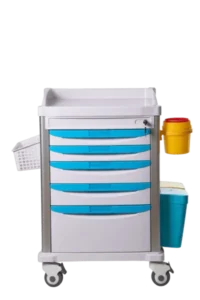
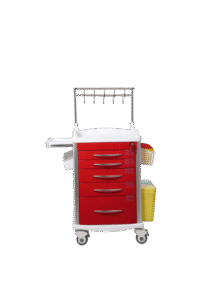
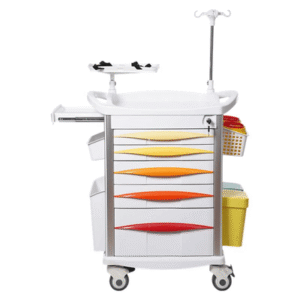
The AM-ET700-1 is the lightest, narrowest emergency cart in our line — three drawers, a defibrillator shelf, and a side-mounted oxygen cylinder bracket, in a frame that’s forty-eight centimeters wide and weighs about eighteen kilograms unladen. A single clinician of any stature can push it at a run, steer it through a doorway without slowing down, and position it at the bedside in under ten seconds. The design principle is simple: a crash cart that’s too heavy or too wide to move quickly is a crash cart that arrives after the critical interventions have already happened. The ET700-1 is built to arrive first.
Three drawers means ruthless prioritization of supplies. The top drawer is emergency medications — epinephrine, atropine, amiodarone, naloxone, dextrose, and a small set of pre-filled syringes. This is a one-drawer ACLS pharmacy, and it covers the drugs that matter in the first five minutes of a code. The middle drawer is airway — basic adjuncts, a bag-valve mask, a compact laryngoscope handle with two blade sizes, and two endotracheal tubes in the most common adult sizes. No surgical airway kit, no pediatric range — those live on the full crash carts. The bottom drawer is IV access and fluids — angiocaths, syringes, alcohol wipes, tourniquets, and two five-hundred-milliliter bags of normal saline. That’s it. Everything else belongs on a restocking cart that follows later.
The defibrillator shelf is sized for a standard AED or compact biphasic unit. The oxygen bracket takes a D-size cylinder — enough for about twenty minutes of high-flow oxygen, which covers the gap between code initiation and the arrival of backup with a full-size tank. A single telescoping IV pole provides one infusion line during transport. The push handle is a single loop at the head end, and the caster configuration is four swivel with two locking — designed for rapid single-person transport rather than stationary code team workflow.
The ET700-1 is designed for environments where the gap between patient decompensation and definitive care is measured in minutes and the first responder is often working alone: rural clinics, community health centers, school nurses’ offices, occupational health stations, and rapid response team carts that need to be the first unit at the bedside while the full crash cart is being retrieved. It’s also the right cart for small procedure rooms in larger hospitals — endoscopy suites, interventional radiology, cardiac catheterization labs — where a code is a known risk but floor space is at a premium. If your facility runs full ACLS codes with a team of four or more, the ET750 is the minimal appropriate cart. The ET700-1 is for the first responder, the solo clinician, the facility where the cart exists to bridge the gap until EMS arrives. If that describes your scenario, send me a note — I’ll help you decide between three drawers and five.
Frequently Asked Questions
What specifications should I review for this model?
Key specifications including dimensions, capacity, power requirement and material composition are provided in the model datasheet. Contact us with your project requirements for the complete specification sheet.
What documents are available for import?
Datasheet, user manual, packing information and applicable conformity documents are confirmed per destination market. Registration requirements vary by country and are reviewed project by project.
Can I request a sample or reference installation?
Sample availability and reference installation details are confirmed based on the product category and order volume. Contact us with your specific requirements.