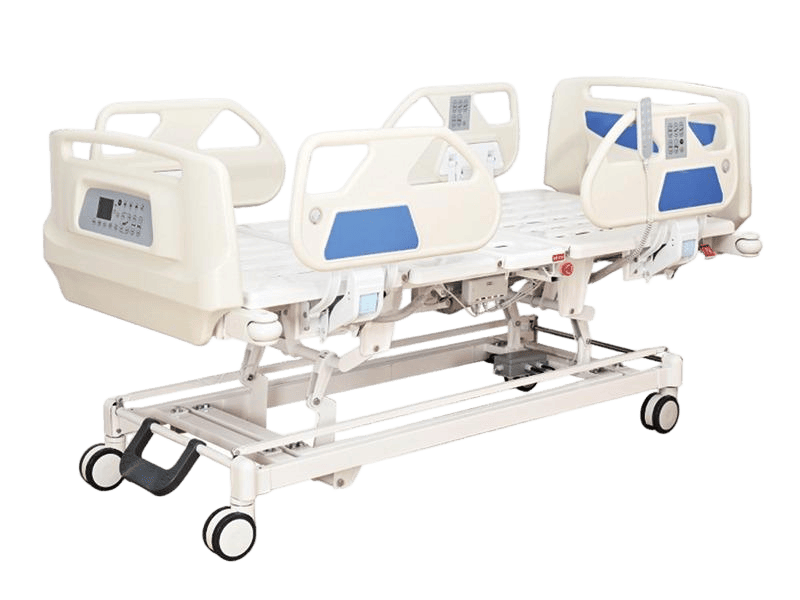
An ICU bed has one job that no other hospital bed has: it has to get out of the way in under three seconds when a patient crashes. Everything else — the cardiac chair, the monitor shelf, the integrated scale — is secondary to the CPR release. I learned this from an intensivist in Singapore who had done a year in a London trauma ICU. He told me about a night when a post-op cardiac patient went into V-fib and the nurse couldn’t find the CPR release lever on an unfamiliar bed — ten seconds of fumbling while the patient had no cardiac output. The patient survived, but the intensivist didn’t forget. “If I can’t drop the backrest instantly without looking,” he said, “I don’t want the bed in my unit.” The H001-02 has the CPR release where your hand finds it blind.
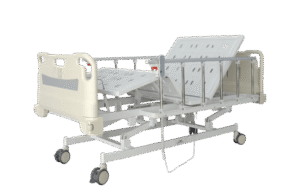
The H001-02 is our full ICU platform — seven electric functions plus the clinical features that separate an ICU bed from a high-acuity ward bed. The CPR release is one motion: a red lever at each side of the head end, positioned at standing height. Pull either lever — left or right, doesn’t matter — and the backrest drops flat in under three seconds with a controlled descent. The head board comes off with one hand — no tools, no clips to pinch — so the intubating physician has unobstructed head-end access. These two features together — instant backrest drop, instant head board removal — are the bed’s response to an airway emergency. In a code, seconds matter, and the bed should take zero of them.
Seven electric functions: backrest, knee section, height, Trendelenburg, reverse Trendelenburg, cardiac chair, and leg elevation. The cardiac chair position is programmed and accessed from a dedicated button. The bed includes an integrated weighing scale — load cells in the four corners of the frame — with accuracy to within one hundred grams. Daily weights matter in the ICU for fluid balance calculation, and the alternative — transferring a critically ill patient onto a separate scale — is a two-person procedure that disrupts monitoring lines and risks extubation. The scale displays on the handset and can zero-out with the mattress and linens in place.
A monitor shelf is integrated into the head end — a stainless steel platform that mounts above the head board and holds a standard multi-parameter monitor, keeping cables organized and off the floor. Below the shelf, an X-ray cassette tray slides out from under the mattress platform — the radiology tech positions the cassette without lifting or log-rolling the patient. This is a small thing until you’ve watched a portable chest X-ray in the ICU turn into a ten-minute production because the cassette had to be wedged under a patient on a bed without a tray.
The actuators are Linak — LA31 for the primary axes, LA27 for secondary — all IPX6, all medical-grade. The handset is a backlit LCD with full function display, lockout controls, scale readout, and battery status. The side rails are aluminum with integrated patient controls on the inner face — backrest and knee only, within nurse-set limits. The frame is powder-coated steel, reinforced at all articulation points for the higher loading cycles of ICU use. Central brake, four anti-static casters, weight capacity two hundred fifty kilograms — the highest in our bed line — because ICU patients may retain liters of fluid.