I once spent an afternoon with an ambulance crew in Manila, riding along on non-emergency patient transfers. Their stretcher was an auto-loading model that had been out of service for three weeks because the hydraulic cylinder was leaking and the local distributor had to order the replacement part from Germany. They were loading patients the old-fashioned way — two-person deadlift into the bay — while a forty-thousand-dollar piece of equipment sat folded in the station garage. That’s not an argument against auto-loaders. It’s an argument for having a stretcher that works when the fancy one doesn’t.
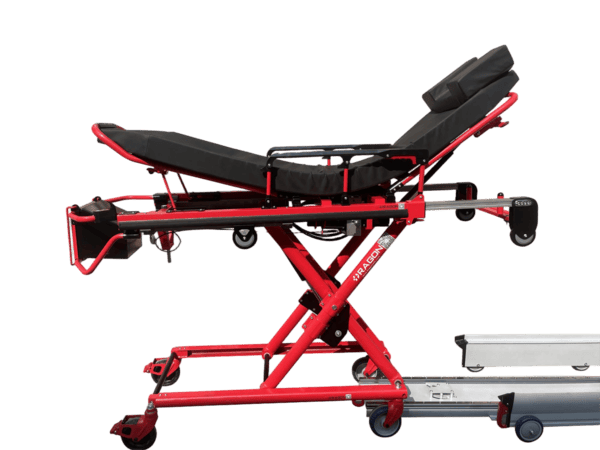
The AM-SS003B is our basic ambulance stretcher, and “basic” here means manual height adjustment, manual backrest positioning, and no loading system that requires a power source or a hydraulic circuit. The frame is welded aluminum alloy — strong enough to hold up to one hundred fifty-nine kilograms, light enough that a two-person crew can load a patient into a standard ambulance bay without needing the automated arm. In an emergency, a stretcher that depends on nothing but human hands is a stretcher that never has a dead battery, a blown fuse, or a seized actuator.
Height adjustment uses a twin-scissor lift mechanism with gas spring assist. The attendant steps on a foot pedal at either end, and the stretcher rises or lowers smoothly through a range of roughly thirty-five to ninety centimeters from the floor. That’s enough to match bed height in most hospitals, ambulance deck height, and supine transfer position. Two modes are available: a fast lift for quick loading and a slow descent for controlled transfers. The difference is a switch position — no tools, no calibration.
The side rails fold down flat against the frame with a one-handed release on each side. When you’re transferring a patient laterally onto a hospital bed, the rail on the receiving side drops and the mattress becomes a continuous surface. That detail saves the crew from wrestling a patient over a raised rail — which is how back injuries happen. The mattress is foam with a seamless vinyl cover, fluid-resistant and cleanable between calls with standard surface disinfectant. Head-end backrest adjusts from flat to approximately seventy-five degrees via a manual crank — again, no power, no actuators, nothing to fail.
The running gear uses four swivel-lock casters, one hundred fifty millimeters in diameter, with central locking via a foot bar at the foot end. In the locked position, the stretcher doesn’t drift when you’re loading a two-hundred-pound patient. In the unlocked position, it tracks straight down a hospital corridor with one hand on the push handle. The wheels have a slight camber that improves straight-line tracking — small detail, but it’s the difference between fighting the stretcher and steering it.
This stretcher is built for services that prioritize reliability over automation. Rural ambulance fleets where the nearest service technician is two hundred kilometers away. Disaster response units that deploy to locations with no power infrastructure. Private medical transport companies doing non-emergency patient transfers where the price difference between a manual stretcher and an auto-loader pays for two months of fuel. And backup units in stations that already have auto-loaders in the primary rigs — because when the primary goes down, you still need to move patients.
If your fleet runs a dozen ambulances and every vehicle needs a stretcher that won’t cost more than the monitor riding on top of it, the SS003B is the answer. Manual doesn’t mean primitive — it means fewer things to break and fewer reasons to cancel a call. Reach out with your fleet size and I’ll quote you per-unit pricing that reflects volume.
Model Comparison
| Specification | AM-SS001B | AM-SS003B | AM-AL004 |
|---|---|---|---|
| Type | Electric auto-loading | Electric auto-loading | Manual folding-leg |
| Material | — | — | Aluminum alloy |
| Expanded size | 208×58×120 cm | 209×61×125 cm | 190×55×92 cm |
| Folding size | 208×58×48 cm | 209×61×48 cm | 190×55×25 cm |
| Backrest angle | 0–55° | 0–55° | Adjustable |
| Load limit | 318 kg | 318 kg | 159 kg |
| Motor | Brushless 1200 W | Brushless 1200 W | — |
| Battery | Li-ion 24 V / 7.8 Ah, detachable | Li-ion 24 V / 7.8 Ah, removable | — |
| Net weight | 65 kg | 77 kg | 40 kg |
Frequently Asked Questions
What specifications should I review for this model?
Key specifications including dimensions, capacity, power requirement and material composition are provided in the model datasheet. Contact us with your project requirements for the complete specification sheet.
What documents are available for import?
Datasheet, user manual, packing information and applicable conformity documents are confirmed per destination market. Registration requirements vary by country and are reviewed project by project.
Can I request a sample or reference installation?
Sample availability and reference installation details are confirmed based on the product category and order volume. Contact us with your specific requirements.