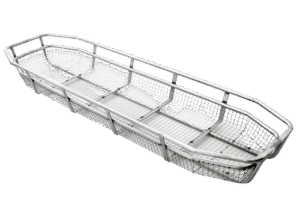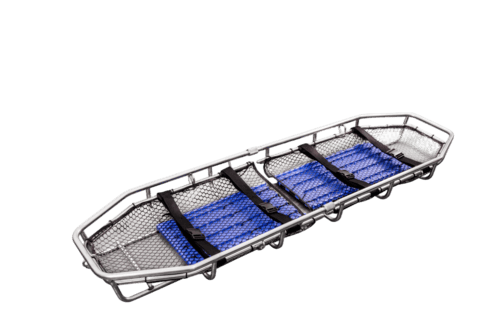
When your helicopter’s equipment bay has maybe eighteen inches of clearance and a fully assembled basket stretcher won’t fit no matter how you angle it, you start to appreciate the value of something that comes apart. I’ve talked to SAR teams in the Pacific Northwest who pack their Bell 429s with the AM-BS008 broken into its two halves, each half slotting into a space no one-piece stretcher can occupy. The stretcher separates at the midpoint—four quick-release pins, no tools—and reassembles in under two minutes when you reach the landing zone. For ground ambulance crews, the split design means you can store it vertically behind the airway seat instead of eating up the entire side compartment.
This isn’t a lightweight compromise. The AM-BS008 uses a stainless steel frame with a 159 kg load capacity—same as our standard basket stretchers. The split point is reinforced with double-wall tubing and locking pins that won’t back out under vibration. We tested it on a sixteen-hour mountain rescue drill in Yunnan where the stretcher got separated, carried to the patient by two teams on different approach routes, reassembled at the accident site, and used to lower a 90 kg patient sixty meters down a scree slope. Nothing shook loose.
The mesh body is polyethylene-coated to resist abrasion from rock faces and helicopter deck edges. Drain holes along the bottom channel keep fluids from pooling during wet-weather operations, and the four vertical lift points are rated for helicopter hoist operations. At 21 kg total weight—about 10.5 kg per half—a single rescuer can manage each piece on foot. The packing footprint is 121 x 68 x 37 cm, roughly half the depth of a one-piece unit. We ship each unit with a waterproof storage cover and a set of four carabiners for immediate rigging.
The locking mechanism at the split joint deserves a closer look. Unlike friction-fit connectors that can loosen over time, the BS008 uses spring-loaded stainless pins that seat into machined receivers. You hear a distinct click when each pin engages. To separate, you pull the pin rings outward simultaneously and slide the halves apart. The design tolerates dirt, mud, and ice—we ran it through thirty separation-reassembly cycles after burying the joint in wet sand, and it never once stuck or jammed.
We’re seeing these go out to mountain rescue associations in Switzerland, coastal SAR units in Norway, and a growing number of air ambulance services in Southeast Asia. If your operation runs tight on storage and can’t afford to leave the basket stretcher behind, this is the model that fits where the others don’t.
I’m Linjian Xiao. At Shanghai Ascend Medtech, we build emergency medical equipment for the people who actually use it—not for the brochure photos. If you have questions about the AM-BS008 or need to compare it against your current basket stretcher setup, reach out through the contact form on this page.
Model Comparison
| Specification | AM-BS001 | AM-BS002 | AM-BS003 | AM-BS004 | AM-BS005 | AM-BS008 |
|---|---|---|---|---|---|---|
| Material | Stainless steel | PE | PE | Stainless steel | Stainless steel | Stainless steel |
| Expanded size | 218×64×24 cm | 220×62.5×16.5 cm | 220×62.5×17.5 cm | 215.5×64×21 cm | 128×64×25 cm | 208×60×19 cm (BS008-1) 218×65×21.5 cm (BS008-2) |
| Folding | — | — | 124×62.5×20.5 cm | 115×64×35.5 cm | — | Separable 2-piece |
| Load limit | 159 kg | 300 kg | 300 kg | 159 kg | 159 kg | 300 kg |
| Net weight | 12.6 kg | 11.2 kg | 13.2 kg | 15.2 kg | 12.6 kg | 20–21 kg |
| Special | Aircraft hook, safety belt | Fire-resistant PE | Fire-resistant PE | Aircraft hook | Compact short model | Separable, 2 sizes |
Frequently Asked Questions
What specifications should I review for this model?
Key specifications including dimensions, capacity, power requirement and material composition are provided in the model datasheet. Contact us with your project requirements for the complete specification sheet.
What documents are available for import?
Datasheet, user manual, packing information and applicable conformity documents are confirmed per destination market. Registration requirements vary by country and are reviewed project by project.
Can I request a sample or reference installation?
Sample availability and reference installation details are confirmed based on the product category and order volume. Contact us with your specific requirements.