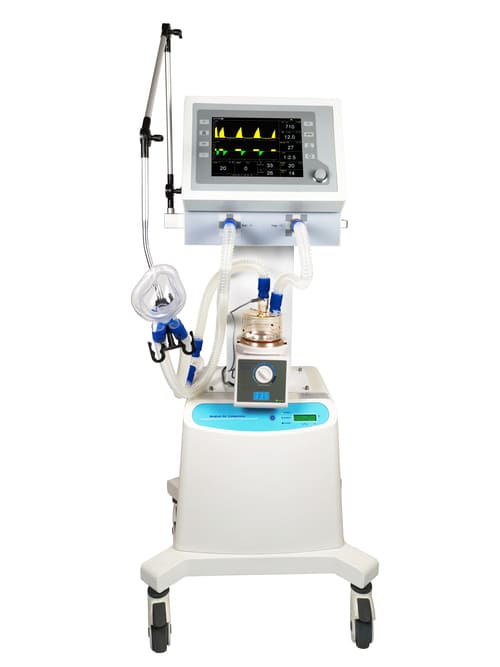
The AM-PA-900B is an ICU ventilator with eight ventilation modes, a 10.4-inch TFT display with waveform monitoring, and a built-in medical air compressor, for tertiary and teaching ICUs.
Key Specifications
| Parameter | Value |
|---|---|
| Ventilation Modes | SIPPV (VCV), IPPV (VCV), PCV, PSV, SIMV, PSIMV, CPAP, MANUAL |
| Tidal Volume | from 20 ml (pediatric/neonatal) |
| Respiration Rate | 1–99 bpm |
| IMV Frequency | 1–20 bpm |
| I/E Ratio | 4:1–1:4 |
| Display | 10.4-inch TFT |
| Air Supply | Built-in medical air compressor |
| Backup Battery | 4 hours |
Features
- Eight ventilation modes including PCV, PSV, CPAP, and PSIMV
- Tidal volume starting at 20 ml for pediatric and neonatal applications
- Respiration rate from 1 to 99 bpm with IMV frequency from 1 to 20 bpm
- I/E ratio spanning 4:1 to 1:4
- 10.4-inch TFT display with real-time pressure, flow, and volume waveforms
- Built-in medical air compressor independent of wall air
- Humidifier with temperature adjustment
- Four-hour backup battery
- Alarm logs, trend storage, and export capability
Applications
Tertiary ICUs, respiratory ICUs, and teaching hospitals managing high-acuity ventilated patients with full waveform analysis and advanced ventilation modes.
Model Comparison
| Specification | AM-PA-900B | AM-PA-700B | AM-PA-500 |
|---|---|---|---|
| Breathing modes | SIPPV(VCV), IPPV(VCV), PCV, PSV, SIMV, PSIMV, CPAP, MANUAL | A/C, IPPV, SIPPV, IMV, SIMV, PEEP, SIGH, SPONT, MANUAL | A/C, IPPV, SIPPV, IMV, SIMV, MANUAL |
| Tidal volume | 20–1500 ml | 50–1500 ml | 50–1200 ml |
| I/E ratio | 4:1–1:4 | 4:1–1:4 | 1:1.5–1:3.0 |
| Respiratory rate | 1–99 bpm | 1–99 bpm | 6–60 bpm |
| IMV frequency | 1–20 bpm | 1–20 bpm | 1–12 /min |
| O2 concentration | 21%–100% | 21%–100% | — |
| PEEP | 0–1.0 kPa | 0–1.0 kPa | 0.1–1.0 kPa |
| Pressure limit | 1.0–6.0 kPa | 1.0–6.0 kPa | 1.0–6.0 kPa |
| Trigger method | Pressure + Volume trigger | Pressure trigger | — |
CE marking and ISO 13485 documentation can be confirmed for the specific model, configuration, legal manufacturer, and destination market.
Frequently Asked Questions
What specifications should I review for this model?
Key specifications including dimensions, capacity, power requirement and material composition are provided in the model datasheet. Contact us with your project requirements for the complete specification sheet.
What documents are available for import?
Datasheet, user manual, packing information and applicable conformity documents are confirmed per destination market. Registration requirements vary by country and are reviewed project by project.
Can I request a sample or reference installation?
Sample availability and reference installation details are confirmed based on the product category and order volume. Contact us with your specific requirements.