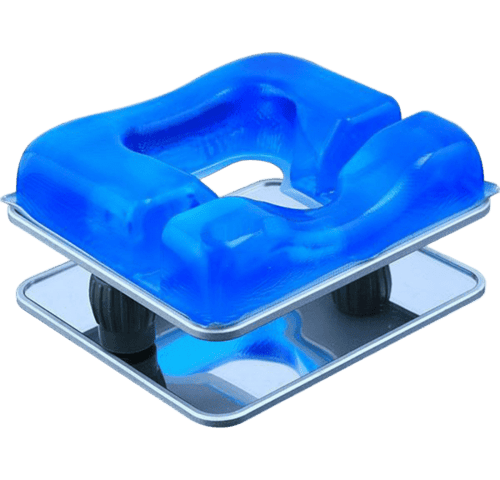
There’s a particular moment in prone spinal fusion cases that drives positioning nurses absolutely crazy. The surgeon wants the head tilted 15 degrees to the right for the approach — better visualization of the pedicle entry points on the concave side of the curve. Two hours later, for closure, they want 5 degrees the other way to access the contralateral instrumentation. With a standard fixed donut pad, the nurse has to crawl under the surgical drapes, loosen the tape and positioning straps, manually reposition the head, re-tape everything, check the airway, and hope the sterile field isn’t compromised in the process. That’s ten minutes of wasted OR time, repeated three or four times per case if the surgeon is particular about their working angles. Multiply that across a spine list of four or five fusions in a day and you’ve burned close to an hour of expensive operating room time on head repositioning alone — time that could have been spent on the next case, on the next patient waiting in pre-op. The AM-TW-011 is our answer to cases where head angle matters and it cannot be static.
The 011 builds on our prone donut platform — a 23×20cm footprint with the same polymer gel core as the AM-TW-001 — but adds two features that change how the OR team works: an adjustable angle mechanism and an integrated mirror. The mirror is the practical detail that teams consistently tell me changes their workflow for the better. It lets the anesthesiologist visually confirm endotracheal tube position, check for facial pressure points across all six contact landmarks, and verify that the eyes are properly protected and taped, all without ducking under the surgical drapes every twenty minutes. For a six-hour spine case, that’s roughly eighteen visual checks the anesthesiologist would otherwise have to do blindly or by feel — reaching under hot, humid drapes, guessing at tube position and facial skin condition. The angle adjustment uses a ratcheted base plate with positive-locking detents at multiple positions, so the circulating nurse or surgical team can tweak head tilt intraoperatively with one hand, from outside the sterile field, without breaking sterility. We ship it in two height configurations — 14cm and 11cm — to accommodate different OR table designs and patient body habitus.
Compared to our fixed prone pad (AM-TW-001), the 011 trades some setup simplicity for intraoperative flexibility. If your spine surgeons work with standardized, single-approach prone positioning and the angles don’t change mid-case, the standard 001 is lighter, faster to deploy, and slightly less expensive per unit. But if your surgeons vary their approach angles between exposure and closure, do combined anterior-posterior procedures on the same patient requiring mid-case repositioning, or operate in teaching hospitals where attending surgeons frequently adjust resident-set positioning, the adjustability of the 011 pays for itself in avoided repositioning time. The mirror alone — giving the anesthesia team continuous visual confirmation of airway and facial status — reduces the cognitive load enough to justify the upgrade for long-duration spine lists.
Frequently Asked Questions
What specifications should I review for this model?
Key specifications including dimensions, capacity, power requirement and material composition are provided in the model datasheet. Contact us with your project requirements for the complete specification sheet.
What documents are available for import?
Datasheet, user manual, packing information and applicable conformity documents are confirmed per destination market. Registration requirements vary by country and are reviewed project by project.
Can I request a sample or reference installation?
Sample availability and reference installation details are confirmed based on the product category and order volume. Contact us with your specific requirements.