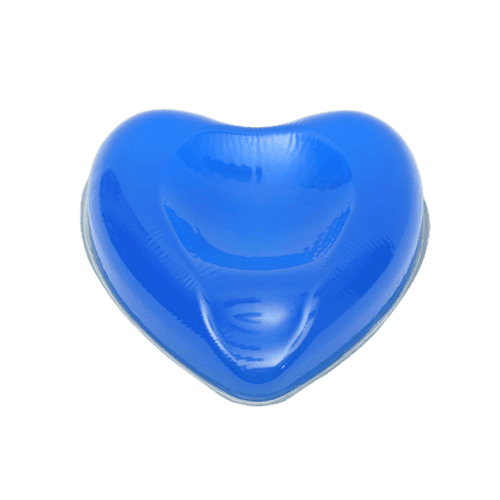
ENT surgery has a positioning problem that general-purpose head pads were never designed to solve, and I found out about it the hard way. About three years ago, we started getting returns from ENT departments — not because the pads were defective, but because a standard ring or donut blocks access to the ear canal. The surgeon would position the patient supine with the head turned laterally, the general pad would sit flush against the side of the skull, and suddenly there was no working angle for the otoscope, the micro-instruments, or the operating microscope. The circulating nurse would end up improvising — wedging folded towels under the contralateral side to tilt the head, stacking linen packs to create an offset, anything to get the ear into a workable position. That improvisation adds setup time, introduces variability the surgical team shouldn’t have to manage, and compromises the sterile field when someone has to reach under the drapes to adjust the ad-hoc positioning. The head drifts. The surgeon compensates by working at an awkward wrist angle. Instruments slip. That pattern — a perfectly good general pad failing a legitimate specialty need — is exactly why I developed the AM-TW-006.
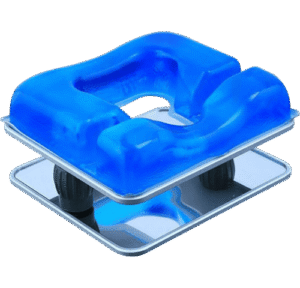
The 006 uses a contoured cutout profile with a 29×28.5cm footprint and asymmetric depth options at 7cm and 3.3cm. The defining design feature is the bilateral lateral relief zone — the pad leaves the periauricular region exposed on both sides while stabilizing the skull from beneath along the sagittal midline and occipital base. The polymer gel surface grips without adhesiveness; the patient’s head stays put through the micro-movements of middle-ear instrumentation, cochlear implant electrode insertion, or endoscopic sinus navigation. The anesthesiologist keeps clear airway access from whichever side isn’t in the surgical field. We also use this pad in supine thyroid procedures and anterior neck cases where the surgical field runs from the chin down to the sternal notch — the contoured shape accommodates neck extension without creating a fulcrum point under the cervical spine that could compress the vertebral arteries. The gel core formulation is the same polymer we use across the entire TW series, so it handles betadine, alcohol, and enzymatic cleaning agents without surface degradation, cracking, or loss of anti-slip performance.
This isn’t a universal pad with a specialty label slapped on. The contour geometry — specifically the bilateral lateral cutouts — is genuinely different from our AM-TW-004 supine ring (no lateral access), our AM-TW-008 horseshoe (open arch but no dedicated periauricular relief), and our AM-TW-001 prone donut (completely different positioning plane). If your OR runs a regular ENT block — tympanoplasty, mastoidectomy, FESS, cochlear implantation, stapedectomy — this pad belongs on the shelf next to the microscope drape and the micro-instrument tray. It’s a specialty tool for a specialty need.
Frequently Asked Questions
What specifications should I review for this model?
Key specifications including dimensions, capacity, power requirement and material composition are provided in the model datasheet. Contact us with your project requirements for the complete specification sheet.
What documents are available for import?
Datasheet, user manual, packing information and applicable conformity documents are confirmed per destination market. Registration requirements vary by country and are reviewed project by project.
Can I request a sample or reference installation?
Sample availability and reference installation details are confirmed based on the product category and order volume. Contact us with your specific requirements.