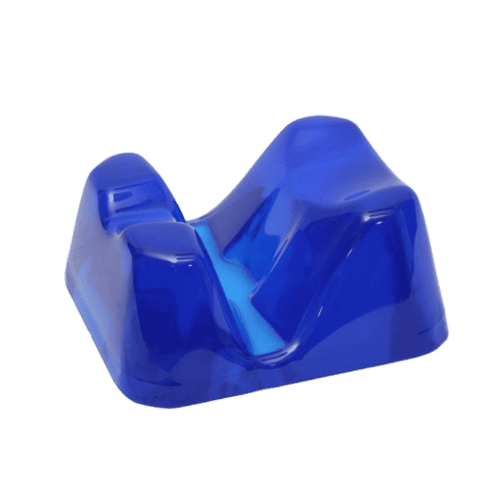
I remember standing in a neurosurgery OR at Huashan Hospital in Shanghai, watching a six-hour posterior fossa tumor resection. The patient was positioned prone on a Sugita head frame, but the facial support underneath was one of our gel donuts. The anesthesiologist had clean, unobstructed access to the breathing circuit the entire time — no kinked tubing, no having to reach blind under the drapes to check the connection. The neurosurgeon had zero drift in head alignment from first incision to closing suture. No repositioning. No pressure alarms from the nursing team. That case shaped how I think about this product — when you’re cutting millimeters from the brainstem, you can’t afford the head shifting because a foam pad compressed unevenly two hours into the procedure. The patient’s face needs to stay exactly where the surgical plan says it should be, and the airway needs to stay accessible without anyone interrupting the sterile field to check.
The AM-TW-001 uses a polymer gel core inside a donut geometry that distributes contact pressure across six facial landmarks simultaneously — the forehead, both cheekbones, both maxillary ridges, and the chin. The center void is what makes this design work: it keeps the eyes, nose, and endotracheal tube completely unloaded. Foam alternatives memory-set under sustained body weight; after hour three, they’re half as thick as they started and the patient’s face is resting on whatever hard surface lies beneath. Polymer gel doesn’t do that — it’s viscoelastic, deforming under load but recovering its shape the instant pressure is removed, maintaining consistent facial support from induction to emergence. The donut contact ring isn’t a flat circle either — we mold it with a subtle anatomical contour that matches the natural convexity of the facial skeleton, so the load distributes across the bony prominences rather than concentrating at the rim of the ring. The anti-slip base anchors to the OR table surface, and the outer shell resists iodine-based prep solutions, alcohol, and standard sterilization protocols without degrading, cracking, or delaminating. We offer it at 28×24×14cm, which fits full-size adult operating tables.
This pad is purpose-built for prone craniotomies, posterior cervical spine procedures, and long-duration neuro cases where the patient is face-down and absolutely still. It’s not a universal headrest — we have the AM-TW-008 horseshoe for that. The donut geometry separates it from our supine ring pad (AM-TW-004), which cradles the occiput from below with a different contact pattern. It’s not the ENT-specific cutout of the AM-TW-006, which leaves the periauricular region exposed. And it’s not the adjustable AM-TW-011, which adds an angle mechanism and mirror. The 001 is the fixed-geometry, maximum-stability prone specialist. If your caseload is heavy on prone neuro, this is the pad you reach for first.
Frequently Asked Questions
What specifications should I review for this model?
Key specifications including dimensions, capacity, power requirement and material composition are provided in the model datasheet. Contact us with your project requirements for the complete specification sheet.
What documents are available for import?
Datasheet, user manual, packing information and applicable conformity documents are confirmed per destination market. Registration requirements vary by country and are reviewed project by project.
Can I request a sample or reference installation?
Sample availability and reference installation details are confirmed based on the product category and order volume. Contact us with your specific requirements.