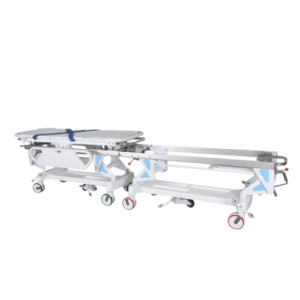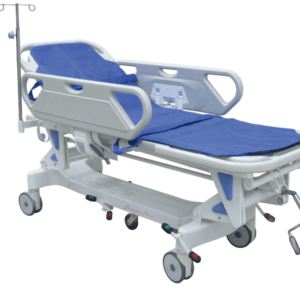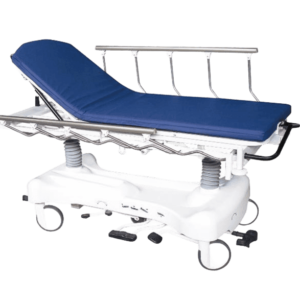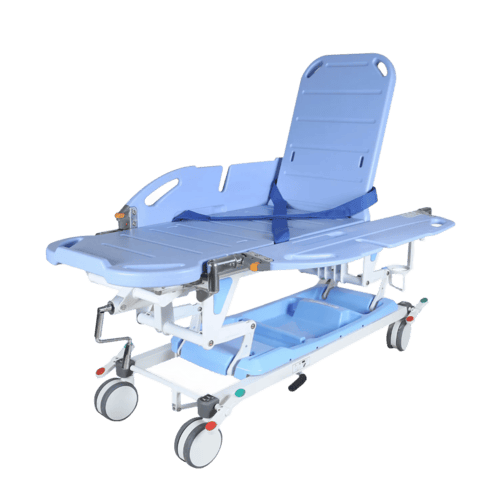
There’s a big difference between a pre-hospital stretcher and a hospital transport stretcher, and if you’ve worked in both environments, you know exactly what I mean. The AM-TC01D is built for the hospital — specifically, for moving patients between departments, from ward to imaging, from ER to ICU. It’s not designed to be loaded into an ambulance. It’s designed to navigate hospital corridors smoothly, quietly, and hygienically, dozens of times a day, for years.
The ABS plastic panels are the first thing I want to talk about, because they’re the feature that matters most in daily use. In a hospital, infection control isn’t a nice-to-have — it’s everything. ABS is non-porous. You wipe it down with standard hospital-grade disinfectant and it’s clean, no residue, no absorption, no hidden colonies of whatever the last patient was carrying. Compare that to fabric surfaces, where you’re basically hoping the cleaning protocol was thorough enough. Our infection control team pushed hard for ABS on every surface a patient or staff member touches, and they were right.
The flip guardrails are another hospital-specific design choice. In pre-hospital, you want rails that lock rigidly in place — you’re bouncing down a road at speed. In-hospital, you need rails that get out of the way fast. A nurse needs to slide a patient laterally onto an MRI table. A physical therapist needs unobstructed access for a transfer assessment. The TC01D guardrails flip down and sit flush with the frame, so there’s nothing in the way. When they’re up, the double-lock mechanism means they’re not going anywhere. Flip down, flip up. Simple, fast, no tools.
Underneath, the frame uses thick-gauge steel tube where it counts — the weight-bearing structure. Four 6-inch double-side casters with a central locking pedal mean one staff member can steer and lock the stretcher without walking around to the other side. The TPR tires are a detail I insisted on because I’ve seen too many hospital stretchers with shredded wheels after a year of use. These are rated to run 30 kilometers under load before showing meaningful wear, and they’ve passed 500-obstacle dynamic testing. In a hospital, that’s maybe three to five years of real-world use before you need to think about replacing them.
Height adjustment is via a mechanical crank system — manual, not hydraulic, which keeps the cost down and the maintenance simple. The backrest uses a pneumatic air spring, so you can sit a patient up gradually without jerking. There’s an oxygen bottle holder underneath rated for a 15kg cylinder, and the base cover supports 20kg of additional gear. For intra-hospital transport where hygiene, maneuverability, and reliability matter more than speed or off-road capability, this is the right tool.
Model Comparison
| Specification | AM-TC01D | AM-YYTC1 | AM-DJC1 |
|---|---|---|---|
| Type | Patient transport cart | Hydraulic transfer trolley | Docking exchange trolley |
| Dimensions | 1930×640 mm | 2120×840×550–860 mm | 1935×640×650/940 mm* |
| Height range | 530–860 mm (gas spring) 500–900 mm (crank) |
550–860 mm | 640–970 mm |
| Backrest | 0–75° / 0–80° | Dual pneumatic lift | 0–75° |
| Load capacity | — | Static 250 kg / SWL 135 kg | 250 kg |
| Guardrails | PP 2-piece flip | Full collapsible aluminum | PP side guards |
| Casters | 6″ central control + 5th wheel | Central brake, dust-proof | 4″ guide wheels |
| Special | Gas spring or crank options | X-ray compatible, CPR, 2 hydraulic pumps, Oxford mattress | Inner/outer docking, anti cross-infection, aluminum rails |
Frequently Asked Questions
What specifications should I review for this model?
Key specifications including dimensions, capacity, power requirement and material composition are provided in the model datasheet. Contact us with your project requirements for the complete specification sheet.
What documents are available for import?
Datasheet, user manual, packing information and applicable conformity documents are confirmed per destination market. Registration requirements vary by country and are reviewed project by project.
Can I request a sample or reference installation?
Sample availability and reference installation details are confirmed based on the product category and order volume. Contact us with your specific requirements.