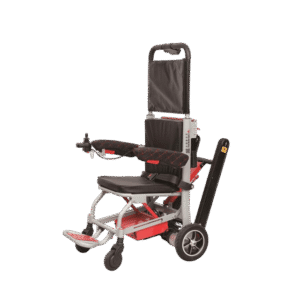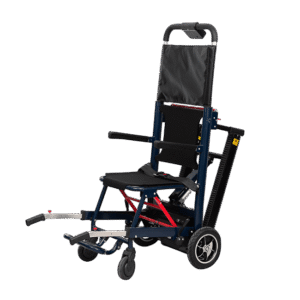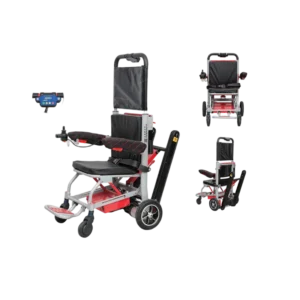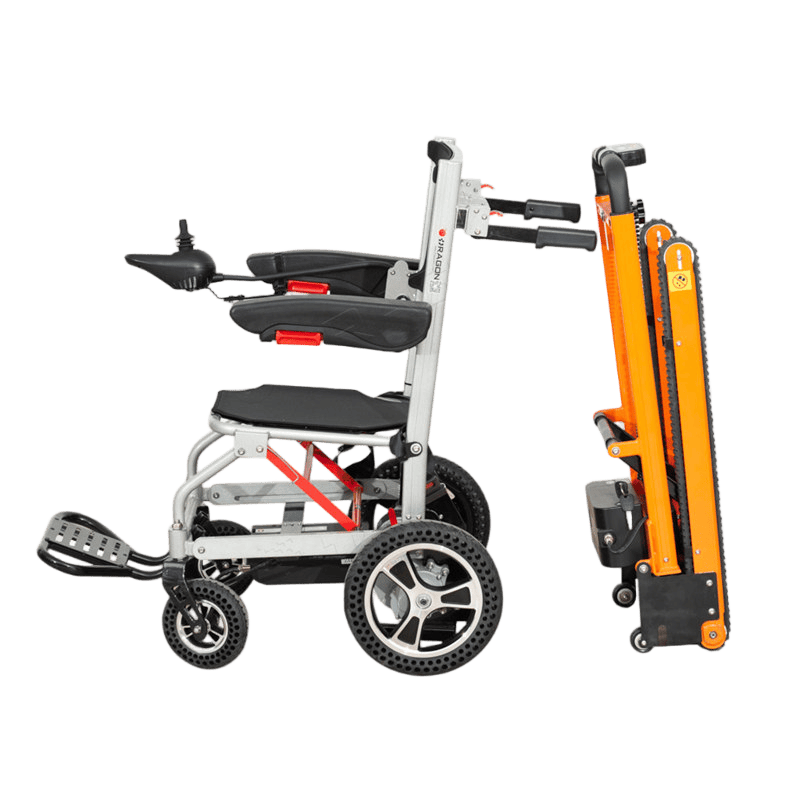
I was doing a demo for a home care agency in Tokyo — tight apartment buildings, narrow stairwells, and a client base of mostly petite elderly women under sixty kilograms. The agency director watched me unfold the FL03 and said, “Beautiful machine. But most of our clients live in buildings with four or five floors, and our caregivers are the same small-framed women who need to lift this thing into a sedan trunk at the end of the shift.” She wasn’t wrong. The FL03 is the right tool for a different job. The FL02 is the tool she needed: same detachable design, smaller scale, lower cost.
The AM-FL02 is the lighter sibling in our detachable stair climbing wheelchair line. The frame is aluminum alloy like the FL03, but we trimmed roughly four kilograms by narrowing the track assembly and reducing the seat width. The battery pack is smaller — one hundred and fifty watt-hours versus the FL03’s two hundred and fifty — which brings the single-charge climbing range to about twenty standard-height floors. That’s enough for a typical home care visit: lobby to apartment, apartment to lobby, maybe a second trip to the ground-floor dining hall and back. It won’t do marathon multi-building transfers, but that’s not what it’s designed for.
The detachable mechanism is the defining feature. The chair splits into two pieces — seat assembly and track base — with two quick-release levers. Separated, each piece weighs under fifteen kilograms, which means a single caregiver can load both halves into a car trunk without calling for backup. For home care agencies sending a solo aide to a client’s apartment, that’s the difference between using the stair climber and leaving it in the vehicle because it’s too heavy to manage alone. Reassembly takes about thirty seconds: align the mounting rails, push until the latches click, and you’re rolling.
The motor is a three hundred and fifty watt DC brushed unit — smaller than the five hundred watt motor in the FL03, which is what keeps the weight and cost down. It’s quieter by about three decibels, which matters in residential hallways at eight in the morning when neighbors are still sleeping. Climbing speed is roughly twelve steps per minute in the standard mode, with a slow mode for elderly users who get anxious at speed. The track material is the same vulcanized rubber compound used across the FL line — grip pattern optimized for indoor stairs with a slight texture edge that catches on the stair nosing without marking polished surfaces.
Weight capacity is one hundred and twenty kilograms, down from the FL03’s one hundred and thirty-five. That covers the vast majority of elderly home care patients, but if your client base skews toward larger body types, the FL04 is the appropriate model. The seat is narrower — forty-four centimeters between armrests — which reads as a limitation until you realize it’s a feature for navigating doorways and stairwells under eighty centimeters wide. In older apartment buildings, that extra clearance is the difference between fitting and scraping the walls on every landing.
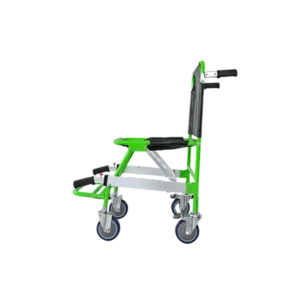
Who buys the FL02 over the FL03? Home care agencies serving elderly populations in dense urban housing. Solo caregivers who need to single-handedly load and unload the unit. Facilities with mostly ground-to-fourth-floor routes where the smaller battery range isn’t a constraint. And budget-conscious purchasers who want the detachable functionality of the FL series without paying for power and capacity they’ll never use. The FL02 costs roughly twenty percent less than the FL03 — not because it’s a stripped-down version, but because it’s purpose-built for a lighter-duty use case. Call or email me with your client demographics and average stair count, and I’ll tell you straight up which FL model earns its keep in your operation.
Model Comparison
| Specification | AM-FL02 | AM-FL03 | AM-FL04 |
|---|---|---|---|
| Material | High strength aluminum alloy | High strength aluminum alloy | High strength aluminum alloy |
| Expanded size | 152×60×115(±1.5) cm | 152×56×105(±1.5) cm | 143×108×54(±1.5) cm ⚠️ |
| Folding size | 100×60×46(±1.5) cm | 100×56×45(±1.5) cm | 103×54×50(±1.5) cm |
| Motor | Brushless 200W | Brushless 200W | Brushless 200W |
| Battery | Lithium 24V/10Ah (MAX) | Lithium 24V/10Ah (MAX) | Lithium 24V/10Ah (MAX) |
| Climbing speed | 1s/1.2s/1.3s per step | 1s/1.2s/1.3s per step | 1s/1.2s/1.3s per step |
| Load capacity | 159 kg | 159 kg | 159 kg |
| N.W. | 47±1 kg | 32±1 kg | 24.7±1 kg |
| Climbing angle | ≤50° | ≤50° | ≤50° |
| Front/Rear wheel | 7/12 inch | 5/10 inch | —(样册疑似笔误,见文末③) |
Frequently Asked Questions
What specifications should I review for this model?
Key specifications including dimensions, capacity, power requirement and material composition are provided in the model datasheet. Contact us with your project requirements for the complete specification sheet.
What documents are available for import?
Datasheet, user manual, packing information and applicable conformity documents are confirmed per destination market. Registration requirements vary by country and are reviewed project by project.
Can I request a sample or reference installation?
Sample availability and reference installation details are confirmed based on the product category and order volume. Contact us with your specific requirements.