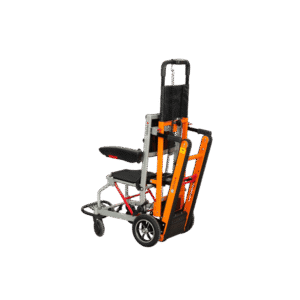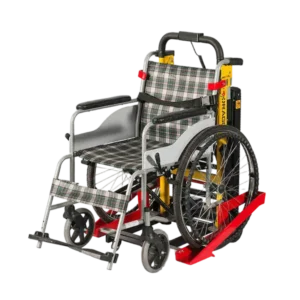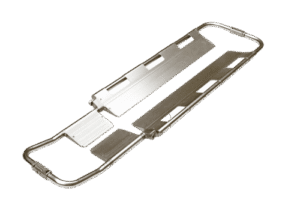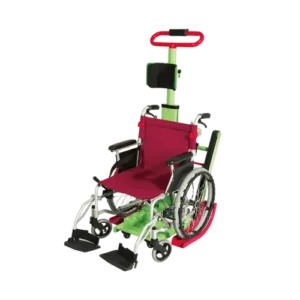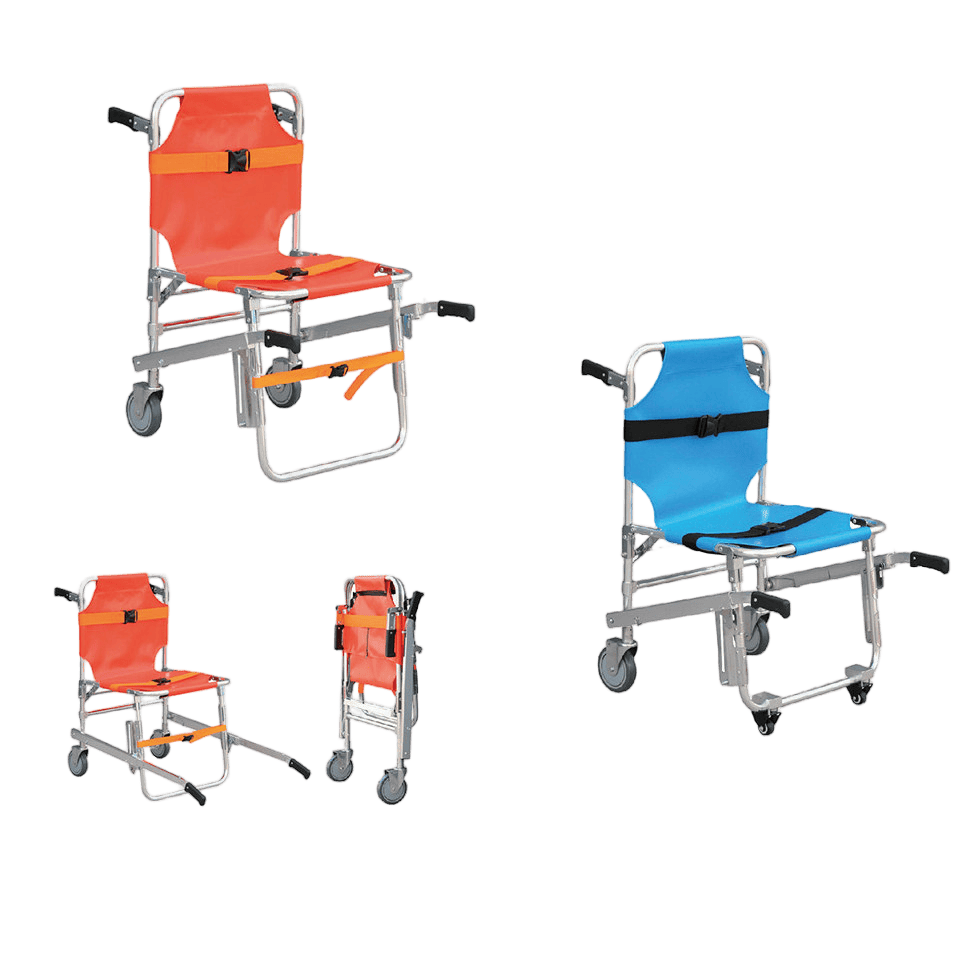
If you’ve ever tried to carry a patient down a narrow staircase in a pre-war building, you already know why the AM-ST008 exists. Standard stretchers don’t turn on tight landings. Powered stair chairs are great, but they’re heavy, expensive, and need battery power that might not be charged when the call comes in. The ST008 is the mechanical solution — aluminum frame, stair tracks, two handles, two people, and gravity.
I’ve watched EMS crews use this in tenement buildings in older cities, the kind with staircases barely 70 centimeters wide and a 180-degree turn every half-floor. A regular stretcher simply will not make those turns. The ST008 is 70 by 54 by 92 centimeters deployed — narrow enough to clear those stairwells. The stair tracks on the back do the work of sliding down step edges, so the operators are guiding and stabilizing, not lifting. Two safety belts secure the patient. Two people operate it — one above, one below. The communication between them is the safety system. I say that because no amount of engineering replaces good training and clear verbal coordination between crew members.
The aluminum frame matters for two reasons. First, weight. This unit is 8 kilograms net. That’s light enough that a single responder can carry it up the stairs, unfold it at the patient’s location, and load them without waiting for backup. Second, hygiene. Aluminum doesn’t absorb fluids, doesn’t rust, and can be wiped down with disinfectant between calls. In an ambulance bay at 2 AM between runs, the last thing anyone wants is a stretcher that needs a deep-clean protocol before it’s safe to use again.
The load rating is 159 kilograms, which covers the vast majority of patients. The wheels are 125 millimeters — small enough to tuck into the frame when you’re in stair mode, large enough to roll on flat ground when you need to move the patient from the base of the stairs to the ambulance. The unit folds to 70 by 54 by 17 centimeters — compact enough to live in an ambulance compartment without eating space that should belong to oxygen tanks and airway kits.
I want to set expectations honestly: this is a manual device. It takes two trained operators. It requires physical effort. It’s not a powered solution. But for narrow staircases, old buildings, and situations where you need something that works without electricity, without hydraulics, and without complexity — it’s the right tool. We’ve sold these to ambulance services in historic city centers across Europe and Asia, and the feedback is always the same: “It fits where nothing else does.” That’s the design brief, and that’s what it does.
Model Comparison
| Specification | AM-ST005/ST006 | AM-ST008A/B | AM-ST10A/B |
|---|---|---|---|
| Material | High strength aluminum alloy | High strength aluminum alloy | High strength aluminum alloy |
| Expanded size | 95×46×97(±1.5) cm | 91×51×113(±1.5) cm | 90×51×91(±1.5) cm |
| Folding size | 88×46×33(±1.5) cm | 91×51×17(±1.5) cm | 90×59×17(±1.5) cm |
| Load capacity | 159 kg | 159 kg | 159 kg |
| N.W. | 7±0.5 kg | 8.9±0.5 kg | 10.5±0.5 kg |
| G.W. | 8±0.5 kg | 9.2±0.5 kg | 12±0.5 kg |
| Operation | Manual | Manual | Manual (2-person) |
Frequently Asked Questions
What specifications should I review for this model?
Key specifications including dimensions, capacity, power requirement and material composition are provided in the model datasheet. Contact us with your project requirements for the complete specification sheet.
What documents are available for import?
Datasheet, user manual, packing information and applicable conformity documents are confirmed per destination market. Registration requirements vary by country and are reviewed project by project.
Can I request a sample or reference installation?
Sample availability and reference installation details are confirmed based on the product category and order volume. Contact us with your specific requirements.