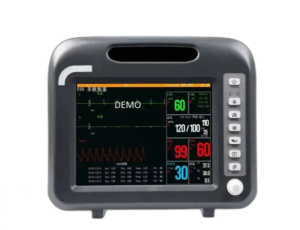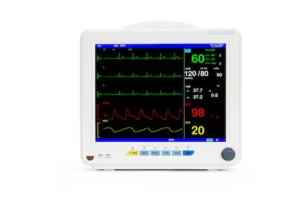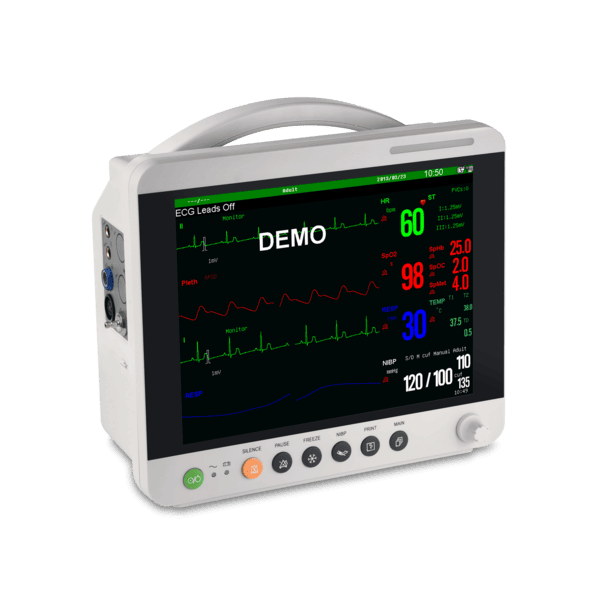
The 9000H is the monitor I put in front of an ICU director and watch them stop talking. Not because it’s flashy — it’s not. Because everything on the screen makes clinical sense and nothing is in the way. This is the top of our SNP9000 line, and I’ll be direct about what it does and who it’s for. If you’re monitoring a post-op patient who’s stable and heading to the floor tomorrow, use the 9000E. If you’re monitoring a patient on a ventilator with three pressors running and an arterial line in place, you need the 9000H. It’s that simple.
The display is 12.1 inches at 1024×768 — same size as the 9000E but higher pixel density, which matters when you’re displaying multiple invasive pressure waveforms simultaneously. You might have ECG, arterial BP, CVP, and an EtCO2 capnography waveform all up at once. If the resolution can’t render those cleanly, you get visual overlap and clinical ambiguity. We pushed the resolution specifically because intensivists told us they read waveforms by shape, and shape degrades at low resolution.
Parameter coverage is where the 9000H separates from everything else we make. Standard: 5-lead ECG, SpO2, NIBP, respiration, temperature, heart rate. Optional — and this is the clinical difference: 2 or 4 channels of invasive blood pressure, mainstream or sidestream EtCO2, anesthetic gas analysis, Nellcor or Masimo SpO2 modules, 3/12-lead ECG, and VGA output for external display. In an OR, the anesthesiologist wants EtCO2, at least one IBP channel, and anesthetic gas on the same screen. The 9000H delivers that without an external module stack cluttering the anesthesia workspace.
The architecture is fully modular — separate parameter board, main board, and power board (AC-DC plus DC-DC). That means you can pull a failing SpO2 module mid-case and the ECG and pressures keep running. The lithium battery gives you four hours of untethered monitoring, which covers intra-hospital transport from ICU to CT and back with margin to spare. The VGA output is standard for wall-mounted displays in surgical suites.
Model Comparison
| Specification | AM-SNP9000E | AM-SNP9000H | AM-SNP900N |
|---|---|---|---|
| Display | 12.1″ TFT, 800×600, touch | 12.1″ TFT, 800×600 / 1024×768 | 12.1″ TFT, 800×600 |
| Parameters | ECG, NIBP, SpO2 (separate boards) | ECG, NIBP, SpO2 (separate module) | ECG, SpO2, NIBP, TEMP, RESP (5-para) |
| Operation | Full touch + navigation knob | Keys / buttons | Keys / buttons |
| ECG display | Dynamic 7-lead, S-T & ARR analysis | 7-lead in phase, S-T & ARR analysis | Up to 8-channel waveform |
| Storage / review | 3600 s full-disclosure + SD card | Waveform capture & history review | 1000-group NIBP, 71 alarm + 60 arrhythmia events |
| Network | — | VGA output | Central monitoring, WiFi / wired |
| Safety | Defibrillation & HF knife resistant | Standby power-saving mode | Fanless, defibrillation-proof |
| Battery | Built-in rechargeable Li | Built-in rechargeable Li | Built-in rechargeable Li |
I want to be clear about the clinical workflow features, because these are the things that make a monitor usable or not at a 3 AM code: real-time ST analysis with arrhythmia classification, SpO2 pitch tone variation, drug dose calculation, multi-display modes including OxyCRG and large-font for distance viewing, standby mode for power saving during gaps in monitoring, 7-lead ECG phase-aligned display, and defibrillator/HF knife interference resistance. TCP/IP networking with CMS support means this plugs into your existing central monitoring infrastructure. SD card and USB for data export. Complete mounting solutions for transport and bedside. If there’s a parameter you need in critical care that the 9000H can’t monitor, I’d genuinely want to hear about it.
Frequently Asked Questions
What specifications should I review for this model?
Key specifications including dimensions, capacity, power requirement and material composition are provided in the model datasheet. Contact us with your project requirements for the complete specification sheet.
What documents are available for import?
Datasheet, user manual, packing information and applicable conformity documents are confirmed per destination market. Registration requirements vary by country and are reviewed project by project.
Can I request a sample or reference installation?
Sample availability and reference installation details are confirmed based on the product category and order volume. Contact us with your specific requirements.