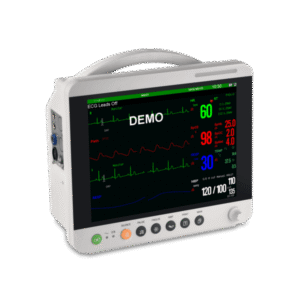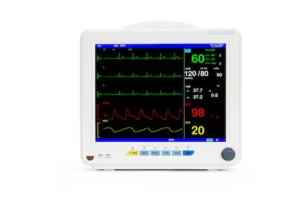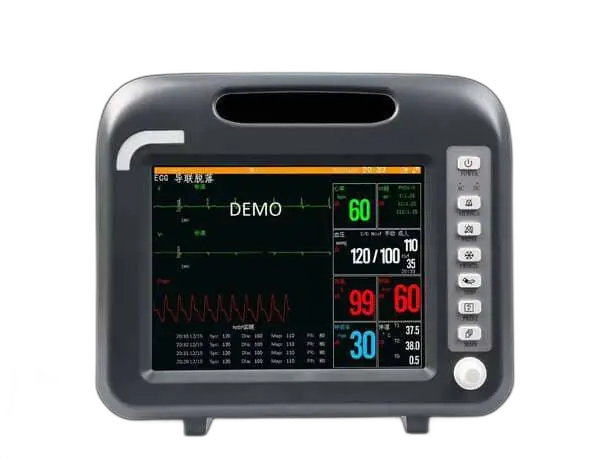
When I’m talking to a hospital about the SNP9000E, the conversation usually starts with someone saying “We love the 9000N, but we need a couple more parameters for our step-down unit.” That’s exactly the gap this monitor fills. It’s not the flagship — that’s the 9000H. It’s not the budget unit — that’s the 9000N. It’s the monitor for the spaces in between. Recovery rooms. Step-down units. Post-anesthesia care. Places where the patient isn’t in immediate critical danger but you can’t afford to miss a trend.
The 12.1-inch color TFT display is the first thing you notice compared to the 9000N. It’s bigger. 800×600 resolution means you can glance across a room and read vitals without walking up to the screen. In a PACU with eight bays, a nurse scanning the room needs to catch a dropping SpO2 or a rising pulse at a distance. Screen size isn’t a luxury — it’s a safety feature. The full touch-screen interface is standard, and we include the navigation knob as a backup because touchscreens fail eventually and I don’t want anyone locked out of their monitor when it matters.
Parameter-wise, the standard configuration covers the essentials: 5-lead ECG, SpO2 (our F-5 sensor), NIBP, temperature, respiration, and pulse rate. That’s your core set. But the board architecture is modular — separate ECG, NIBP, and SpO2 boards — so if one channel fails, the others keep running. That matters more than people think. A single-board monitor that loses its SpO2 processing might take the whole unit down. Separated boards mean you lose one parameter and keep monitoring the rest while you swap the module.
The clinical features I actually use when I demo this unit: real-time ST segment analysis with arrhythmia detection, SpO2 pitch tone variation (so you can hear desaturation without looking), drug dose calculation, and 3600 seconds of full-disclosure waveform review in internal storage. The SD card slot is there for memory extension and data export. Networking is TCP/IP — the platform is ready for central monitoring if your facility scales up.
Model Comparison
| Specification | AM-SNP9000E | AM-SNP9000H | AM-SNP900N |
|---|---|---|---|
| Display | 12.1″ TFT, 800×600, touch | 12.1″ TFT, 800×600 / 1024×768 | 12.1″ TFT, 800×600 |
| Parameters | ECG, NIBP, SpO2 (separate boards) | ECG, NIBP, SpO2 (separate module) | ECG, SpO2, NIBP, TEMP, RESP (5-para) |
| Operation | Full touch + navigation knob | Keys / buttons | Keys / buttons |
| ECG display | Dynamic 7-lead, S-T & ARR analysis | 7-lead in phase, S-T & ARR analysis | Up to 8-channel waveform |
| Storage / review | 3600 s full-disclosure + SD card | Waveform capture & history review | 1000-group NIBP, 71 alarm + 60 arrhythmia events |
| Network | — | VGA output | Central monitoring, WiFi / wired |
| Safety | Defibrillation & HF knife resistant | Standby power-saving mode | Fanless, defibrillation-proof |
| Battery | Built-in rechargeable Li | Built-in rechargeable Li | Built-in rechargeable Li |
On the optional side, you can add touch screen, thermal recorder, 3/12-lead ECG, 2/4-channel invasive blood pressure, Nellcor or Masimo SpO2, BIS, multi-gas analysis, and cardiac output. You don’t need all of those in a step-down unit. But the fact that you can add them means you’re not buying a dead-end monitor. The 9000E grows with your unit. That’s the thinking behind it — more than a basic monitor, not as much as an ICU rig, and never obsolete.
Frequently Asked Questions
What specifications should I review for this model?
Key specifications including dimensions, capacity, power requirement and material composition are provided in the model datasheet. Contact us with your project requirements for the complete specification sheet.
What documents are available for import?
Datasheet, user manual, packing information and applicable conformity documents are confirmed per destination market. Registration requirements vary by country and are reviewed project by project.
Can I request a sample or reference installation?
Sample availability and reference installation details are confirmed based on the product category and order volume. Contact us with your specific requirements.