About six years ago I visited a cat rescue in Guangdong that had outgrown its space twice in eighteen months. They were housing seventy-three cats on cages bought piecemeal — welded wire, plastic-coated, some that were basically rabbit hutches with shelves ripped out. The owner said, “I spend more time cleaning than I do with the cats. Three compartments have doors that don’t close right.” That visit started the PC11.
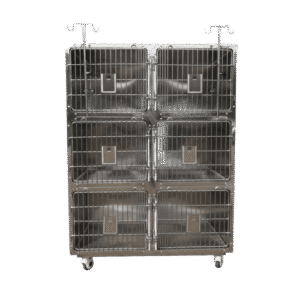
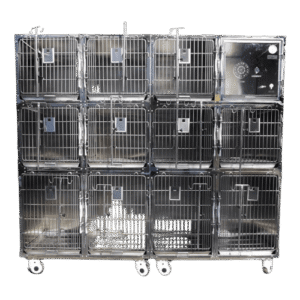
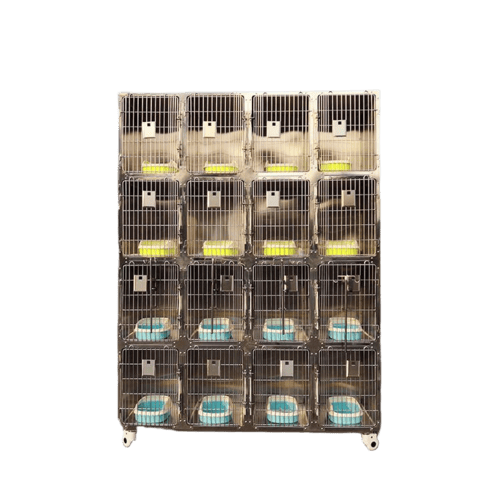
Twenty-eight compartments across four layers. Seven per layer, each with its own front door. Stacked individual units drift over time — doors stop aligning, gaps between stacked cages become trap points for a paw or tail. The PC11 is welded as one frame from bottom to top. No drift, no gaps. Every door lines up on day one and five years later.
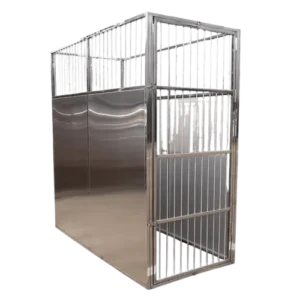
The frame is 304 stainless steel. Cattery cleaning protocol isn’t a damp cloth — it’s a pressure washer with disinfectant, daily. Mild steel rusts in that environment in under two years. Powder-coated steel chips where cats scratch at the bars. Stainless doesn’t care. Hit it with quaternary ammonium, bleach, steam — the material holds.
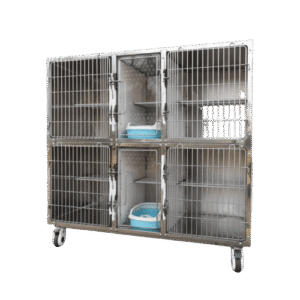
Each compartment is roughly sixty centimeters deep, fifty wide, forty-five tall — enough for a litter box, a resting shelf, and vertical stretch room. The shelf doubles as a perch and divider, giving the cat a choice between open floor and elevated resting. That choice matters for stress. Cats in single-level cages with no vertical option show higher cortisol after three days of boarding.
Full-width front doors on every compartment — not half-doors, not top-opening hatches. You can remove a cat carrier, a litter box, or an uncooperative cat without the door edge catching. Latches are spring-loaded slide bolts — no hooks, no friction catches a smart cat can jiggle open. I’ve watched a Bengal open a friction-latch cage in under four minutes.
This is a boarding facility cage, not a home cage or a vet clinic unit. Twenty-eight compartments is overkill for a practice that houses three cats overnight. But for a cattery that takes thirty cats during Lunar New Year, or a shelter intake room during kitten season, the PC11 is the infrastructure you build the room around. It ships flat-packed, assembles with bolts — two people, one afternoon. Once anchored, it doesn’t move. Check your floor loading if you’re above ground level. Send me your facility layout and I’ll tell you if one PC11 beats six four-compartment cages for your space.