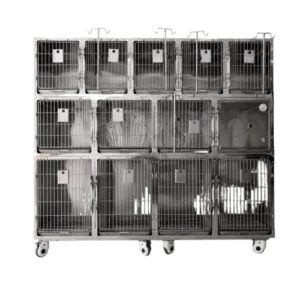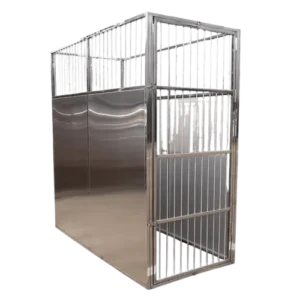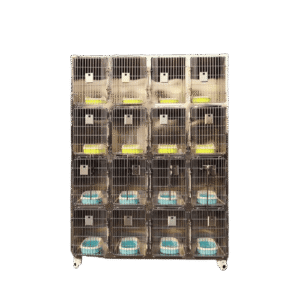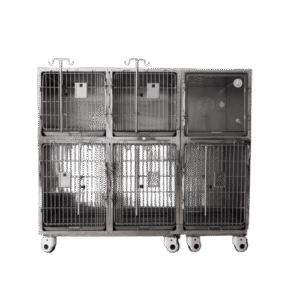
A feline specialist in Beijing told me something I’ve never forgotten: “I look at whether the cat is looking at me.” She meant body posture, ear position, pupil dilation, whether the cat is hiding or presenting. These are clinical signs for a species that masks illness until it can’t anymore. And they’re invisible if the cage walls are solid steel or frosted panels. That’s the entire rationale for the PC05.
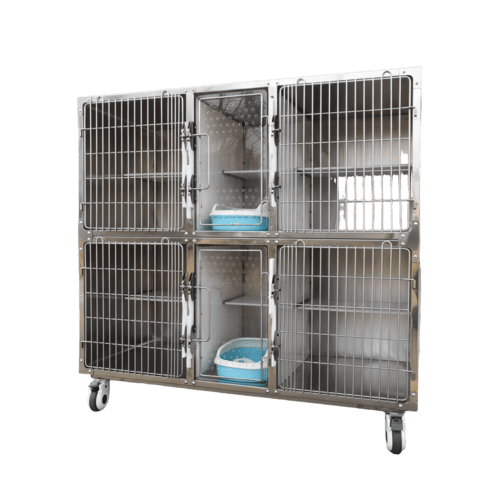
Two layers, six compartments — three over three. Front panel and both side panels are transparent acrylic, eight millimeters thick. The back wall is stainless for structure, the floor is stainless for cleaning. But the three sides staff actually look through are optically clear. You can read a cat’s body language from across the room without approaching the cage. That’s a clinical monitoring tool, not a luxury.
Why acrylic instead of glass? Acrylic absorbs impact without shattering. A dog throwing its weight against glass is a liability. A cat swatting at motion outside the cage is a non-event against acrylic. The material is overbuilt for feline capability, but that thickness also provides sound damping — quieter interior than a wire kennel where every meow echoes off metal bars.
Acrylic panels sit in stainless channel frames with silicone buffer gaskets — no direct acrylic-to-metal contact. Thermal expansion from years of warm-water cleaning would eventually crack acrylic seated against steel. The gasket absorbs the differential. Individual panels are replaceable if scratched — screws from inside the frame, accessible but not to a cat.
Each compartment has an integrated stainless resting shelf visible through the side panel. You can see whether the cat is up or down without changing your vantage point. In a cat ward where approaching the cage can spook a nervous patient, knowing the cat’s position lets you adjust your approach — sometimes the right approach is not approaching at all.
Full-width front acrylic doors with magnetic catch closures. Strong enough a cat can’t push them open — and some try, systematically testing every edge with a paw. The magnet self-centers the door when closed, maintaining clean visual lines. Quiet engagement, no slam.
One cleaning rule: no abrasives, no scouring pads. Soft cloth, mild disinfectant, rinse, dry. Abrasion clouds acrylic permanently. Every PC05 ships with a cleaning card in English and Chinese — post it visible in the cat ward because the first time a new kennel tech uses a green scouring pad, you’ve got a cloudy panel.
This is a cat-only cage. Don’t put dogs in it. The acrylic won’t break but it’ll scratch, and a barking dog amplifies stress for every cat in visual range. For feline-only practices and cat-specific wards where behavioral monitoring drives clinical decisions, the PC05 replaces wire-mesh cages that block half the information you need. Send me ward photos and I’ll sketch the visibility sightlines.