I picked up the phone at 2 AM to a vet in Shenzhen who had four parvo puppies in isolation and no way to deliver controlled oxygen. She’d been running a makeshift setup — tubing taped to standard wire kennels, blankets draped over the top. Her FiO2 was probably hitting twenty-five percent on a good day. The puppies needed forty-plus. One didn’t make it. She ordered the PC06 the next morning.
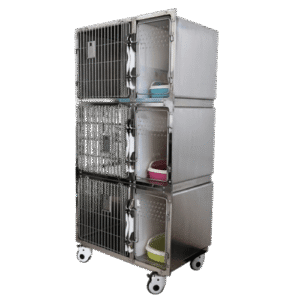
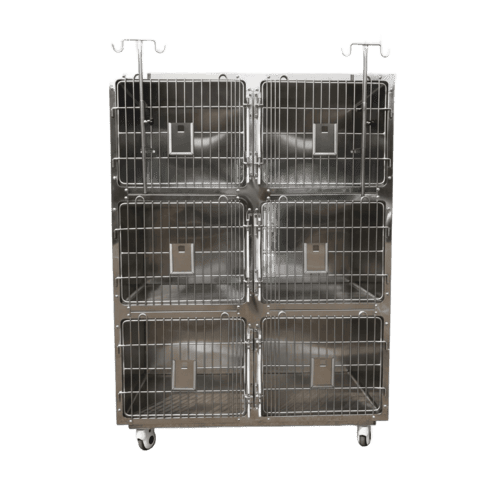
Three layers, six independently sealable compartments. Each has its own front door and its own oxygen inlet port at the top. Run oxygen to one compartment, all six, or any combination. That’s the difference between a real ICU cage and a kennel with an oxygen hose pointed at it: you’re controlling the environment inside the chamber, not just blowing O2 in the general direction.
Stainless steel frame with transparent acrylic panels on the front and sides. The acrylic isn’t aesthetic — it’s functional. Every time you open an oxygen chamber, FiO2 drops to room air in under thirty seconds and takes minutes to rebuild. You need to check respiratory rate and gum color visually at least four times an hour during critical cases. If you have to open the door each time, the oxygen saturation never stabilizes. The PC06 gives you monitoring visibility without breaking the seal.
The oxygen inlet is a standard 6mm barbed fitting connecting to any veterinary concentrator or wall-source flowmeter. The cage is passive — no internal fan, no electronics, nothing that can spark or fail. Oxygen enters at the top inlet, CO2 and excess gas vent at the bottom. No moving parts. One less thing for a night tech to troubleshoot.
Temperature inside trends two to three degrees above ambient — the sealed chamber traps body heat plus concentrator output. That’s usually fine for adults. For neonates, pair the PC06 with an external warming pad under the compartment floor; the stainless base conducts heat efficiently.
Each door has a silicone gasket seal and a cam-lock mechanism that pulls the door tight against the seal — same principle as a refrigerator door. Gaskets are consumables. Budget replacement every twelve to eighteen months under heavy use.
This cage is not for boarding or general housing. It’s specifically for respiratory cases, post-anesthetic recovery where the airway matters, and critical patients who benefit from supplemental oxygen. If your practice sees maybe two pneumonia cases a year, the PC06 is overbuilt. But if your hospital takes parvo, feline URI outbreaks, smoke inhalation, or brachycephalic post-ops — the cases where oxygen is the difference between recovery and a phone call nobody wants to make — this cage earns its floor space. Reach out with your typical respiratory caseload.