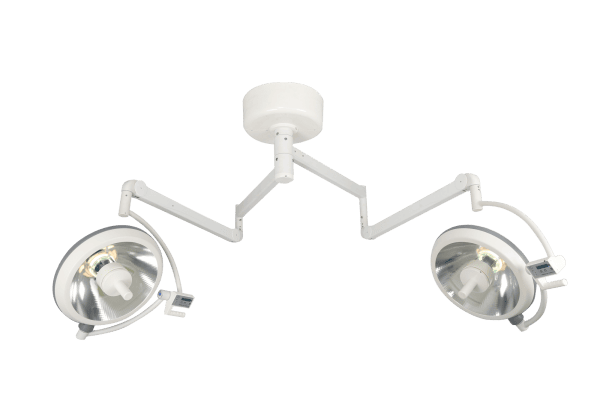
The AM-LED700/500 is a dual-head halogen surgical light system with a 700 mm main head and a 500 mm satellite head, for general surgery, orthopedic, cesarean, and trauma procedures where halogen light quality is required.
Key Specifications
| Parameter | Value |
|---|---|
| Light Source | Halogen (dual-head) |
| Head Configuration | 700 mm main + 500 mm satellite |
| Illuminance (700 / 500) | ~80,000 Lux / ~60,000 Lux (at 1 m) |
| Bulb Base | G9.5 |
| Bulb Lifespan | 1,000–2,000 hours |
| Mounting | Ceiling-mounted suspension arm, ~180° rotation |
| Standard | IEC 60601-2-41 |
Features
- Dual-head configuration with 700 mm main and 500 mm satellite heads
- Overlapping light fields with depth penetration into body cavities
- Continuous-spectrum halogen output for tissue differentiation
- Tool-free bulb replacement with standard G9.5 bases
- Passive heat chimney in the head housing
- Thermal rise at the patient plane within the 10°C IEC limit
- Independently adjustable focus and position on both heads
Applications
General surgery, orthopedic procedures, cesarean sections, and trauma cases in rural hospitals, veterinary practices, and teaching hospitals where a modular halogen system is preferred.
Model Comparison
| Specification | AM-LED700/700 DX | AM-LED700/500 ZN | AM-LED5/3 | AM-LED200 |
|---|---|---|---|---|
| Illuminance (Lux) | 40,000–180,000 | 40,000–160,000 (LED700) 30,000–140,000 (LED500) |
40,000–180,000 (LED5) 30,000–160,000 (LED3) |
20,000 (at 1 m) |
| Lamp Source | 73 × German OSRAM | German OSRAM | 71/45 × German OSRAM | 7 W × 7 |
| Bulb Life (h) | >60,000 | >50,000 | >50,000 | ≥50,000 |
| Color Temperature (K) | 3,500–5,500 | 3,700–5,000 | 4,000–6,000 | 4,700 |
| Color Rendering Index (Ra) | >98 | 85–98 | 85–98 | — |
| Light Beam Depth | 160 cm | 130 cm | 130 cm | — |
| Spot Diameter | 20–26 cm | 16–28 cm | 16–28 cm | 8 cm |
| Light Adjustment Range | 10%–100% | 10%–100% | 1%–100% | — |
CE marking and ISO 13485 documentation can be confirmed for the specific model, configuration, legal manufacturer, and destination market.
Frequently Asked Questions
What specifications should I review for this model?
Key specifications including dimensions, capacity, power requirement and material composition are provided in the model datasheet. Contact us with your project requirements for the complete specification sheet.
What documents are available for import?
Datasheet, user manual, packing information and applicable conformity documents are confirmed per destination market. Registration requirements vary by country and are reviewed project by project.
Can I request a sample or reference installation?
Sample availability and reference installation details are confirmed based on the product category and order volume. Contact us with your specific requirements.