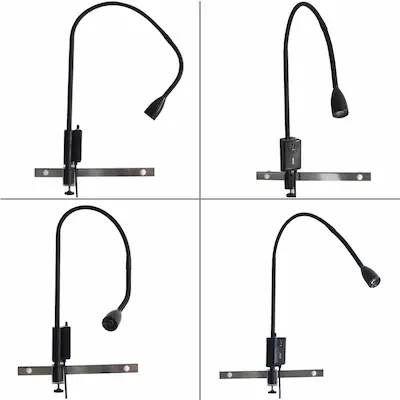
I once visited a rural health clinic where the only exam light in the triage room was a desk lamp the nurse had brought from home — one of those articulated architect lamps with a compact fluorescent bulb that took thirty seconds to warm up. She’d been using it for two years. It wasn’t sterile, it wasn’t bright enough, and the color temperature was somewhere around “office cubicle beige.” The AM-KD-2003W-3 is the product I wish I could have handed her that day: a real medical examination light that costs about as much as a nice dinner for four and requires exactly zero training.
The AM-KD-2003W-3 is our entry-level LED examination lamp. It’s the light you put in triage bays, nursing stations, bedside assessment areas, and small clinic rooms where the clinical need is simple: you need to see a wound, a rash, a throat, or a pupil response, and you need enough light to do it without dragging an expensive floor-standing unit across the building. The light head contains a single 3-watt LED producing about 4,000 lux at roughly twelve inches. That’s not surgical-level intensity and it’s not pretending to be. It’s enough to inspect a pressure ulcer, evaluate pharyngeal erythema, or check an IV insertion site at the bedside — which is exactly what most clinical assessments require.
The gooseneck arm is twelve inches long and fully flexible. Bend it, twist it, point it — it stays. There are no joints to loosen, no counterweights to calibrate, no springs to fatigue. The simplicity is the point: when a nurse needs to do a quick skin assessment on a bed-bound patient at 3 AM, she doesn’t want to adjust three axis knobs. She wants to grab the light, aim it, and work. The LED is rated for approximately 30,000 hours — about ten years of normal clinical use — and if it ever does fail, the entire head assembly is field-replaceable in about ninety seconds with a single connector.
Mounting options are deliberately flexible because these lights end up in all kinds of spaces. The standard configuration is a wall-mount bracket that screws into any flat vertical surface — drywall with anchors, concrete block, doesn’t matter. The bracket footprint is about the size of an index card. We also offer an optional mobile cart base for facilities that want to share one light between two or three beds. The cart is narrow enough to roll between gurneys in a tight emergency department hallway and stable enough not to tip at full gooseneck extension. Power is standard 110-240V AC with a medical-grade plug — no transformer brick, no special wiring.
The light output is a cool white around 6,000K, which was a deliberate choice. At this price point, we prioritized contrast over color accuracy. A 6,000K LED makes blood stand out against skin, highlights wound edges, and makes it obvious when a dressing needs changing. It’s not the right temperature for dermatoscopic diagnosis — if you need CRI above 90 and precise tissue color differentiation, you should be looking at our AM-LED200 series. But for the nurse checking a post-surgical incision or the paramedic examining a laceration in the ambulance bay, contrast is what matters and contrast is what this light delivers.
Infection control is straightforward. The gooseneck is sheathed in medical-grade silicone with no exposed metal coils — wipe it with standard surface disinfectant between patients. The light head housing is ABS plastic with a sealed lens bezel; liquids run off rather than pooling. It’s not rated for sterile field use and we don’t claim it is, but it holds up to the kind of frequent wipe-downs that happen in a real clinical environment.
This light is for the clinics and departments that are often last in line for equipment budgets. Community health centers. School nurse offices. Nursing home assessment rooms. Phlebotomy stations where the tech needs to find a vein on an elderly patient with fragile skin. Correctional facility medical units. Military aid stations. Anywhere the choice is between a purpose-built medical exam light at an accessible price and whatever improvised lighting people are using because nobody thought to budget for one.
If you’re outfitting a facility where every dollar has to justify itself, and you need exam lighting that’s simple, durable, and priced like an expense rather than a capital purchase, the AM-KD-2003W-3 is what we built. Send me a note with your requirements — quantity, mounting preference, and your location — and I’ll put together pricing that reflects the reality of your budget. No glossy brochures. No minimum-order theater. Just an honest light at an honest price.