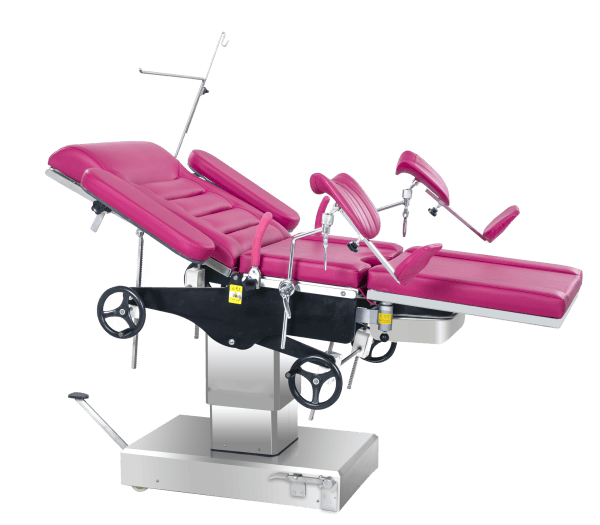
The AM-JJK is a manually operated hydraulic gynecological table with twin-pedal height adjustment, a manual-crank backrest, and articulating lithotomy leg supports, for clinics without reliable electricity.
Key Specifications
| Parameter | Value |
|---|---|
| Height Range | 650–900 mm (twin-pedal hydraulic) |
| Backrest Adjustment | 0–60° (manual crank) |
| Trendelenburg | 15° |
| Max Patient Weight | 180 kg |
| Table Top | Single-piece seamless cushion, high-density foam with medical-grade PVC |
| Base | Powder-coated steel, four locking casters |
Features
- Twin-pedal hydraulic pump: one pedal raises, one releases and lowers
- Manual-crank backrest adjustment from 0 to 60 degrees
- Trendelenburg tilt of 15 degrees
- Seat section with perineal cutout and articulating lithotomy leg supports
- Single-piece seamless PVC-over-foam cushion with no fluid-collecting gaps
- Stainless steel drainage tray beneath the perineal cutout
- Paper roll holder and integrated side rails accepting standard gynecology stirrups
- Powder-coated steel base with four locking casters
Applications
Maternity clinics and gynecology settings, particularly in areas with unreliable electricity where mechanical operation is preferred.
Model Comparison
| Specification | AM-KDC-Y CBYT | AM-KDC-Y CLK | AM-KDC-Y JJK | AM-KDC-Y DGN |
|---|---|---|---|---|
| Type | Electric delivery bed | Electric delivery table | Hydraulic delivery table | Electric exam table |
| Table size | 192×92 cm | 185×60 cm | 185×60 cm | 185×60 cm |
| Height range | 65–90 cm | 74–100 cm | 74–100 cm | 74–100 cm |
| Longitudinal slide | 25 cm | — | — | — |
| Trendelenburg/Reverse | 5°/5° | 10°/25° | 15°/25° | 15°/25° |
| Back plate (up/down) | 65° (up) | 75°/10° | 75°/10° | 75°/10° |
| Foot plate (up/down) | 55°/5° | — | — | — |
| Load capacity | 200 kg | — | — | — |
| Power | — | AC220V, 50Hz | AC220V, 50Hz | AC220V, 50Hz |
CE marking and ISO 13485 documentation can be confirmed for the specific model, configuration, legal manufacturer, and destination market.
Frequently Asked Questions
What specifications should I review for this model?
Key specifications including dimensions, capacity, power requirement and material composition are provided in the model datasheet. Contact us with your project requirements for the complete specification sheet.
What documents are available for import?
Datasheet, user manual, packing information and applicable conformity documents are confirmed per destination market. Registration requirements vary by country and are reviewed project by project.
Can I request a sample or reference installation?
Sample availability and reference installation details are confirmed based on the product category and order volume. Contact us with your specific requirements.