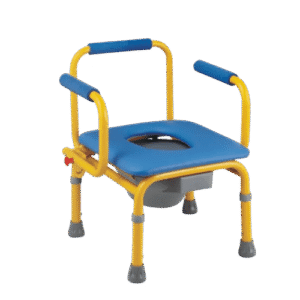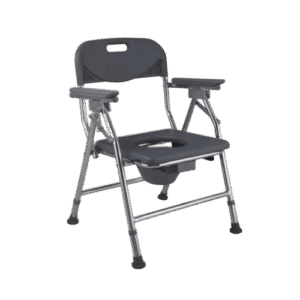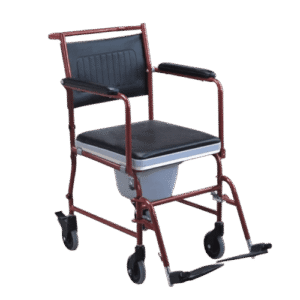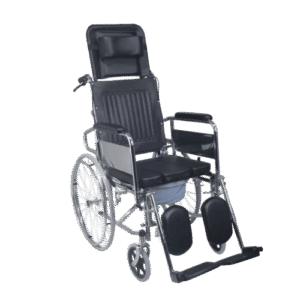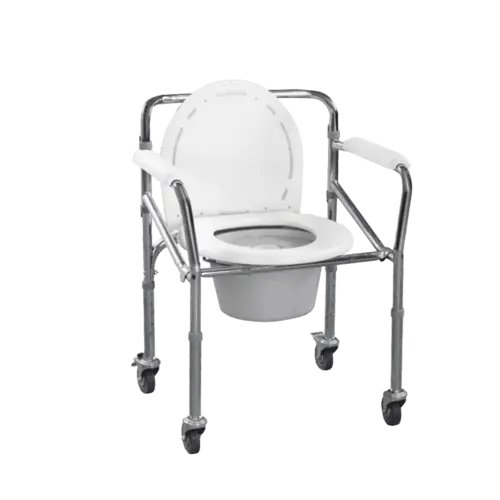
Not every commode is a permanent fixture. Sometimes the need is temporary — a knee replacement that keeps someone off stairs for six weeks, an elderly parent visiting for the holidays who can’t climb to the second-floor bathroom, a hospice patient whose final weeks are being spent at home with family. The AM-FS696 is the commode I designed for those temporary situations: light enough to carry from room to room, foldable enough to store in a closet when the need passes, and inexpensive enough that buying it for a six-week recovery period doesn’t feel like a waste.
The 696 is the lightest commode in our line — just over six kilograms assembled. The frame is aluminum with thinner-gauge tubing than our full-time commodes, which keeps the weight and cost down while still providing a one-hundred-kilogram weight capacity. I’m direct about the tradeoff: a lighter frame means you’ll feel slightly more flex when a heavy user sits down compared to our heavier-gauge models. That flex is within the frame’s elastic deformation range — it’s not failing, it’s not permanent — but if the user is anxious about equipment stability, the stiffer 692 or 8995L may give them more psychological comfort. For a confident user who just needs a place to go at night for a few weeks, the 696’s weight savings are worth it.
The folding mechanism is the simplest we make. No hinges to lubricate, no locking pins to fuss with. The two side frames cross at the center and are joined by a pivot bolt. To fold, lift the seat off — it snaps on and off the frame rails — and push the two halves together. The folded package is about eighteen centimeters thick and stands upright in a closet or slides under a bed. The seat, bucket, and backrest stack on top. A caregiver can set it up or break it down in about ninety seconds without instructions.
The seat is blow-molded HDPE with a textured surface and a U-shaped opening. It’s not padded, and that’s intentional — this is a commode, not a lounge chair, and a smooth plastic surface that can be wiped down with disinfectant is more important than softness for the ten to fifteen minutes someone typically spends on it. The bucket is eight liters — slightly smaller than our ten-liter standard — which keeps the rear profile compact and is adequate for overnight use with a morning empty. Lid, carry handle, slides out from the rear.
Armrests flip up for lateral transfers, same mechanism as the 692 — spring-loaded hinge, no tools. The backrest is a curved HDPE panel attached with thumbscrews. Rubber-tipped legs, no casters — this chair is meant to be carried to its position and left there. If you need mobility, the 7961L is the wheeled option. If you need stowability, the 696 is the folding option.
The 696 is the chair I recommend when the use case is temporary, portable, or occasional — a family that needs a commode for a parent’s two-week visit, a post-surgical patient who’ll recover and not need it again, a small home care agency wanting lightweight units for short-term placements. It’s not the right chair for daily long-term use by a heavy or anxious user. Know your user. If the chair is temporary and the user is average weight and not equipment-anxious, save the money and get the 696. If it’s permanent, step up to the 692 or 899. Tell me your timeline and user profile, and I’ll give you the straight answer.
Frequently Asked Questions
What specifications should I review for this model?
Key specifications including dimensions, capacity, power requirement and material composition are provided in the model datasheet. Contact us with your project requirements for the complete specification sheet.
What documents are available for import?
Datasheet, user manual, packing information and applicable conformity documents are confirmed per destination market. Registration requirements vary by country and are reviewed project by project.
Can I request a sample or reference installation?
Sample availability and reference installation details are confirmed based on the product category and order volume. Contact us with your specific requirements.