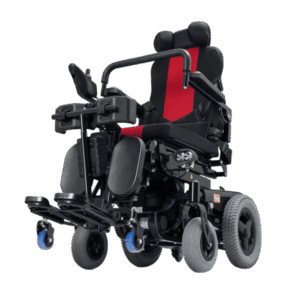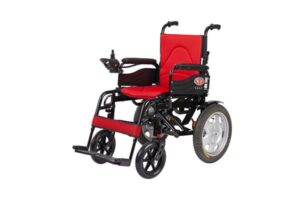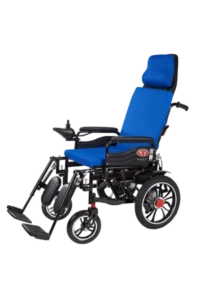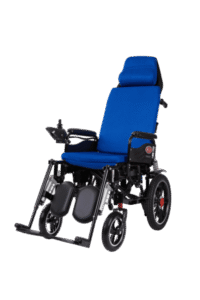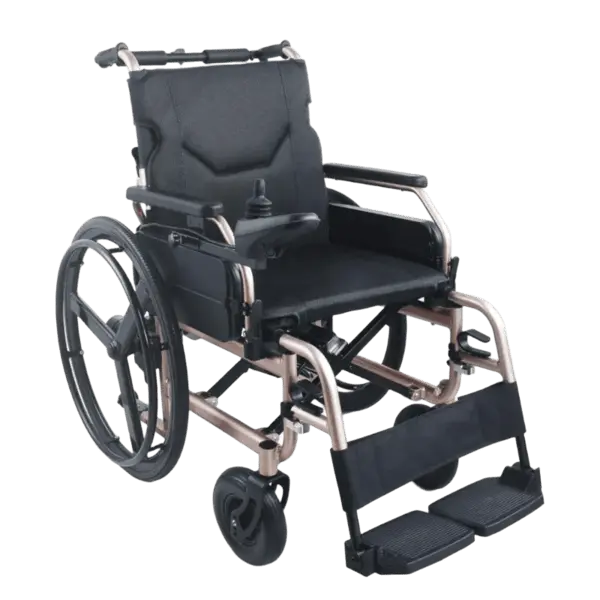
Most power wheelchairs move you horizontally. They get you from the bedroom to the kitchen, from the kitchen to the front door, from the front door to the sidewalk. What they don’t do is bring you to eye level with someone standing, or let you reach a high kitchen cabinet, or shift your weight off your sitting bones after four hours in the same position. The AM-FS101LAEPF1 does all of that. It’s a joystick-controlled electric wheelchair with an automated standing function—push a button or use the stance-control system, and the chair elevates the user from a seated position to a near-standing posture. For someone with spinal cord injury, muscular dystrophy, or severe osteoarthritis, the ability to stand—even with mechanical assistance—isn’t a novelty feature. It’s circulation, digestion, bone density, and the psychological difference between looking up at everyone you talk to and meeting them at eye level.
The standing mechanism is electric-linear-actuator driven. The seat platform rises on a scissor-lift assembly while the backrest tilts forward slightly and the knee supports engage to stabilize the lower legs. The transition from seated to standing takes about fifteen seconds and is smooth enough that the user doesn’t feel like they’re being launched. The control is either via the joystick controller (mode switch from drive to stand) or a separate button panel on the armrest. The chair can stop at any angle between fully seated and fully elevated—not just binary up or down—which matters for users who can’t tolerate full standing but benefit from a partial weight shift at thirty or forty-five degrees.
The frame is aluminum, foldable, which is unusual for a standing power chair. Most standing wheelchairs are rigid frames with heavy steel bases, and transporting one requires a van with a lift. The FS101LAEPF1 folds to roughly the size of a large suitcase—the backrest collapses forward, the footrests fold up, and the whole assembly can be lifted into a car trunk by a caregiver. The tradeoff is weight capacity: one hundred kilograms for the standing function (the drive-only capacity is higher). If you need standing capability above one hundred kilograms, a rigid-frame standing chair is the safer option. The aluminum frame keeps the chair’s unladen weight manageable—about thirty-two kilograms with batteries—which is light for a standing power chair but still heavy enough that the user isn’t lifting it themselves.
The drive system uses two two-hundred-watt brushless motors driving six wheels: two large drive wheels in the mid-position and four smaller casters front and rear for stability. The six-wheel configuration provides a smaller turning radius than a four-wheel power chair and better obstacle clearance than a center-drive design. The joystick controller is programmable—acceleration, deceleration, and top speed can be adjusted by a technician or caregiver to match the user’s reaction time and control precision. The battery is a twenty-four-volt lithium pack mounted in a removable compartment under the seat, providing a range of approximately fifteen to twenty kilometers on drive-only mode and slightly less when the standing function is used frequently, since the actuator draws significant current.
The seat is padded foam with a breathable mesh cover—not the vinyl you find on standard wheelchairs, because someone spending six to ten hours a day in this chair needs air circulation against their skin. The armrests flip up for lateral transfers. The footrests are height-adjustable and swing-away. The backrest has a tension-adjustable strap system for lumbar support. The push bar at the rear allows a caregiver to push the chair manually when the motors are disengaged, and the drop-back handle design keeps the push bar out of the way when not in use.
Who’s the FS101LAEPF1 for? Users who need electric mobility and also need—or would benefit from—regular changes in position from seated to standing. People who want to cook at a standard-height counter, look someone in the eye during a conversation, or reach a shelf without transferring to a separate standing frame. It’s not for bariatric users above one hundred kilograms in standing mode, and it’s not for rough outdoor terrain—the six-wheel configuration handles sidewalks and gentle slopes well but isn’t an all-terrain design. If you’re a clinician evaluating standing mobility options for a patient, or a user researching power standing chairs that don’t require a dedicated vehicle for transport, this is the model I’d ask you to look at. Contact me through the form below with the user’s weight, daily standing needs, and transport situation.
Frequently Asked Questions
What specifications should I review for this model?
Key specifications including dimensions, capacity, power requirement and material composition are provided in the model datasheet. Contact us with your project requirements for the complete specification sheet.
What documents are available for import?
Datasheet, user manual, packing information and applicable conformity documents are confirmed per destination market. Registration requirements vary by country and are reviewed project by project.
Can I request a sample or reference installation?
Sample availability and reference installation details are confirmed based on the product category and order volume. Contact us with your specific requirements.