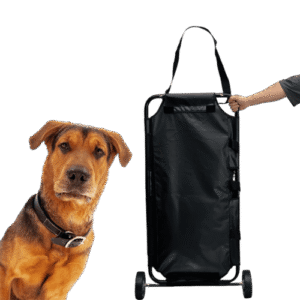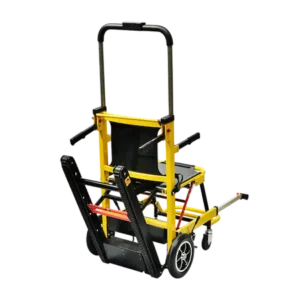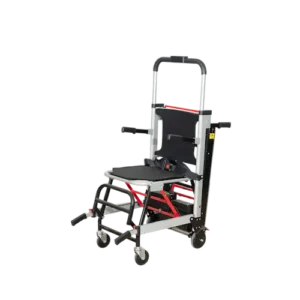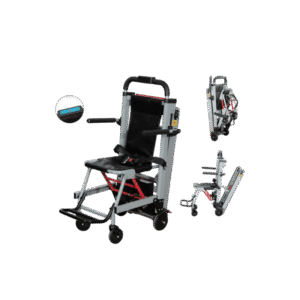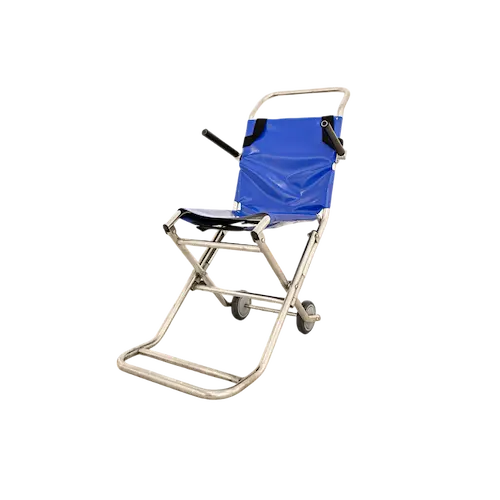
A fire marshal I spoke with at a safety conference put it bluntly: “Powered stair chairs are great until the power goes out, and the one time you actually need to evacuate a building, the power is usually out.” He wasn’t wrong. Building evacuations happen during fires, earthquakes, and blackouts — all scenarios where you can’t count on a charged battery. The AM-ST005 and ST006 are manual stair chairs with integrated tracks, and they work exactly the same way whether the grid is up, down, or burning.
The ST005 and ST006 share the same core mechanism: a folding or rigid-frame chair with a continuous rubber track system mounted to the back. The operator tilts the chair backward onto the tracks, and gravity does the descent work — the caregiver’s job is to control the speed, not to lift the patient’s full weight. The tracks engage each stair edge and create a controlled slide that converts stair-step geometry into a smooth linear motion. It’s the same principle as a moving dolly on stairs, but with a seat, armrests, a footrest, and safety restraints designed around a human body rather than a refrigerator box.
The difference between the two models is frame design. The ST005 folds — the backrest collapses against the seat, and the whole assembly stores against a wall in a stairwell equipment cabinet. It’s the model for buildings with limited storage: office towers, apartment buildings where the stair chair lives in a wall-mounted cabinet on every third floor, school buildings with multiple stairwells. The ST006 has a rigid welded frame — slightly heavier, slightly stronger, no folding mechanism to maintain or potentially rattle loose over years of vibration. It’s the model for dedicated evacuation teams that use the chair regularly: hospital evacuation squads, nursing home fire crews, industrial safety teams that drill monthly.
The track material is a high-durometer rubber compound with a tread pattern designed for both carpeted and hard-surface stairs. On commercial carpet — office buildings, hotels — the tracks grip without snagging. On concrete or marble stairs — institutional buildings, older hospitals — the rubber compound maintains friction even when the stair surface is polished smooth. The tracks are replaceable as a wear item; if your facility runs evacuation drills every quarter, you’ll get about five years from a set before the tread depth warrants replacement.
Patient restraints are a three-point harness with a center-release buckle — quick to secure, quick to release. Armrests are padded with closed-cell foam that doesn’t absorb fluids, and the seat is contoured to prevent the patient from sliding forward during the tilted descent position. The footrest folds up for storage and locks down for use with a spring-loaded pin. Weight capacity is one hundred and thirty-five kilograms — appropriate for the vast majority of evacuation scenarios.
There are no electronics in either model. No battery, no motor, no controller board, no charging dock. The operational cost is zero after purchase — no electricity, no battery replacement cycle, no firmware updates. A facility manager can hang ten of these in stairwell cabinets and check them once a year during the annual fire inspection. That’s the entire maintenance program. Compare that to a powered chair fleet where every unit needs to be on a charging schedule, battery health needs to be monitored, and the one unit that got unplugged six months ago by a janitor looking for an outlet is dead exactly when it’s needed.
The ST005/ST006 isn’t for every scenario. If your facility has ten floors and the evacuation team is small, a powered chair will reduce operator fatigue on multi-floor descents. If your staircases are unusually steep or narrow, check the track geometry against your stair dimensions — I’m happy to help with that. But for the vast middle of evacuation preparedness — buildings with standard staircases, dedicated floor wardens, and a safety plan that needs to work when the building’s electrical system doesn’t — a manual stair chair is the most reliable tool in the kit. Tell me about your building: floor count, stair width, storage constraints. I’ll recommend the ST005, the ST006, or tell you honestly if you need a powered model instead.
Model Comparison
| Specification | AM-ST005/ST006 | AM-ST008A/B | AM-ST10A/B |
|---|---|---|---|
| Material | High strength aluminum alloy | High strength aluminum alloy | High strength aluminum alloy |
| Expanded size | 95×46×97(±1.5) cm | 91×51×113(±1.5) cm | 90×51×91(±1.5) cm |
| Folding size | 88×46×33(±1.5) cm | 91×51×17(±1.5) cm | 90×59×17(±1.5) cm |
| Load capacity | 159 kg | 159 kg | 159 kg |
| N.W. | 7±0.5 kg | 8.9±0.5 kg | 10.5±0.5 kg |
| G.W. | 8±0.5 kg | 9.2±0.5 kg | 12±0.5 kg |
| Operation | Manual | Manual | Manual (2-person) |
Frequently Asked Questions
What specifications should I review for this model?
Key specifications including dimensions, capacity, power requirement and material composition are provided in the model datasheet. Contact us with your project requirements for the complete specification sheet.
What documents are available for import?
Datasheet, user manual, packing information and applicable conformity documents are confirmed per destination market. Registration requirements vary by country and are reviewed project by project.
Can I request a sample or reference installation?
Sample availability and reference installation details are confirmed based on the product category and order volume. Contact us with your specific requirements.