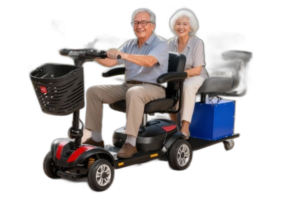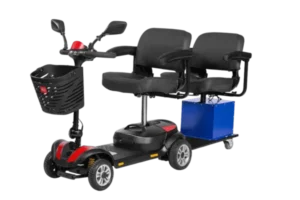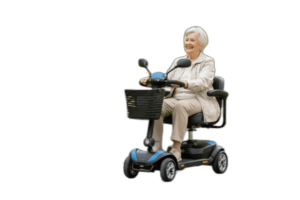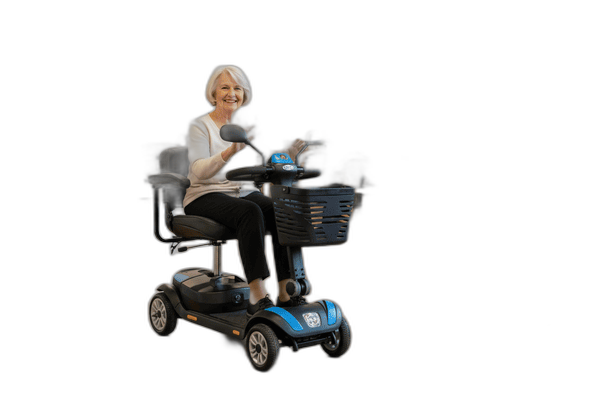
A social worker in a suburban district of Beijing called me on behalf of an elderly man who’d been housebound for eighteen months. His pension covered rent, food, and not much else. A mobility scooter—any mobility scooter—was a financial stretch, but without one, his world had shrunk to the forty square meters of his apartment and the view from his third-floor window. She asked me, bluntly, what was the cheapest scooter I’d feel comfortable putting my own grandfather on. The AM-C1 is the answer I gave her. It’s our entry-level mobility scooter—four wheels, a simple tiller, a twenty-kilometer range, and every safety feature we build into our more expensive models. What’s missing are the premium features: no suspension, no pneumatic tires, no LCD display, no lithium battery. What’s present is a scooter that starts, stops, steers, and supports up to one hundred fifty kilograms without making me nervous.
The C1 uses the same carbon steel chassis as the C2 but with solid PU tires instead of the C2’s slightly larger wheels. The tires are puncture-proof—no inner tube to go flat, no air pressure to check—which is exactly what you want in an entry-level product where maintenance neglect is a real concern. The tradeoff is ride quality: PU tires transmit more road vibration than pneumatic tires. On smooth indoor surfaces and well-maintained sidewalks, the difference is negligible. On cobblestone or gravel, you’ll feel it. That’s the honest tradeoff: low maintenance versus plush ride, and for the first-time scooter user who just wants something that works, low maintenance usually wins.
The motor is a two-hundred-fifty-watt brushed DC unit with a top speed of eight kilometers per hour. The battery is a twenty-four-volt, twelve-amp-hour lead-acid pack delivering fifteen to twenty kilometers of range. The control panel is simple—a speed dial, a battery indicator with four LED bars, a horn button, and a forward-reverse toggle. Nothing digital to fail, nothing that requires reading a manual to understand. Turn the key, turn the speed dial to your comfort level, push the throttle lever forward, and go. Release the throttle, and the automatic electromagnetic brake engages immediately. There’s no coasting, which is a safety feature, not an annoyance—when you let go, the scooter stops.
The seat is a padded vinyl chair with a manual swivel—lift the lever, rotate, sit—and flip-up armrests. It’s not a captain’s chair with adjustable lumbar support, and I won’t pretend it is. It’s a comfortable seat for trips of an hour or two, which is what the C1’s battery range supports anyway. The tiller angle adjusts with a knob, and the scooter disassembles into four pieces for transport. The heaviest piece is about sixteen kilograms—liftable by a family member, not the rider themselves. The turning radius is one-point-two meters, same as the C2, which means it handles indoor spaces and narrow store aisles without the frustration of a full-size turning circle.
Who’s the C1 for? First-time scooter buyers who don’t know what features they need and don’t want to overinvest. Elderly users on fixed incomes whose mobility needs are local—the supermarket, the pharmacy, the community center, all within a few kilometers. Family members buying for a parent who’s resisted mobility aids and might not use a scooter enough to justify a premium model. It’s also the scooter I recommend for facilities that need a small fleet—assisted living centers, community centers, places of worship—where multiple units are needed and per-unit cost matters more than premium features.
If you need all-day range or you’re traveling on rough outdoor surfaces, I’ll point you to the B-series instead. But if you need a scooter that gets you from A to B and back reliably, without costing more than it should, the C1 is the honest entry point. Contact me through the form below and I’ll give you straight pricing and lead times for your quantity.
Model Comparison
| Specification | AM-C1 | AM-B2 | AM-C2 |
|---|---|---|---|
| Chassis material | Carbon steel | Carbon steel | Carbon steel |
| Motor | Domestic 250W | Domestic 250W | Domestic 250W |
| Controller | Dalanmek | Dalanmek | Dalanmek |
| Battery | 24V 12Ah lead-acid | 24V 12Ah lead-acid | 24V 12Ah lead-acid |
| Load capacity | 150 kg | 150 kg | 150 kg |
| Charging time | 6–8H | 6–8H | 6–8H |
| Speed | 0–8 km/h | 0–8 km/h | 0–8 km/h |
| Climbing ability | ≤12° | ≤12° | ≤12° |
| Mileage | 15–20 km | 15–20 km | 15–20 km |
| Braking | Automatic electromagnetic | Automatic electromagnetic | Automatic electromagnetic |
| Front wheel | 190×54 mm (7.5″ PU) | 190×54 mm (7.5″ PU) | 190×54 mm (7.5″ PU) |
| Rear wheel | 215×70 mm (8.5″ PU) | 215×70 mm (8.5″ PU) | 215×70 mm (8.5″ PU) |
| Shock absorption | No | Yes | Yes |
| Vehicle size | 110×52×97 cm | 110×52×97 cm | 110×52×97 cm |
| N.W. (excl. battery) | 42 kg | 42 kg | 42 kg |
| Detachable chassis | Yes | —(样册未列) | Yes |
| Color | Red/Blue/Black | Red/Blue/Black | Red/Blue/Black |
Frequently Asked Questions
What specifications should I review for this model?
Key specifications including dimensions, capacity, power requirement and material composition are provided in the model datasheet. Contact us with your project requirements for the complete specification sheet.
What documents are available for import?
Datasheet, user manual, packing information and applicable conformity documents are confirmed per destination market. Registration requirements vary by country and are reviewed project by project.
Can I request a sample or reference installation?
Sample availability and reference installation details are confirmed based on the product category and order volume. Contact us with your specific requirements.