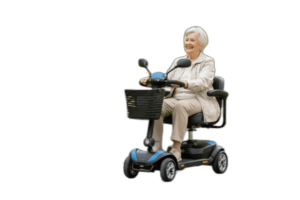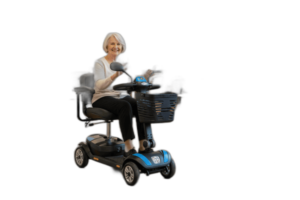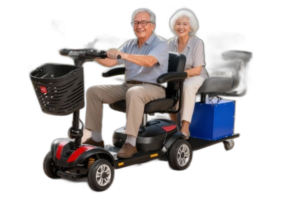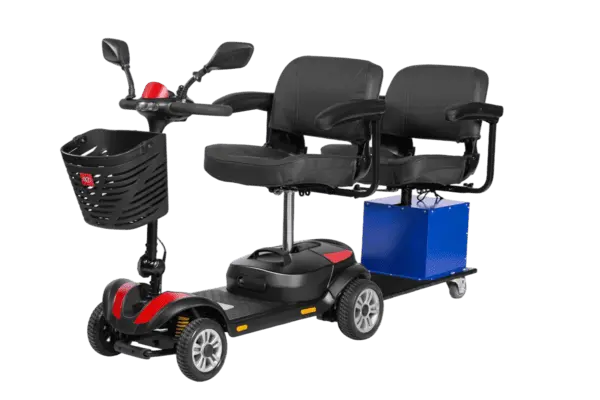
There’s a gap in the mobility scooter market that most manufacturers pretend doesn’t exist: the space between the entry-level compact scooter that fits in a car trunk but runs out of battery before lunch, and the premium touring scooter that goes forty-five kilometers but costs more than a used car and won’t fit through a standard doorway. The AM-B2 lives in that gap. It’s our mid-range scooter—longer range than the C-series, more affordable than the B1 premium model, with enough suspension and ground clearance to handle the uneven sidewalks and gravel paths that compact scooters struggle with. For someone who needs to get to the local shops, the park, and back home without range anxiety and without spending premium money, the B2 is the honest middle ground.
The chassis is carbon steel with a reinforced frame that supports one hundred fifty kilograms. The suspension is where the B2 distinguishes itself from the C-series: front and rear coil-over-shock suspension with about forty millimeters of travel, which absorbs the impact of sidewalk cracks, curb cuts, and the occasional gravel parking lot without transmitting the jolt up through the seat and into the rider’s spine. If you have a back condition—and many mobility scooter users do—that suspension isn’t a luxury feature. It’s the difference between arriving at your destination in pain and arriving without noticing the bumps.
The motor is a five-hundred-watt brushless DC unit driving the rear wheels. Brushless motors are more efficient and have longer service lives than the brushed motors in entry-level scooters—fewer parts to wear out, no brush dust to contaminate the housing, and about fifteen percent more range per amp-hour of battery capacity. The battery is a forty-eight-volt, twenty-amp-hour lead-acid pack that delivers a range of approximately thirty to thirty-five kilometers on a full charge. That’s enough for a round trip to the grocery store, the pharmacy, and the park without worrying about whether the battery indicator’s last bar is telling the truth. Charging time is six to eight hours—overnight, in other words.
Ground clearance is seven centimeters, up from the C-series’ four. That extra three centimeters is the margin between clearing a raised sidewalk crack and getting hung up on it. The tires are pneumatic—not solid PU—which provides additional shock absorption and better traction on loose surfaces. The tradeoff is maintenance: pneumatic tires need air pressure checks and can go flat. But for the user whose daily route includes outdoor surfaces rougher than smooth tile, the ride quality improvement is worth the maintenance tradeoff. A flat tire is annoying. A spine full of micro-jolts from solid tires on brick pavement is a chronic pain condition.
The seat is a padded vinyl captain’s chair with adjustable height, flip-up armrests, and a swivel function for easier mounting. The tiller is angle-adjustable with an LCD display showing speed, battery level, and odometer—more information than the basic LED panel on the C-series, because the B2 user is typically spending more time on the scooter and making longer trips where battery monitoring matters. The scooter breaks down into five pieces for transport, and the heaviest piece is the rear section at about eighteen kilograms—manageable for a family member loading a vehicle, not something the rider should be lifting themselves.
The B2 sits between the C1/C2 entry-level scooters and the B1 premium model. If you need the most affordable option and your routes are indoor and smooth-pavement only, the C-series saves you money. If you need maximum range and the smoothest ride and price isn’t the primary constraint, the B1 is the upgrade. But if you’re somewhere in between—decent daily range, real suspension, outdoor-capable without the premium price tag—the B2 is where I’d put my own money. Send me your typical daily distance and terrain, and I’ll tell you honestly whether the B2 covers it or whether you should step up or down.
Model Comparison
| Specification | AM-C1 | AM-B2 | AM-C2 |
|---|---|---|---|
| Chassis material | Carbon steel | Carbon steel | Carbon steel |
| Motor | Domestic 250W | Domestic 250W | Domestic 250W |
| Controller | Dalanmek | Dalanmek | Dalanmek |
| Battery | 24V 12Ah lead-acid | 24V 12Ah lead-acid | 24V 12Ah lead-acid |
| Load capacity | 150 kg | 150 kg | 150 kg |
| Charging time | 6–8H | 6–8H | 6–8H |
| Speed | 0–8 km/h | 0–8 km/h | 0–8 km/h |
| Climbing ability | ≤12° | ≤12° | ≤12° |
| Mileage | 15–20 km | 15–20 km | 15–20 km |
| Braking | Automatic electromagnetic | Automatic electromagnetic | Automatic electromagnetic |
| Front wheel | 190×54 mm (7.5″ PU) | 190×54 mm (7.5″ PU) | 190×54 mm (7.5″ PU) |
| Rear wheel | 215×70 mm (8.5″ PU) | 215×70 mm (8.5″ PU) | 215×70 mm (8.5″ PU) |
| Shock absorption | No | Yes | Yes |
| Vehicle size | 110×52×97 cm | 110×52×97 cm | 110×52×97 cm |
| N.W. (excl. battery) | 42 kg | 42 kg | 42 kg |
| Detachable chassis | Yes | —(样册未列) | Yes |
| Color | Red/Blue/Black | Red/Blue/Black | Red/Blue/Black |
Frequently Asked Questions
What specifications should I review for this model?
Key specifications including dimensions, capacity, power requirement and material composition are provided in the model datasheet. Contact us with your project requirements for the complete specification sheet.
What documents are available for import?
Datasheet, user manual, packing information and applicable conformity documents are confirmed per destination market. Registration requirements vary by country and are reviewed project by project.
Can I request a sample or reference installation?
Sample availability and reference installation details are confirmed based on the product category and order volume. Contact us with your specific requirements.