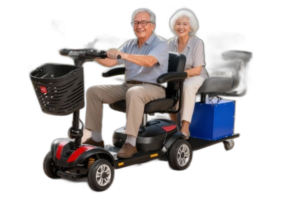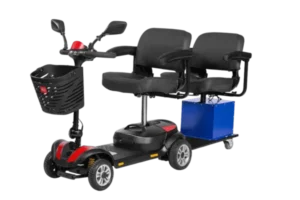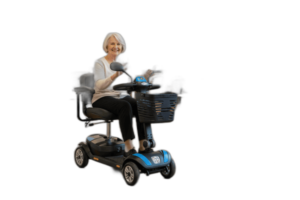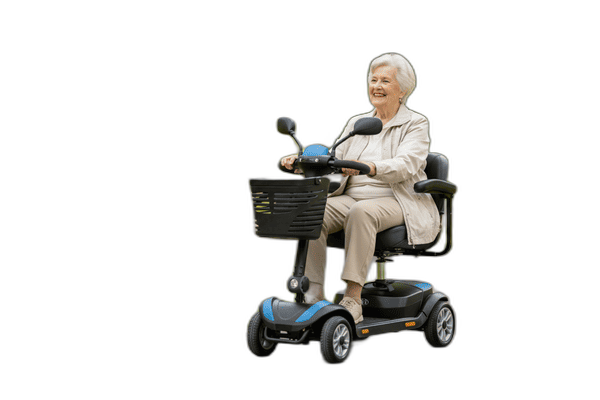
A retired engineer in his late sixties emailed me last year with a spreadsheet. He’d been comparing mobility scooters for three months—columns for range, weight capacity, turning radius, ground clearance, tire type, suspension travel, and price per kilometer of range. He’d done the math on ten different models from five manufacturers. “I’m not buying a scooter,” he wrote. “I’m buying the next five years of being able to leave my house every day without depending on my daughter to drive me.” The AM-B1 was the scooter that won his spreadsheet. It’s our premium mobility scooter—one hundred eighty kilogram weight capacity, forty to forty-five kilometer range, full four-wheel suspension, pneumatic tires, and a ground clearance that handles real-world outdoor terrain. If the C-series is for getting to the shops, the B1 is for getting to the shops, then the park, then across town to visit a friend, then home—all in one charge, on one scooter, without compromise.
The frame is reinforced carbon steel with a double-wishbone front suspension and independent rear suspension. That’s automotive terminology for a reason: the B1’s suspension isn’t a couple of springs under the seat; it’s a mechanical system with forty to fifty millimeters of travel at each wheel that keeps all four tires in contact with the ground even when the surface is uneven. If one wheel drops into a pothole, the other three stay planted, and the scooter doesn’t lurch. For a rider with balance concerns or a spinal condition, that stability margin is the difference between confident travel and white-knuckling every curb cut.
The motor is an eight-hundred-watt brushless DC unit—the most powerful in our scooter line—delivering smooth acceleration from a standstill and enough torque for inclines up to twelve degrees. The battery is a forty-eight-volt, thirty-amp-hour pack, which is the largest we fit and the reason the range pushes to forty-five kilometers. That’s not a marketing number tested on a flat track with a fifty-kilogram rider; it’s a real-world number on mixed terrain with an average-weight rider at moderate speed. The battery is mounted low in the chassis for stability, and it’s sealed against moisture and dust ingress. Lead-acid chemistry, because at this capacity level, the cost premium for lithium is significant and the weight of the battery actually contributes to the scooter’s planted, stable feel—when a strong crosswind hits a lightweight scooter, you feel it. When it hits the B1, you don’t.
The seat is a full captain’s chair with adjustable height, adjustable armrest width, adjustable backrest angle, and a sliding seat base that moves forward and backward to accommodate different leg lengths. The armrests are padded and flip up. The headrest is adjustable. The tiller has an infinite-angle adjustment with a gas strut assist—pull the lever, position the tiller, release, and it stays. The LCD display shows speed, battery percentage, odometer, trip meter, and a diagnostic indicator. There’s a USB charging port under the display for a phone or GPS unit. These are features that read like a luxury spec sheet, but for someone spending three to five hours a day on this scooter, each one is a quality-of-life decision that compounds over months and years.
The tires are pneumatic with an aggressive tread pattern that handles grass, gravel, packed dirt, and wet pavement without slipping. Ground clearance is nine centimeters—high enough for most curb transitions and driveway aprons. The lights are LED: headlight, taillight, and turn signals, all integrated into the body rather than bolted on as afterthoughts. The scooter doesn’t disassemble for transport the way the C-series does—it’s a full-size machine, and it needs a ramp or a lift for vehicle loading. I’m direct about that because a customer who buys a B1 expecting to break it into pieces and load it into a sedan trunk is going to be disappointed and angry, and I’d rather they know that before they buy.
Who’s the B1 for? Heavy daily users who spend more than two hours a day on their scooter. Riders who need to cover real distance—ten, fifteen, twenty kilometers in a day—and don’t want to plan their life around charge cycles. Users over one hundred fifty kilograms who need the higher weight capacity without pushing the machine to its limit. People whose environment includes hills, rough pavement, park paths, and weather that a compact scooter wasn’t designed to handle. If your daily mobility is a three-kilometer round trip on smooth sidewalks, the B1 is overkill—save your money and get the C2 or B2. But if you’re the person who built the spreadsheet, who measured their daily route on Google Maps, who’s been holding out for a scooter that doesn’t feel like a compromise—the B1 is the machine you’ve been looking for. Send me your typical daily distance and terrain, and I’ll confirm whether the B1 fits or point you to the right B-series model.
Frequently Asked Questions
What specifications should I review for this model?
Key specifications including dimensions, capacity, power requirement and material composition are provided in the model datasheet. Contact us with your project requirements for the complete specification sheet.
What documents are available for import?
Datasheet, user manual, packing information and applicable conformity documents are confirmed per destination market. Registration requirements vary by country and are reviewed project by project.
Can I request a sample or reference installation?
Sample availability and reference installation details are confirmed based on the product category and order volume. Contact us with your specific requirements.