The History of Surgical Lights—ascend medtech
The History of Surgical Lights
Part I: The History of European Surgical Lights—From “God’s Light” to the “Intelligent Eye”
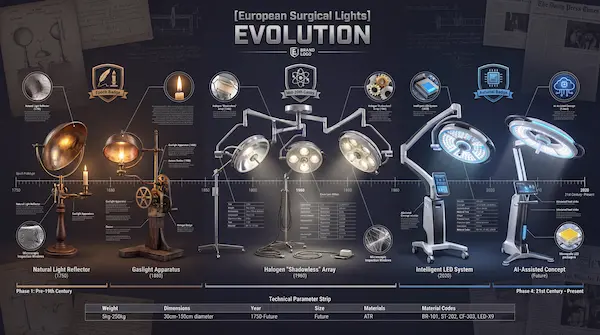
As the birthplace of modern medicine, Europe’s history of the surgical light is virtually synonymous with the entire evolution of surgical illumination. This progression can be summarized in four key stages.
Stage 1: The Era of Natural Light (19th Century and Earlier)
In the earliest days of surgery, illumination depended entirely on the best light source available: the sun. Operating rooms of that time, often called “operating theaters,” were typically located on the top floor of buildings, featuring massive glass domes or south-facing windows.
Imagine having to schedule surgeries based on the sun’s position. On overcast or rainy days, the surgical risk was exceptionally high. Furthermore, to achieve optimal lighting, the patient had to be kept in a fixed position (as multi-functional surgical tables did not yet exist), rather than being adjusted according to surgical needs. Surgeons were entirely at the mercy of the weather, a significant constraint for physicians striving for precision.
Stage 2: The Exploration of Artificial Light Sources (Late 19th to Early 20th Century)
The invention of the electric lamp marked the first turning point. Physicians began attempting to introduce incandescent bulbs into the operating room, but this brought a host of new problems:
High Heat: Early bulbs generated substantial heat, which could desiccate the patient’s wound tissue during prolonged exposure. It also caused surgeons to perspire profusely, compromising their stability and comfort.
Shadows: A single light source cast deep shadows from the surgeon’s head, shoulders, and instruments onto the surgical field. This was the most critical issue, as an obstructed view meant operating “blind,” which carried extreme risks.
My Perspective: This phase was like fumbling in the dark. We had light, but the light was disobedient. I have read the notes of predecessors who lamented that the lighting of that era was “both an angel and a devil.” To mitigate shadows, they would even use mirrors to reflect light from different angles—a cumbersome and minimally effective solution, yet the best available at the time.
Stage 3: The Birth and Maturation of the “Shadowless” Concept (Mid-20th Century)
The true revolution occurred in the 1920s and 1930s. European manufacturers, led by companies like Martin and Berchtold in Germany, introduced the core concept of the “shadowless lamp.” They achieved this by combining multiple high-intensity light heads onto a large lamp disc, allowing light beams to converge on the surgical area from various points.
Core Technology: When the surgeon’s head or hand obstructed a portion of the light, beams from other angles would immediately compensate, thus maximally eliminating shadows. However, it wasn’t absolutely shadowless, but rather a significant relative reduction.
Key Technologies:
Halogen Bulbs: Provided higher luminance and better color rendering than incandescent bulbs.
Cold Light Technology: Through specially coated filters (cold light mirrors), the majority of infrared radiation (heat) was reflected backward, allowing only visible “cold” light to illuminate the surgical field. This largely solved the problem of “roasting” the surgical team and patient.
My Perspective: This was the era when we truly gained our freedom. The large, circular lamp, resembling a “showerhead” and also known as a multi-lamp surgical light, became an icon of the operating room. We could finally concentrate on the surgery itself in a bright, clear, and relatively cool environment. The Color Rendering Index (CRI) of the light also became critically important, as we needed the light to faithfully reproduce the natural colors of human tissue, enabling precise differentiation between arteries, veins, nerves, and pathological tissues. During this period, European products, especially those “Made in Germany,” became the global gold standard for their exquisite craftsmanship and reliability.
Stage 4: The LED Revolution and Smart Integration (21st Century to Present)
If the halogen lamp represented the “analog era,” the advent of the LED ushered in the “digital age.” The advantages of Light Emitting Diodes (LEDs) are overwhelming:
Extremely Low Heat: As a native cold light source, LEDs produce virtually no infrared radiation, fundamentally solving the heat issue.
Ultra-Long Lifespan & High Efficacy: Their lifespan is tens of times longer than halogen bulbs, with significantly lower energy consumption. An OSRAM LED, for instance, can achieve a lifespan of over 60,000 hours.
Superior Optical Quality: LEDs can easily achieve an extremely high Color Rendering Index (Ra > 95) and even allow for adjustable color temperatures to suit different types of surgery (e.g., neurosurgery favors a cooler temperature, while general surgery may prefer warmer tones).
Design Freedom: The small size of LED chips allows lamp heads to be designed thinner and more aerodynamically (to comply with laminar flow purification systems in the OR), enabling flexible layouts for a more perfect shadowless effect.
Intelligent Integration: Modern European surgical lights from brands like Dräger and TRUMPF, as well as Chinese suppliers like Ascend Medtech, have evolved into integrated platforms. The central axis of the light head can accommodate HD cameras for surgical training and recording, and be equipped with displays to show the patient’s vital signs or radiological images in real-time.
My Perspective: The surgical light we use today is an “intelligent robot.” It not only provides illumination but also serves as our interface with the entire surgical information ecosystem. We can switch to endoscopy mode (providing soft, ambient light) with a single touch, or adjust the light spot size to focus on deep surgical fields. It acts like a highly trained assistant, always providing the exact light I need.
Part Two: The Development History of Surgical Lights in China — From “Catch-up” to “Running Side by Side”
Compared to Europe, China’s modern medical industry started later, and the development of surgical lights has followed a completely different “catch-up – surpass” curve.
Stage One: Dependence on Imports and Initial Replication (Before the 1980s)
From the early days of the founding of the country to before the reform and opening up, high-end operating rooms in China were almost entirely dependent on imported equipment, mainly from the Soviet Union and Europe, which were expensive. Some domestic medical equipment manufacturers began to attempt replication, but the products were mostly simple single-head or multi-hole reflector surgical lights, technologically equivalent to the early 20th century European level, mainly solving the problem of “whether there is or not.”
My Perspective: In that era, using imported multi-head halogen surgical lights was a symbol of top-tier hospitals. Most grassroots hospitals still used the “big bulb” style of lighting, with common issues of shadows and heat. As a doctor, you had to rely on your rich experience to “imagine” the details hidden in the shadows, and the surgical difficulty was unimaginable.
Stage Two: Large-scale Imitation and Market Popularization (1980s – Early 21st Century)
After the reform and opening up, with the development of the market economy and increased international exchanges, Chinese manufacturers began systematically studying and imitating European halogen integral reflector surgical lights. The goal of this stage was clear: to achieve mainstream functions at a lower price.
Key Features: “Looks like” and “cost-effectiveness.” By learning from foreign designs, key issues such as shadow-free lighting and cold light were resolved. Although there were still gaps in materials, craftsmanship, optical precision, and durability compared to European top brands, the price of surgical lights was significantly reduced, allowing them to rapidly popularize in hospitals at all levels in China.
My Perspective: This was a crucial “popularization” stage. It enabled tens of thousands of Chinese doctors to use qualified “shadow-free lights” for the first time. Although we knew they might not be as stable as German products and the lights might degrade faster, they greatly improved our working conditions and raised the level of surgical safety nationwide. During this stage, we were “students” and “catch-up players.”
Stage Three: “Overtaking on the Curve” in the LED Era (Since the 2010s)
When the world began to transition to LED technology, China seized a historic opportunity. With its huge advantage in the LED industry (the world’s largest LED producer) and a well-developed electronics manufacturing ecosystem, Chinese surgical light manufacturers were almost in sync with their European counterparts, and even introduced mature LED surgical lights faster.
Technological Leap: Chinese brands (such as Shanghai Medical Instruments and Shandong Xinhua) are no longer just imitators. They have started to independently carry out optical design and developed unique LED lens technologies to achieve more uniform light spots and better deep cavity illumination.
Cost Advantage and Globalization: With a strong supply chain and large-scale production, Chinese LED surgical lights have maintained high quality while offering strong price competitiveness. Now, Chinese-made surgical lights not only dominate the domestic market but are also exported in large quantities around the world.
Innovation and Differentiation: In terms of intelligence, Chinese brands have also kept up with the trend. High-definition cameras and multimedia integration have become standard features. Some manufacturers have also explored beneficial innovations in human-machine interaction and automated light spot adjustment.
My Perspective: This is an exciting “running side by side” or even “leading” stage. Now, when I enter any modern operating room in China, I see domestic LED surgical lights that are no less than imported brands in terms of lighting quality, controllability, and level of intelligence. We can proudly say that in the field of surgical lighting, we have transformed from a “catch-up player” into a strong contender on the table.