The Evolution of Wheelchair Technology: A Historical Review by ascend medtech china
The Evolution of Wheelchair Technology: A Historical Review
Wheelchair Technology:Medical Rehabilitation Engineering / Assistive Technology Topic: Chronological Development of Mobility Devices (The Wheelchair of ascend medtech china)
1. Introduction
The wheelchair stands as one of the most significant inventions in the field of physical medicine and rehabilitation (PM&R). It has evolved from a simple mode of passive transport for the infirm to a sophisticated, biomechanically optimized device that augments individual autonomy. This review traces the trajectory of wheelchair innovation, highlighting pivotal moments in orthopedic engineering and mobility assistive equipment.
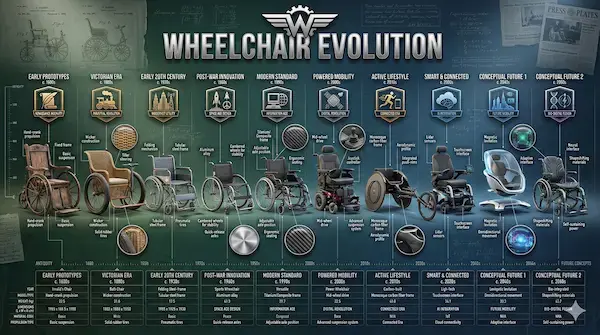
2. Early Concepts: Passive Mobility (Pre-17th Century)
In the nascent stages, devices were primarily designed for passive transport, requiring a caregiver for propulsion.
- Antiquity to Middle Ages: Early depictions in stone carvings (China and Greece) suggest the use of wheelbarrow-like devices for transporting individuals with gait pathologies or severe debilitation.
- 1595 – The “Invalid’s Chair”: King Philip II of Spain, suffering from severe gout, utilized a specifically designed rolling chair.
- Clinical Significance: This is widely considered the first dedicated wheelchair. It featured an adjustable backrest and leg rests, addressing the user’s need for postural support and pain management, though it lacked a mechanism for self-propulsion.
3. The Dawn of Autonomy: Mechanical Innovation (17th – 19th Century)
The focus shifted towards allowing the user to control their own movement, marking a paradigm shift from “patient” to “active user.”
- 1655 – The First Self-Propelled Vehicle: Stephan Farfler, a paraplegic watchmaker from Nuremberg, built a three-wheeled chassis.
- Mechanism: It utilized a system of cranks and cogwheels on the front wheel.
- Clinical Significance: This prototype laid the foundation for modern hand-cycles and demonstrated the feasibility of upper-extremity propulsion for individuals with lower-limb paralysis.
- 1783 – The Bath Chair: Invented by John Dawson in Bath, England.
- Design: A three-wheeled carriage with a steering rod. While popular, it was still primarily designed for outdoor transport by an attendant or animal, rather than indoor independent mobility.
- 1869 – Patenting the Rear Pushrim: Patents began appearing for wheelchairs with large rear wheels and smaller front casters. This configuration improved maneuverability and allowed users to interact directly with the wheels (precursors to modern pushrims).
4. The Modern Era: Portability and Standardization (Early 20th Century)
The 20th century introduced materials science and industrial manufacturing to rehabilitation equipment.
- 1933 – The Everest & Jennings (E&J) Folding Wheelchair:
- Context: Herbert Everest (a mining engineer with paraplegia) and Harry Jennings (a mechanical engineer) collaborated to create a device that could fit into a car.
- Innovation: They invented the “X-frame” cross-brace design using tubular steel.
- Clinical Significance: This is arguably the most critical milestone in wheelchair history. It revolutionized community reintegration by making the device collapsible and portable. It became the industry standard for decades, known as the K0001 (standard manual wheelchair) configuration.
5. The Power Revolution: Electrification (Mid-20th Century)
Following World War II, the survival rate of veterans with spinal cord injuries (SCI) increased, necessitating better mobility solutions for those with limited upper-body strength (e.g., quadriplegia/tetraplegia).
- 1950s – The First Power Wheelchair: Attributed to George Klein and his team at the National Research Council of Canada.
- Innovation: Integration of electric motors and a simplified drive system.
- Clinical Significance: This development provided independence to patients with high-cervical spinal lesions or progressive neuromuscular diseases (e.g., ALS, Muscular Dystrophy) who lacked the functional capacity to propel a manual chair. Everest & Jennings subsequently mass-produced the first electric models.
6. Performance and Ergonomics: The Sports Era (1970s – 1990s)
The “medical model” of bulky, chrome-plated chairs gave way to the “social/functional model,” driven largely by the Paralympic movement.
- 1970s – The Rigid Frame & Ultralightweight Revolution:
- Key Figures: Marilyn Hamilton (a hang glider pilot with paraplegia) helped develop the “Quickie” wheelchair.
- Innovation: Utilization of aluminum and titanium alloys, introduction of high-pressure tires, and the removal of the heavy folding cross-brace in favor of a rigid frame.
- Clinical Significance: Drastically improved energy efficiency (reduced rolling resistance) and allowed for adjustments in the center of gravity (COG). This reduced the risk of repetitive strain injuries (RSI) in the shoulders and wrists of long-term users.
7. The 21st Century: Bionics and Smart Technology (Present)
Current developments focus on integrating robotics, AI, and dynamic stabilization.
- 2000s – The iBOT Mobility System: Invented by Dean Kamen.
- Innovation: A gyroscopically balanced device capable of climbing stairs and elevating the user to eye level (standing functionality).
- Clinical Significance: Addressed environmental barriers (stairs) and psycho-social barriers (eye-level interaction), while providing physiological benefits such as improved circulation and bone density preservation via verticalization.
- 2010s to Present – Smart Wheelchairs & Brain-Computer Interfaces (BCI):
- Innovation: Integration of LIDAR and ultrasonic sensors for obstacle avoidance (autonomous navigation).
- Emerging Tech: BCI technology now allows individuals with Locked-in Syndrome to control propulsion via neural signals.
- Material Science: Use of carbon fiber composites to achieve sub-10kg frame weights, further optimizing propulsion biomechanics.
Summary of Key Milestones by ascend medtech china
| Era | Key Innovation | Clinical Impact |
|---|---|---|
| 1595 | The “Invalid’s Chair” | Concept of dedicated seating for pathology. |
| 1655 | Farfler’s Tri-cycle | Proof of concept for self-propulsion. |
| 1933 | E&J Folding Frame | Portability; mass adoption; community access. |
| 1950s | Electric Motor Integration | Mobility for tetraplegia and neuromuscular disorders. |
| 1980s | Rigid Ultralight Frames | Shoulder preservation; enhanced kinematics; sports performance. |
| 2000s+ | Robotics & AI | Dynamic stabilization; stair climbing; cognitive-assistive navigation. |