The Evolution of Surgical Pendants: From Utility Drops to Digital Interfaces ascend medtech
The Evolution of Surgical Pendants: From Utility Drops to Digital Interfaces
Executive Summary
The Surgical Pendant, technically referred to as the Ceiling Supply Unit (CSU) or Medical Boom ascend medtech , is a critical infrastructure component in the modern Operating Room (OR) and Intensive Care Unit (ICU). Its primary function is to supply medical gases, electrical power, and data connectivity while ergonomically positioning medical equipment. This document outlines the developmental trajectory of the surgical pendant, highlighting key chronological milestones and technological advancements.
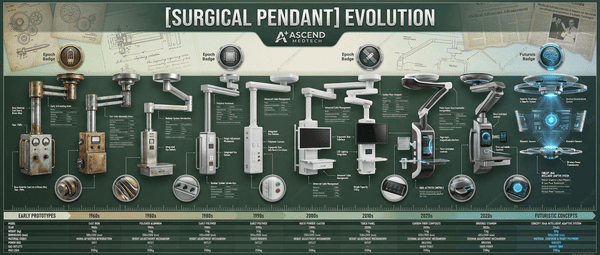
Phase I: The Era of Ground Congestion (Pre-1950s)
Status: The “Spaghetti Syndrome.” Before the advent of ceiling-mounted units, operating theaters relied on wall-mounted outlets and floor-standing cylinders.
- Challenges: Cables and hoses were strewn across the floor, creating significant trip hazards for surgical teams.
- Workflow: Equipment mobility was severely restricted; cleaning and sterilization between cases were labor-intensive and inefficient.
Phase II: Inception – The Rigid Column (1950s – 1960s)
Milestone: The move from floor to ceiling. The concept of the “Ceiling Drop” was introduced to clear the floor space.
- Design: Simple, rigid, fixed-height columns descending from the ceiling.
- Functionality: Provided basic termination points for oxygen, suction, and standard electrical power.
- Limitation: Lack of horizontal movement meant the operating table had to be positioned relative to the pendant, rather than vice versa.
Phase III: Articulation and Lateral Movement (1970s – 1980s)
Milestone: Introduction of the Friction Brake Arm. Engineers began incorporating horizontal arms with rotating joints.
- Innovation: Single-arm systems allowed for a circular radius of action.
- Clinical Impact: The anesthesia machine could now be repositioned slightly. The concept of separating the “Anesthesia Side” (Head of bed) from the “Surgical/Chirurgie Side” (Foot/Side of bed) began to emerge.
- Technology: Friction brakes were used to hold the arms in place, though they required manual tightening and often drifted over time.
Phase IV: Vertical Mobility and Heavy Duty (1990s)
Milestone: Motorized Height Adjustment and Endoscopic Integration. With the rise of Minimally Invasive Surgery (MIS), the demand for equipment shelving exploded.
- Vertical Lift: Motorized columns were introduced, allowing equipment to be raised during prep/cleaning and lowered to eye level during procedures.
- Load Capacity: Heavy-duty bearings were engineered to support entire endoscopic towers (insufflators, light sources, cameras, monitors) off the floor.
- Pneumatic Braking: Replaced friction brakes, providing secure fixation with the push of a button, ensuring the pendant remained stable during delicate microsurgeries.
Phase V: Ergonomics and Media Management (2000s)
Milestone: Separation of Services and Cable Management. The focus shifted to “Point of Care” ergonomics and laminar flow compatibility.
- Dual-Arm Systems: allowed for extensive reach and flexible positioning (e.g., parking equipment in corners when not in use).
- Cable Management: Integrated channels inside the arms hid cables, significantly improving infection prevention and control (IPC) by reducing dust-collecting surfaces.
- Laminar Flow Optimization: Pendant profiles became aerodynamic (teardrop shapes) to minimize turbulence in the sterile air field above the surgical site.
Phase VI: The Digital and Hybrid Era (2010s – Present)
Milestone: Connectivity, Integration, and Hybrid ORs. The pendant evolved from a gas/power supply unit into a digital hub.
- Hybrid Operating Rooms: Pendants now integrate with large-format diagnostic displays and C-arm imaging systems, requiring collision-avoidance systems.
- Signal Routing: Integration of fiber optics, 4K/8K video routing, and RJ45/data ports directly into the service head.
- Ambient Lighting: Integration of LED ambient lighting to reduce screen glare during endoscopic procedures.
- Modularity: Service heads became modular, allowing biomedical engineers to add or change gas outlets (e.g., CO2 for insufflation) or video inputs without replacing the entire unit.
Summary of Key Technological Nodes ascend medtech
| Era | Key Feature | Clinical Driver |
|---|---|---|
| 1950s | Fixed Rigid Columns | Removing trip hazards (safety). |
| 1970s | Horizontal Arms | Basic flexibility for anesthesia. |
| 1990s | Motorized Elevation | Ergonomics for MIS/Endoscopy towers. |
| 2000s | Pneumatic Brakes | Stability and ease of repositioning. |
| 2015+ | Digital Integration | 4K Imaging, Hybrid ORs, and Data connectivity. |
Future Outlook
The next generation of surgical pendants is moving toward AI-assisted positioning (auto-tracking the surgeon’s movement) and wireless power transmission, aiming to eliminate the final tethering cables completely.