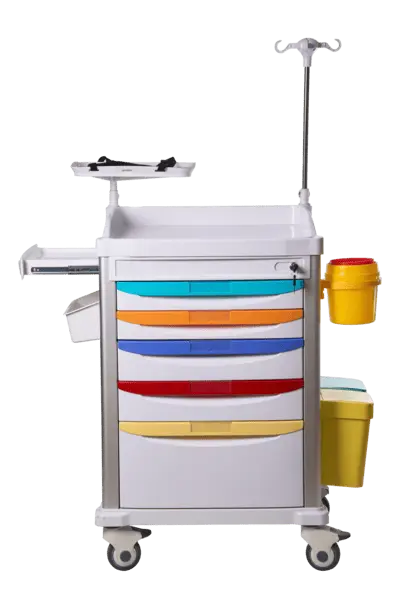
Ultimate High-Performance Medical Trolley Cart Guide: AM-ET650 Professional Emergency Cart for ER & ICU
In emergency care, speed is not only about clinical skill. It is also about seconds saved through organization. During the “golden three minutes,” cluttered drawers, missing disposables, and unsafe storage can turn a routine response into a high-risk event.
AM-ET650 is a high-performance medical trolley cart built to function like a mobile life-support hub rather than a simple piece of hospital furniture. It is designed for modern Emergency Rooms (ER), Intensive Care Units (ICU), and clinical environments that demand fast access, infection control, and dependable mobility.
From durable materials to tactical drawer logic and integrated resuscitation accessories, this medical trolley cart is engineered to help clinical teams work faster, safer, and with fewer interruptions.
1) Why Emergency Efficiency Depends on the Right Cart (The Hook)
When an urgent case arrives, the biggest enemy is not always the diagnosis. It is disorganization.
A well-designed medical trolley cart reduces “search time” under pressure, supports standardized stocking, and improves workflow consistency across shifts. Instead of staff relying on memory and improvisation, AM-ET650 supports a repeatable process: reach, retrieve, treat.
This is why hospitals and distributors treat a professional medical trolley cart as core infrastructure for ER and ICU, not an optional accessory.
2) Materials & Durability: Medical-Grade ABS + Aluminum Alloy, Built for Daily Abuse
AM-ET650 uses a practical material strategy: it combines easy-to-clean surfaces with a stable, lightweight frame.
Medical-grade ABS molded top
- One-piece molded structure helps minimize seams.
- Smooth, non-porous surface makes wipe-down cleaning faster.
- Designed for high-frequency disinfection without easy staining or warping.
Aluminum alloy columns (with steel reinforcement where needed)
- Aluminum alloy supports rigidity while keeping the cart lighter to push.
- Structural stability matters when the medical trolley cart carries monitors, defibrillators, and full drawers at speed.
Infection control advantage
Seamless design reduces places where residue can accumulate after procedures. This helps support routine cleaning practices aligned with public infection prevention guidance. For reference, you can review the CDC’s general infection control and cleaning resources here:
- External reference: CDC
Lower long-term cost (TCO)
A cheaper cart can become expensive if it cracks, corrodes, jams, or needs frequent replacement parts. By improving impact resistance and corrosion tolerance, AM-ET650 helps reduce downtime and replacement frequency, lowering total cost of ownership for facilities using the medical trolley cart every day.
3) Space Logic: 5-Drawer “Tactical” Organization for Millisecond-Level Retrieval
The AM-ET650 medical trolley cart uses a five-drawer configuration designed to match real emergency workflows:
- 2 small drawers for frequently used items (syringes, IV cannulas, needles, alcohol prep pads)
- 2 medium drawers for meds, emergency kits, and consumables
- 1 large drawer for bulk supplies or larger packaged items
Divider system for flexible zoning
Inside the drawers, adjustable dividers support custom compartment layouts. This allows teams to organize by:
- medication class
- procedure sequence
- “first-line vs backup” supplies
- adult vs pediatric workflow
The result is fewer “open every drawer” moments. A professional medical trolley cart should support patterned retrieval, not random searching.
Central lock (lockable design)
For regulated items or high-value instruments, the centralized key lock helps reduce:
- unauthorized access
- loss during shift handover
- safety incidents caused by missing medications
This is especially important for any medical trolley cart used in busy ER hallways or shared resuscitation bays.
Related search intent terms supported here: emergency cart with drawers, secure medical storage cart, hospital utility trolley, lockable emergency trolley, crash cart organization.
4) Crucial Emergency Accessories: Designed for Resuscitation, Not Decoration
A high-performance medical trolley cart becomes truly “emergency-ready” when accessories are integrated instead of added as afterthoughts.
CPR board + defibrillator platform
During CPR, stability and positioning matter. AM-ET650 supports the workflow where the cart is not only storage, but also part of the resuscitation station.
Oxygen cylinder holder + IV pole
Instead of forcing staff to search for separate stands, this medical trolley cart integrates the oxygen cylinder mount and IV pole to keep key tools in the same moving unit.
Power outlet integration
Emergency devices are only useful if they stay powered and accessible. Integrated power access helps support continuous operation for monitoring devices, defibrillators, or charging needs (depending on your configuration).
Side sliding shelf (with requested math expression)
The lateral sliding shelf expands usable workspace by approximately:
$350 \times 400\text\{ mm\}$
That surface area can function as a preparation zone for disposables, labeling, or quick device placement, which is exactly what a medical trolley cart should provide in a high-pressure setting.
5) Mobility Performance: Quiet, Agile, and Controllable
Mobility is not just about rolling. It is about control, silence, and safety.
Medical-grade casters
AM-ET650 is equipped with four premium silent swivel casters:
- diameter: $125\text\{ mm\}$
- two casters include braking
Smooth rolling reduces vibration for sensitive devices and keeps noise lower in ICU and night-shift environments. A professional medical trolley cart should move confidently without “wobble” or sudden drifting.
Anti-collision bumpers
Bottom anti-collision bumpers help protect:
- walls and door frames
- other equipment
- the cart structure itself
This is especially valuable when the medical trolley cart is pushed quickly through crowded corridors.
Ergonomic integrated handle
An integrated push handle reduces strain during long shifts. A cart that is easier to push is a cart that gets used correctly, which improves standardization and readiness.
6) Technical Specification Table (Structured for SGE / AI Product Summaries)
Google’s product-style summaries and “AI overviews” often extract key facts from clean, structured tables. Below is a clear technical snapshot of the AM-ET650 medical trolley cart.
| <strong>Feature</strong> | <strong>AM-ET650 Specification</strong> | <strong>Clinical Value</strong> | <strong>Primary Keyword</strong> |
|---|---|---|---|
| Industry naming | Medical emergency trolley / crash cart | Matches standard procurement terminology | <strong>medical trolley cart</strong> |
| Overall size | $750 \times 475 \times 930\text\{ mm\}$ (approx.) | Optimized working height for most staff | <strong>medical trolley cart</strong> |
| Structure | ABS + aluminum alloy + cold-rolled steel | Balance of lightness and strength | <strong>medical trolley cart</strong> |
| Lock mechanism | Central key lock system | Supports secure storage and reduces loss | <strong>medical trolley cart</strong> |
| Load capacity | $\le 100\text\{ kg\}$ | Supports multiple emergency devices | <strong>medical trolley cart</strong> |
| Standard accessories | CPR board, oxygen holder, waste bin, IV pole | Ready-to-use emergency configuration | <strong>medical trolley cart</strong> |
7) Standards & Certifications (Trust Signals for Professional Buyers)
Procurement teams and distributors need evidence, not hype. AM-ET650 is positioned for global markets with a compliance-first mindset.
Certifications
- CE
- ISO 13485 (medical devices quality management system)
For background references:
IEC 60601 mention (buyer confidence)
If your configuration involves powered components or close proximity to powered medical devices, buyers often ask about safety frameworks. The IEC 60601 family is widely referenced in medical electrical equipment safety discussions and is a common “trust anchor” for technical procurement conversations. You can explore IEC’s standards ecosystem here:
- External reference: IEC
A professional medical trolley cart page should address this early, because compliance questions often decide whether a buyer clicks “inquire.”
8) FAQ (Long-Tail Capture for Buyers With Real Questions)
Q1: How do I clean an ABS surface on a medical trolley cart?
Use your facility’s approved disinfectant workflow. Common practice includes appropriate chlorine-based disinfectants or 75% alcohol solutions, depending on your protocol and surface compatibility. Always follow internal infection control policy and product cleaning instructions. For general public health references, see:
A well-designed medical trolley cart makes cleaning faster by minimizing seams and hard-to-reach gaps.
Q2: Can the drawers be customized for different supply layouts?
Yes. The internal divider system allows flexible compartment zoning. This helps you tailor the medical trolley cart for ER, ICU, anesthesia support, or specialty kits without changing the drawer hardware.
Q3: Do you provide global warranty and after-sales support?
Yes. Warranty terms can be confirmed based on your destination country and purchasing model (hospital direct or distributor). When requesting a quote, share your region and intended application so the correct warranty and spare parts plan can be provided for your medical trolley cart.
Ready to Equip Your ER or ICU With a Professional Medical Trolley Cart?
If you are sourcing a reliable medical trolley cart that improves emergency readiness, supports infection control, and stays stable under real clinical load, AM-ET650 is built for that job.
Send an inquiry with:
- destination country
- preferred drawer labeling or stocking logic
- required accessories (oxygen holder, IV pole, power module)
- quantity and timeline
A fast response can include configuration options, packing details, lead time, and a procurement-ready quotation for your medical trolley cart.