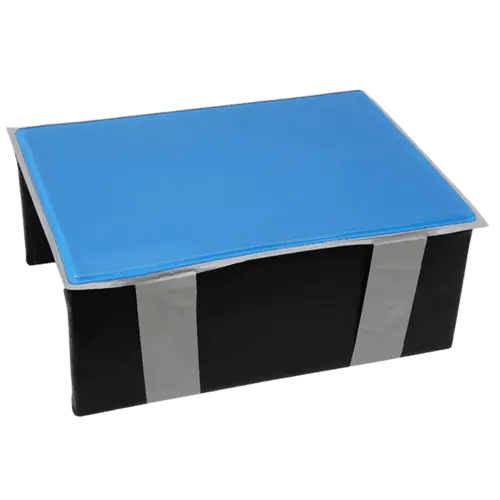
Lateral decubitus positioning for total hip arthroplasty creates a very specific problem that doesn’t get talked about enough in surgical positioning literature — probably because it affects the non-operative side, and the post-op note focuses on the replaced joint. The patient is on their side. The operative hip is up, draped and prepped in a sterile field. The dependent lower limb — the one against the table — gets compressed between the hard table surface and the full weight of the upper limb pressing down through multiple layers of surgical drapes, plus the intermittent pressure of the surgical team leaning in during acetabular reaming and stem insertion. By the time the components are implanted and the wound is closed, two to three hours have passed. The patient’s dependent leg, from knee to ankle, has been under sustained, unmonitored compression. When they wake up in the PACU, the replaced hip feels fine but the contralateral leg is numb — fibular head compression has caused a transient common peroneal nerve palsy that takes hours or days to resolve, and in rare cases doesn’t fully resolve at all. That’s nerve compression from positioning, not from surgery. It’s entirely preventable. The AM-TW-014 tunnel pad was designed to eliminate exactly that mechanism of injury.
The tunnel geometry — 64×46×25cm — fully encircles the dependent lower limb, distributing contact force around a full 360 degrees instead of concentrating it on the lateral calf, the fibular head, and the lateral malleolus — the three points where compression neuropathy and skin breakdown most commonly occur. The full enclosure is the critical design element that distinguishes this from open-trough pads: weight comes from above, and an open trough has no structural mechanism to protect the top of the limb from that downward force. The polymer gel conforms to the individual limb contour and distributes the compressive load evenly across the entire circumference of the leg, converting a point load or edge load into a distributed surface load. And the gel doesn’t collapse — that’s the failure mode of foam tunnel alternatives, which compress to half their original thickness within the first hour and lose their protective geometry precisely when the risk is highest. Our polymer gel maintains its structural integrity and its protective shape throughout the entire procedure. The anti-slip base anchors the tunnel to the table surface so it doesn’t migrate or rotate when the surgeon applies high-torque rotational force during acetabular reaming — a maneuver that can easily shift poorly anchored positioning devices and create new pressure points mid-procedure.
The tunnel pad is fundamentally different from our concave pad (AM-TW-012). The 012 is an open trough designed for prone limb support where surgical access is needed above the supported limb — knees, arms, ankles in prone procedures. The 014 is a full enclosure for lateral limb protection where compression comes from all directions and the entire limb circumference needs protection. If you’re an orthopedic center running hip and knee replacements in lateral position, the 014 belongs in your positioning kit alongside the AM-TW-018 hip pad for greater trochanter offloading and the AM-TW-017 semi-circle for axillary support. Together, the three pads create a complete lateral positioning system.
Frequently Asked Questions
What specifications should I review for this model?
Key specifications including dimensions, capacity, power requirement and material composition are provided in the model datasheet. Contact us with your project requirements for the complete specification sheet.
What documents are available for import?
Datasheet, user manual, packing information and applicable conformity documents are confirmed per destination market. Registration requirements vary by country and are reviewed project by project.
Can I request a sample or reference installation?
Sample availability and reference installation details are confirmed based on the product category and order volume. Contact us with your specific requirements.