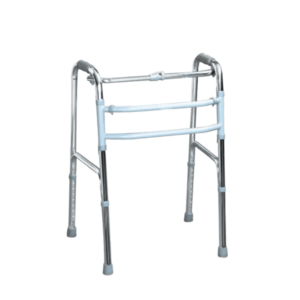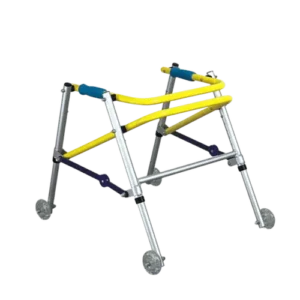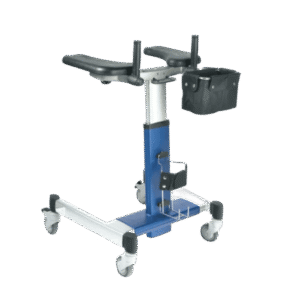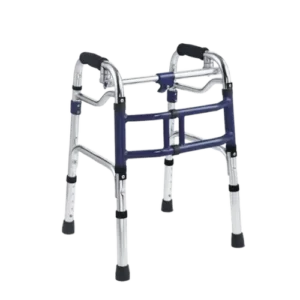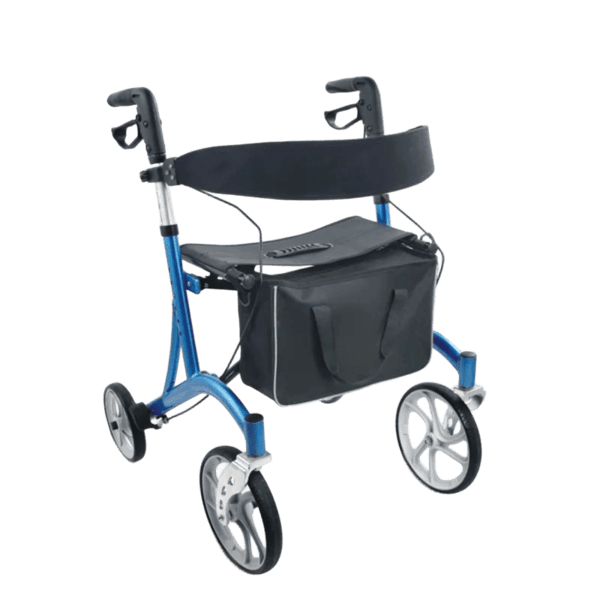
Some patients can walk but can’t lift. A person with advanced rheumatoid arthritis in both shoulders, or someone recovering from bilateral mastectomy who’s restricted from upper-body exertion, or a patient with muscular dystrophy whose legs still function but whose arms fatigue after about thirty seconds of sustained effort—all of these people need a walking frame that rolls. The AM-FS9862LH puts wheels on all four legs so the frame never needs to be lifted. The patient pushes forward, the wheels roll, the hand brakes control speed, and the entire gait cycle happens without the frame ever leaving the ground. For patients with upper-body limitations, this is the difference between walking independently and being stuck in a chair.
The frame is aluminum, 3.1 kilograms—heavier than our non-wheeled models because the four-wheel configuration requires additional bracing at the wheel mounts to handle the torsional loads that occur when one wheel hits a door threshold while the other three are on flat ground. The front wheels are 5-inch swivel polyurethane with 360-degree rotation; the rear wheels are 5-inch fixed-direction polyurethane. Fixed rear wheels rather than swivels are a deliberate choice: swivel rears make the frame feel loose and unpredictable, especially during weight transfer, while fixed rears track straight and provide a stable base when the patient leans into the frame. The hand brakes are loop-lock style on both sides—squeeze to decelerate, push down to park—with separate cables running to each rear wheel for independent braking action.
The height adjusts from 800 to 950 millimeters in six positions, and each side operates independently for doorway navigation—though with four wheels, the maneuverability is already significantly better than a glide-cap frame. The hand grips are contoured vinyl at 36 millimeters diameter, angled slightly forward to match the pushing motion rather than the lifting motion of a standard walker. The grip angle is subtle—about 8 degrees from vertical—but it reduces wrist extension strain over hours of use, which matters when the patient’s upper-body limitation means every bit of ergonomic advantage counts toward independent mobility. The grip angle is subtle—about 8 degrees from vertical—but it reduces wrist extension strain over extended use. The frame folds with a center-pull mechanism to about 220 millimeters deep, though the wheels add bulk compared to a standard frame’s folded profile.
If you’re a physiotherapist working with patients whose legs are functional but whose shoulders, arms, or hands can’t handle the repetitive lifting of a standard walker, the 9862LH is the frame that bridges that gap. I stock these in Shanghai—contact me through the form below for current availability, pricing, and shipping timelines to your location.
Frequently Asked Questions
What specifications should I review for this model?
Key specifications including dimensions, capacity, power requirement and material composition are provided in the model datasheet. Contact us with your project requirements for the complete specification sheet.
What documents are available for import?
Datasheet, user manual, packing information and applicable conformity documents are confirmed per destination market. Registration requirements vary by country and are reviewed project by project.
Can I request a sample or reference installation?
Sample availability and reference installation details are confirmed based on the product category and order volume. Contact us with your specific requirements.