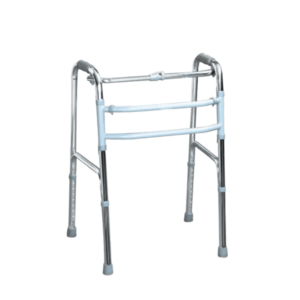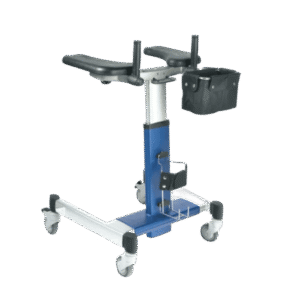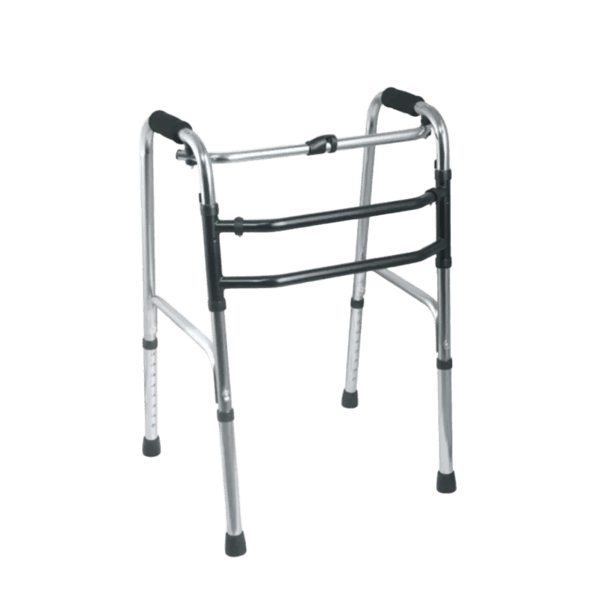
Balance disorders—whether from vestibular dysfunction, peripheral neuropathy, or simply the gradual decline in proprioception that comes with age—create a specific fear that people without balance problems don’t understand. The fear isn’t of walking. It’s of the moment between sitting and standing, when your center of mass is moving from stable to unstable territory and your inner ear isn’t giving your brain the right signals about which way is up. The AM-FS9125L is a stand-up walker engineered specifically for that transition moment. The hand grips are set higher and further forward than a standard walker, giving the user a stable two-handed anchor point they can reach before they begin to rise, not after they’re already committed to standing.
The frame is aluminum, 2.7 kilograms, with an extended front arch that positions the hand grips at 820 to 1020 millimeters from the floor—about 80 millimeters higher at the upper end than a standard walker. This extra height changes the biomechanics of the sit-to-stand motion from a forward-leaning pull to a more vertical push-down, which engages the triceps and latissimus dorsi instead of the lower back and hip flexors. For a patient with vestibular dysfunction who feels dizzy during position changes, the vertical push is also safer than the forward lean because it keeps the head closer to an upright orientation, reducing the positional vertigo that can trigger a fall during the transition.
The hand grips are oversized at 40 millimeters diameter, larger than our standard 36-millimeter grips, because the wider diameter requires less finger flexion to maintain a secure hold. This matters for elderly users with arthritis or reduced grip strength—they can wrap their palms around the grip and bear weight through the heel of the hand rather than needing to close their fingers into a tight fist. The grip angle is set at 12 degrees forward from vertical, which matches the natural wrist extension angle when pushing down from a seated position. The front legs have fixed glide caps for stability during the sit-to-stand phase; the rear legs have our high-traction compound caps for the same reason. Wheels are not an option on this model—the entire point is planted stability during the transition, and wheels undermine that purpose.
The 9125L adjusts in height across seven positions from 820 to 1020 millimeters at the hand grip, each side operates independently, and the frame folds to 200 millimeters deep via center-pull. If you’re treating patients with balance disorders, or if a family member avoids standing up from chairs because the dizziness scares them more than they’ll admit, the 9125L is the frame that addresses the specific moment they’re afraid of. Contact me below.
Frequently Asked Questions
What specifications should I review for this model?
Key specifications including dimensions, capacity, power requirement and material composition are provided in the model datasheet. Contact us with your project requirements for the complete specification sheet.
What documents are available for import?
Datasheet, user manual, packing information and applicable conformity documents are confirmed per destination market. Registration requirements vary by country and are reviewed project by project.
Can I request a sample or reference installation?
Sample availability and reference installation details are confirmed based on the product category and order volume. Contact us with your specific requirements.