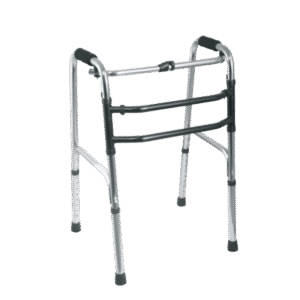
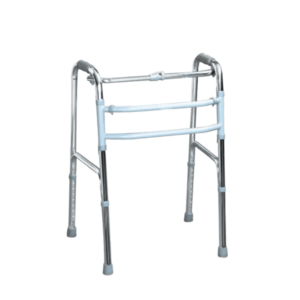
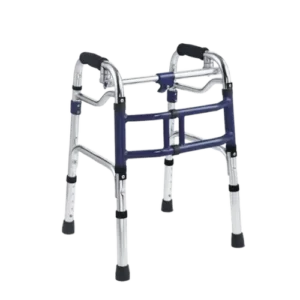
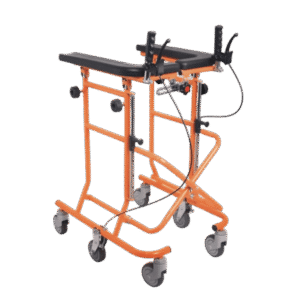
There’s a specific patient who needs a walking frame with wheels rather than a standard four-glide frame: the post-spinal surgery patient whose upper body strength is temporarily compromised—either from the surgery itself or from the post-operative restriction against lifting more than five pounds. A standard walker requires the patient to lift the frame slightly with each step forward, which activates the very paraspinal muscles that are supposed to be resting. The AM-FS968L puts 5-inch swivel wheels on both front legs, so the patient pushes forward rather than lifts—the frame rolls, the rear glide caps provide the friction that prevents it from running away, and the patient’s spine stays in neutral alignment throughout the gait cycle.
The frame is aluminum, weighing 2.8 kilograms with wheels, and the front wheels are polyurethane with sealed ball bearings that roll smoothly on tile, linoleum, and low-pile carpet without chattering or catching. The rear glide caps are our high-traction compound—more grip than our standard caps, because with wheels on the front, the rear needs to provide enough braking force to prevent the frame from rolling forward when the patient leans into it during weight transfer. The balance between front-wheel freedom and rear-cap friction is the engineering challenge that separates a useful wheeled walker from a dangerous one, and we spent a lot of time testing different cap compounds on different floor surfaces to get it right.
Each side operates independently with push-button mechanisms at the fold joints, so the patient can navigate through a doorway by advancing one side, then the other—no lifting, no tilting, no wide turns. The height adjusts from 800 to 960 millimeters with spring-loaded pins at each leg. The hand grips are contoured vinyl with a forward-canted angle that matches the natural wrist position when pushing rather than lifting—subtle, but noticeable over the course of a day’s use. The front wheels swivel 360 degrees, which means the walker turns in place without the patient needing to lift and pivot it, a significant advantage in bathrooms and small kitchens.
The 968L folds with a one-hand center pull to about 200 millimeters deep, and the wheels don’t need to be removed for folding—they tuck inward as the sides come together. It’s a practical detail that matters when the patient is folding and unfolding the frame multiple times per day to move between rooms. If you’re recovering from spinal surgery, or you’re a physiotherapist prescribing mobility aids for post-spinal patients, the 968L is the frame that doesn’t ask the spine to do work it’s not ready for. Contact me through the form below for specs and pricing.
Frequently Asked Questions
What specifications should I review for this model?
Key specifications including dimensions, capacity, power requirement and material composition are provided in the model datasheet. Contact us with your project requirements for the complete specification sheet.
What documents are available for import?
Datasheet, user manual, packing information and applicable conformity documents are confirmed per destination market. Registration requirements vary by country and are reviewed project by project.
Can I request a sample or reference installation?
Sample availability and reference installation details are confirmed based on the product category and order volume. Contact us with your specific requirements.