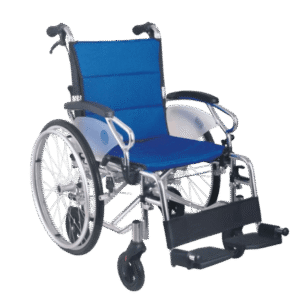
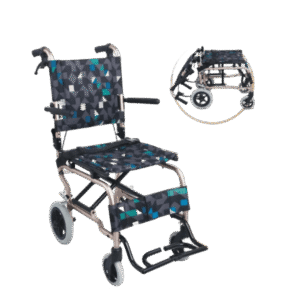
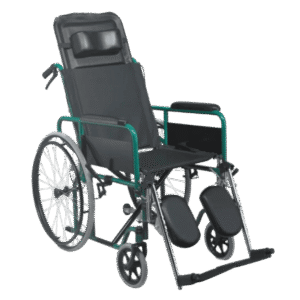
A standard eighteen-inch wheelchair seat doesn’t fit everyone. For larger-framed adults—whether from body type, post-surgical swelling, or simply needing room for a winter coat and a seat cushion—an eighteen-inch seat becomes a squeeze that pinches the hips, restricts circulation, and makes transfers feel unstable because the user is perched on the edges rather than seated inside the frame. The AM-FS210ABE-61 has a twenty-inch seat width, which sounds like a small two-inch difference until you sit in both chairs back to back. For the user who’s been making do with a chair that’s too narrow—compensating, shifting, never quite comfortable—those two inches are the margin between tolerating the chair and actually fitting in it.
The frame is powder-coated steel with a reinforced seat rail that handles the additional span across a wider seat without flexing. The powder coating is baked-on epoxy—more chip-resistant than wet-paint finishes and more forgiving of the minor impacts that happen when a wider chair navigates narrower doorways. The frame folds with the standard X-brace mechanism, pulling the two sides together to roughly thirty-two centimeters folded width. The tradeoff of steel over aluminum is weight: the FS210ABE-61 weighs about seventeen kilograms, which means the caregiver doing the lifting needs to be reasonably strong or using a vehicle lift. If the caregiver can’t manage that weight and the user needs the twenty-inch width, I’ll point you toward our aluminum twenty-inch options. But for a chair that stays in one location—the user’s home, a care facility day room—the weight of steel is irrelevant and the cost savings are real.
The rear wheels are twelve-inch solid PU tires on composite rims with handrims for self-propulsion. The twelve-inch diameter is a compromise between the maneuverability of eight-inch transport wheels and the self-propulsion capability of twenty-four-inch standard wheels. A user with reasonable upper-body strength can propel themselves on twelve-inch wheels across smooth indoor surfaces—hospital corridors, apartment hallways, supermarket aisles. For long outdoor distances or rough terrain, these aren’t the right wheels, and I want to be straightforward about that. If the user needs to self-propel across town, they need twenty-four-inch rear wheels and the wider overall width that comes with them. The FS210ABE-61 is designed for indoor use and short outdoor transfers where a caregiver provides most of the pushing, with the option for the user to reposition themselves independently within a room.
The front casters are eight-inch solid tires on swivel forks, wider than the six-inch casters on narrower models to distribute the chair’s front-end weight more evenly and reduce rolling resistance on carpet and uneven surfaces. The wheel locks are push-to-lock on both sides, mounted on the seat frame rails with extension handles that make them easier to engage from a seated position. The seat and backrest are padded black nylon with double-stitched seams at the load-bearing edges. The armrests are padded, flip-back for transfers, positioned at the correct width relative to the twenty-inch seat—not the standard eighteen-inch armrest spacing that would pinch a larger user’s hips. The footrests are swing-away, adjustable for lower-leg length, with wide composite foot plates that accommodate larger footwear.
Who’s the FS210ABE-61 for? Larger-framed adults who’ve been squeezed into eighteen-inch chairs that leave bruises on their hips. Bariatric-adjacent users who don’t need a full bariatric chair but exceed the comfortable limits of standard sizing. Post-surgical patients with abdominal dressings or edema that require extra clearance. Users in colder climates who wear heavier clothing and find standard chairs too tight in winter. Facilities that need to stock a range of seat widths—not just the default eighteen—because patient demographics vary and dignity means having a chair that fits. If the user is close to or over one hundred twenty kilograms, I’d recommend stepping up to a reinforced frame with a higher weight rating. But for the user who simply needs a wider seat in a standard steel frame, the 210ABE-61 is the chair that fits. Contact me with the user’s hip width at the widest point, and I’ll confirm the sizing.
Model Comparison
| Specification | AM-FS903LAJPQF9 | AM-FS874LJPF7 | AM-FS907LABH | AM-FS723LQF14 | AM-FS210ABE-61 | AM-FS874LAJ-30 | AM-FS804LABJ | AM-FS800LBF3 |
|---|---|---|---|---|---|---|---|---|
| Total length | 102 cm | 89 cm | 96 cm | 85 cm | 105 cm | 90 cm | 93 cm | 73.5 cm |
| Total width | 69 cm | 62 cm | 63 cm | 52 cm | 77.5 cm | 53 cm | 47 cm | 38 cm |
| Total height | 92 cm | 89 cm | 91 cm | 80 cm | 91.5 cm | 85 cm | 89 cm | 86.5 cm |
| Fold width | 37 cm | 26 cm | 26 cm | 35 cm | 30 cm | 28 cm | 25 cm | 58 cm ⚠️ |
| Seat width | 46 cm | 46 cm | 46 cm | 36 cm | 61 cm | 30 cm | 37 cm | 35 cm |
| Seat depth | 40 cm | 40 cm | 40 cm | 36 cm | 45 cm | 30 cm | 36 cm | 34 cm |
| Seat height | 47 cm | 49 cm | 51 cm | 48 cm | 52 cm | 44 cm | 45 cm | 49 cm |
| Backrest height | 44 cm | 38 cm | 37 cm | 27 cm | 40 cm | 42 cm | 38.5 cm | 34 cm |
| Front wheel Ø | 15 cm | 18 cm | 15 cm | 10 cm | 20 cm | 15 cm | 12.5 cm | 7.6 cm |
| Rear wheel Ø | 56 cm | 56 cm | 40 cm | 60 cm | 31 cm ⚠️ | 53 cm | 15 cm ⚠️ | 12.5 cm |
| Max load | 100 kg | 100 kg | 100 kg | —(样册未列) | 125 kg | 100 kg | 100 kg | 100 kg |
| N.W. | 14.5 kg | 11.8 kg | 13.7 kg | 10.7 kg | 17.8 kg | 12.3 kg | 6.7 kg | 6 kg |
Frequently Asked Questions
What specifications should I review for this model?
Key specifications including dimensions, capacity, power requirement and material composition are provided in the model datasheet. Contact us with your project requirements for the complete specification sheet.
What documents are available for import?
Datasheet, user manual, packing information and applicable conformity documents are confirmed per destination market. Registration requirements vary by country and are reviewed project by project.
Can I request a sample or reference installation?
Sample availability and reference installation details are confirmed based on the product category and order volume. Contact us with your specific requirements.