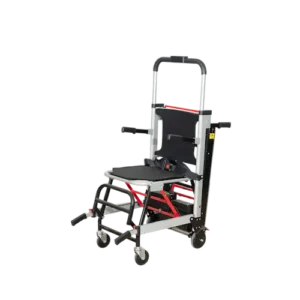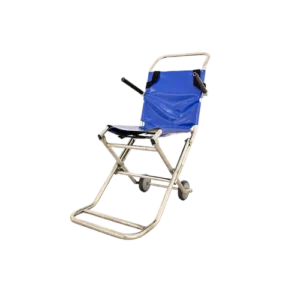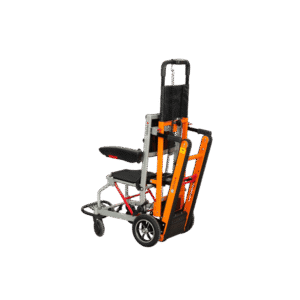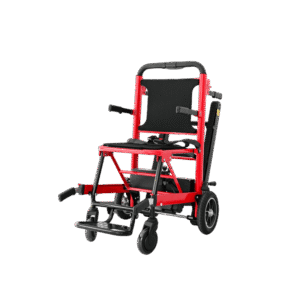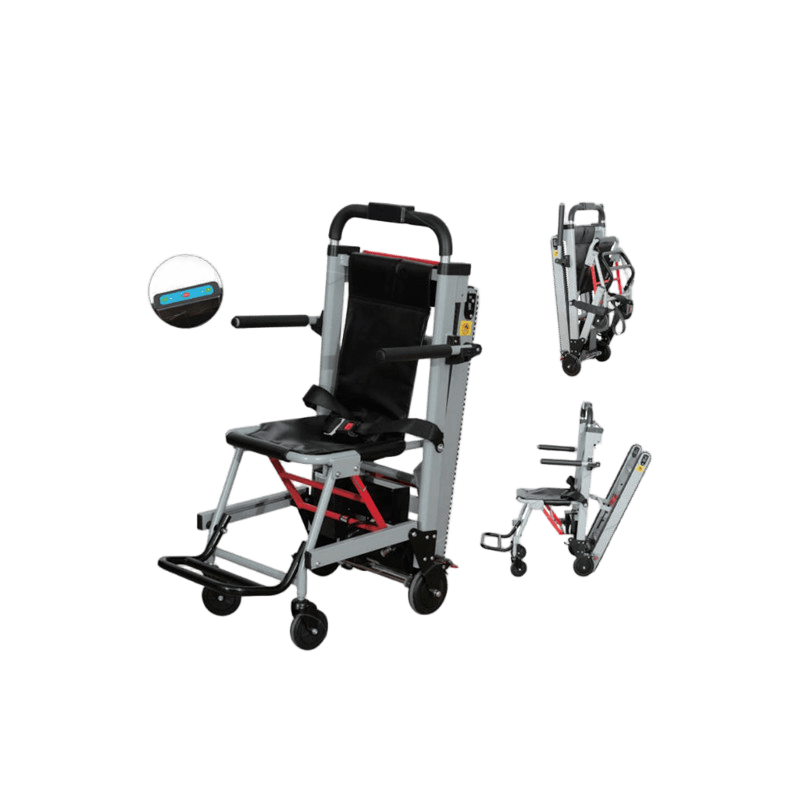
I got a call from a woman in Chengdu last year. She was caring for her eighty-two-year-old father in a sixth-floor walkup — no elevator, old building, and Dad had reached the point where climbing stairs meant stopping to rest on every landing. She’d been looking at motorized stair climbers online and the prices made her eyes water. “I don’t need it to go thirty floors on one charge,” she said. “I need it to get him from the lobby to his apartment twice a day without bankrupting me.” That conversation is why the AM-EST01S exists.
The EST01S is our entry-level stair climbing wheelchair, and I want to be clear about what “entry-level” means here. It means simpler — not weaker. It means you don’t need to charge a battery because there isn’t one. The chair uses a mechanical track system: the caregiver tilts the chair back onto its rubber tracks, applies steady upward pressure, and the tracks engage with each stair edge to climb. It’s the same principle as the motorized models, minus the motor. For a single flight of stairs, the physical effort is comparable to pushing a loaded wheelchair up a ramp — entirely manageable for a reasonably fit adult caregiver. Two flights is a workout. Three flights, and I’d start recommending a motorized model. Be honest about your stair count.
The frame is aluminum alloy, which keeps the assembled weight around twenty-three kilograms. That’s light enough for one person to fold and load into a car trunk, and it’s part of why this model costs roughly a third of our motorized FL series. The seat is padded with medical-grade foam and vinyl — not luxurious, but wipe-clean and comfortable enough for the ten to fifteen minutes it takes to navigate a typical residential staircase. Armrests flip up for lateral transfers from a bed or standard wheelchair. A five-point safety harness keeps the user secure during the tilt-back climbing position.
Where the EST01S makes the most sense is in predictable, low-demand environments: a retirement-age couple where one spouse can still assist the other, a home health aide making daily visits to a client in an older building, or a small residential care facility with one staircase and a limited equipment budget. You’re not paying for battery management systems, motor controllers, or charging docks — just the frame, the tracks, the wheels, and the safety features. If the tracks wear out in five years, they’re replaceable as a service item.
This chair does not self-load into vehicles and it’s not rated for professional EMS use. It’s a home mobility device — the stair equivalent of a manual wheelchair rather than a power chair. If you need battery-powered climbing, faster operation, or higher weight capacity, our EST and FL series are the right next step up. But if your stairs are straightforward and your budget is real, the EST01S does exactly what it promises: gets someone up and down the stairs safely, every time, without making you finance it. Send me a note with your stair count and user weight, and I’ll tell you honestly whether this model fits or if you should look higher in the line.
Model Comparison
| Specification | AM-EST90C | AM-EST001 | AM-EST00C | AM-EST01S |
|---|---|---|---|---|
| Material | High strength aluminum alloy | High strength aluminum alloy | High strength aluminum alloy | High strength aluminum alloy |
| Expanded size | 159×63×112(±1) cm | 158×63×104(±1) cm | 158×47.5×104(±1) cm | 146×56×98(±1) cm |
| Folding size | 106×63×36(±1) cm | 102×47.5×32(±1) cm | 102×47.5×32(±1) cm | 100×56×27(±1) cm |
| Motor | Carbon brush 120W | Carbon brush 120W | Carbon brush 120W | Carbon brush 100W |
| Battery | 24V/13AH (MAX) | 24V/13AH (MAX) | 24V/13AH (MAX) | Lithium 24V/10Ah (MAX) |
| Climbing speed | Avg 40 steps/min (5%) | Avg 40 steps/min (5%) | Avg 40 steps/min (5%) | Avg 40 steps/min (5%) |
| Load capacity | 159 kg | 159 kg | 159 kg | 100 kg |
| N.W. | 27±1 kg | 28±2 kg | 25±2 kg | 21±0.5 kg |
| Climbing angle | ≤50° | ≤50° | ≤50° | ≤50° |
| Front/Rear wheel | 5/8 inch | 3/5 inch | 3/5 inch | 4/5 inch |
Frequently Asked Questions
What specifications should I review for this model?
Key specifications including dimensions, capacity, power requirement and material composition are provided in the model datasheet. Contact us with your project requirements for the complete specification sheet.
What documents are available for import?
Datasheet, user manual, packing information and applicable conformity documents are confirmed per destination market. Registration requirements vary by country and are reviewed project by project.
Can I request a sample or reference installation?
Sample availability and reference installation details are confirmed based on the product category and order volume. Contact us with your specific requirements.