The Evolution of Operating Tables: From Barbaric Beginnings to Intelligent Systems
The Evolution of Operating Tables: From Barbaric Beginnings to Intelligent Systems
## Introduction
The operating table—a piece of equipment we take for granted in modern hospitals—has a fascinating history that mirrors the evolution of surgery itself. From makeshift wooden planks in 18th-century barbershops to today’s intelligent, robot-integrated platforms, the operating table tells the story of medical progress, innovation, and the relentless pursuit of better patient outcomes.
This article explores two parallel journeys: Europe’s organic development of surgical technology and China’s path from adoption to innovation.
—
## Early Development and Exploration (Before the 18th Century Evolution of Operating Tables)
Before modern medicine, European surgery was more like a brutal fight. Operations took place in barbershops, markets, or even battlefields. The “operating table” might be a wooden table, a few chairs pushed together, or just the ground.
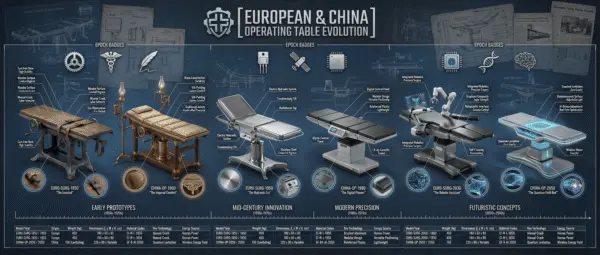
In the 18th century, as demand for surgeries like bladder stone removal increased, Europe saw the emergence of dedicated “surgical chairs” or basic operating tables. These wooden devices sometimes had adjustable backrests and straps to restrain patients. Their main purpose was to hold patients still while they were conscious and in severe pain, not to enable precise operations.
—
## 19th Century: Birth of the Modern Operating Table
The 19th century saw rapid development in surgery, and the modern operating table emerged during this period.
### The Push from Anesthesia
After the successful use of ether anesthesia in 1846, patients could remain still without pain. Surgeons no longer had to fight struggling patients. Operating table design shifted from restraint to flexible positioning for better surgical access.
### The Revolution of Aseptic Technique
After Lister introduced antiseptic methods in 1867, surgical infection rates dropped dramatically. Wooden operating tables were phased out because their porous nature made them difficult to clean and prone to harboring bacteria. Metal tables (cast iron, steel) that were easy to clean and disinfect replaced them.
### Advancement of Surgical Techniques
As doctors deepened their understanding of human anatomy, they invented various complex procedures. German surgeon Trendelenburg’s invention of the “head-down, feet-up position” greatly improved visibility in pelvic surgery. This required operating tables to have lifting, tilting, and folding capabilities.
—
## 20th Century to Present: Mechanization, Electrification, and Intelligence
After the 20th century, European operating table development accelerated.
### Power Systems
Manual cranks were replaced by hydraulic and electric systems. Doctors could adjust the table with foot pedals or buttons, improving both efficiency and precision.
### Modular and Specialized Functions
Specialized operating tables appeared for different departments, such as orthopedic traction beds, neurosurgical head fixation systems, and urological lithotomy position beds.
### Application of Materials Science
To accommodate intraoperative X-ray examination, table surfaces began using radiolucent materials (like carbon fiber), enabling real-time imaging guidance during surgery.
### Intelligence and Integration
Today’s high-end operating tables can interface with imaging equipment (C-arms, O-arms), navigation systems, and surgical robots (like da Vinci), achieving data integration and coordinated operation.
—
## The Chinese Story: Introduction, Catch-up, and Innovation Evolution of Operating Tables
China’s operating table development differs from Europe’s, going through a process from late Qing “Western learning spreading east” to post-reform catch-up.
### Ancient Tradition and Modern Introduction
Although ancient China had legends of Hua Tuo using “mafeisan” (anesthetic powder), surgical procedures didn’t develop systematically due to concepts like “the body and hair are received from parents.” China didn’t evolve specialized operating tables independently.
From the late 19th to early 20th century, Western medicine entered China with missionaries and overseas students, bringing modern medical knowledge and the first modern operating tables. During this period, China’s operating tables were entirely imported.
### From Imitation to Independent Production (1950s-1980s)
**Initial Stage:** Some domestic equipment factories referenced blueprints from the Soviet Union and Eastern European countries, or reverse-engineered imported operating tables. Products from this period had simple functions, mainly meeting basic operations like lifting and tilting, solving the problem of “having something versus nothing.”
**Self-Reliance:** Before reform and opening up, medical equipment factories in Shanghai, Jiangsu, and other areas could independently produce mechanical and hydraulic operating tables with relatively complete functions, meeting the basic needs of domestic hospitals.
### Reform and Opening to Present: Rapid Catch-up
**Technology Introduction and Joint Ventures:** After the 1980s, through joint ventures and technical cooperation with foreign brands (like Germany’s MAQUET and TRUMPF), Chinese companies quickly mastered technologies for electric and specialized operating tables. Product quality and functionality improved substantially.
**Rise of Domestic Brands:** After the 21st century, a group of domestic brands (like Yian, Mindray, Likang) emerged. They captured the mid-to-low-end market with cost advantages and quick response to domestic market needs, and began advancing into the high-end market.
**Innovation and Advancement:** Now, China is one of the world’s largest operating table producers, and has made progress in technological innovation. Domestic high-end electric operating tables approach international brands in functionality, materials, and intelligence. In combining 5G, AI, and robotics technologies, Chinese companies show late-mover advantages, narrowing the gap in remote surgery and intelligent surgical robots.
—
## Looking Forward
The operating table has evolved from a simple restraint device to an intelligent platform deeply integrated into digital medical systems. As we look to the future, we can expect even greater integration with emerging technologies—from AI-assisted positioning to seamless coordination with robotic surgical systems.
The parallel stories of European innovation and Chinese adaptation and advancement remind us that medical technology development is both a technical challenge and a reflection of broader social and economic forces. Today’s operating tables represent not just engineering achievement, but centuries of learning, adaptation, and the shared human goal of better surgical outcomes.
We look forward to a safer, more precise, and more efficient surgical environment.
—
## Key Takeaways
– **18th Century:** Basic wooden surgical chairs focused on patient restraint
– **1846:** Ether anesthesia changed table design from restraint to positioning
– **1867:** Lister’s antiseptic methods led to metal tables replacing wooden ones
– **20th Century:** Mechanization, electrification, and specialization accelerated
– **21st Century:** Integration with imaging, navigation, and robotic systems
– **China’s Journey:** From complete import dependence to becoming a major global producer
– **Future Direction:** Deep integration with AI, 5G, and intelligent medical systems