Dental Chair Evolution: Europe vs. China Market Insights
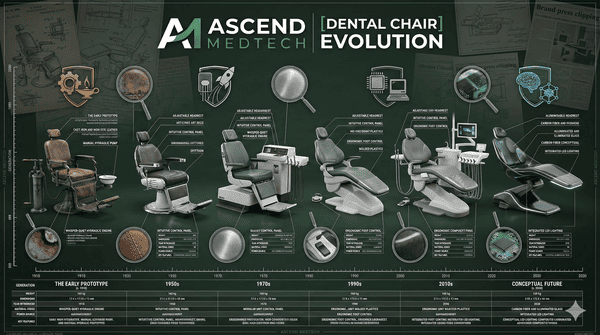
Dental chairs have evolved from basic mechanical seats into **integrated, digital treatment workstations**. Europe has long set the benchmark for high-end standards and system integration, while China has rapidly moved upmarket with **competitive performance, faster delivery, and a stronger cost structure**, making Chinese mid-to-high-end dental chairs increasingly attractive to clinics worldwide.[[1]](https://www.innomd.org/article/5f73f085218ba1179299197c)[[2]](https://www.chyxx.com/industry/1225463.html)
1) A Brief History of Dental Chairs: From “a chair” to a digital workstation
A modern dental chair unit (often called a **dental treatment unit**) is the core infrastructure of a practice, combining patient positioning, operatory lighting, suction, air/water systems, and instrument delivery into one working platform.
Dental chair development can be summarized in four major stages:
Stage 1: Early professionalization
As dentistry evolved into a modern medical profession, tools and workflows became more standardized—creating demand for specialized equipment rather than improvised seating setups.[[1]](https://www.innomd.org/article/5f73f085218ba1179299197c)
Stage 2: Integration begins (chair + delivery + utilities)
By the mid-20th century, materials and manufacturing advances enabled stronger integration. Sources note that **in the 1950s, steel dental carts entered clinical use and gradually evolved into today’s integrated dental treatment units**, signaling the shift toward chair-centered workflows.[[1]](https://www.innomd.org/article/5f73f085218ba1179299197c)
Stage 3: Pneumatic/electric systems improve stability and efficiency
With mature pneumatic systems, valves, and powered actuation, dental units became:
– smoother and more precise in positioning
– more efficient for four-handed dentistry
– more reliable for high-frequency clinical use
This period also helped European brands establish a durable reputation in the premium segment.
Stage 4: The digital era (the chair becomes a workflow hub)
With the rise of digital dentistry, the chair unit is no longer “just hardware.” It increasingly functions as an **entry point for clinical data and workflow efficiency**, connecting with imaging, scanning, and practice systems. In China, market discussion and research also highlight accelerating adoption of “digital and smart” dental treatment units.[[3]](https://finance.sina.com.cn/roll/2025-05-14/doc-inewpmqy1032965.shtml?froms=ggmp)
2) Europe vs. China: Two major markets, different buying logic
Europe: premium standards and system integration
European buyers typically prioritize:
– strict quality expectations and safety compliance
– infection-control-oriented design and cleanability
– ergonomic comfort for both patient and clinician
– integrated solutions (chair + imaging/scanning + software) for long-term workflow value
China: scale manufacturing + fast iteration, moving into mid-to-high-end
China has developed clear advantages in manufacturing scale and supply chain depth. Industry research indicates that in 2024 China’s dental chair industry reached **~285,000 units of production capacity and ~35.7 billion RMB market size**, with continued growth expected.[[2]](https://www.chyxx.com/industry/1225463.html)
This translates into practical value for buyers and distributors:
– stable supply and shorter lead times
– flexible configurations to match different clinic models
– easier parts availability and service network build-out
At the same time, “smart/digital” upgrades are becoming a key direction in China’s dental unit market.[[3]](https://finance.sina.com.cn/roll/2025-05-14/doc-inewpmqy1032965.shtml?froms=ggmp)
3) Why mid-to-high-end Chinese dental chairs are worth promoting now
For distributors and clinic customers, the most compelling message is not “cheap.” It is **high value with real operational benefits**:
- **Competitive clinical performance**
Focus on smooth positioning, stability under load, ergonomic design, and workflow efficiency.
- **Lower total cost of ownership (TCO)**
Not only purchase price, but also:
– maintenance and parts cost
– downtime risk
– upgrade/expansion cost over time
- **Faster delivery and more controllable service**
Especially valuable for new clinic openings, chain expansions, and equipment replacement cycles.
- **Clear upgrade path toward digital workflows**
Emphasize future-ready interfaces, programmable chair positions, and integration potential as clinics modernize.[[3]](https://finance.sina.com.cn/roll/2025-05-14/doc-inewpmqy1032965.shtml?froms=ggmp)
## 4) Buying Guide (Use this as your “avoid mistakes” conversion module)
### A. Start with the clinic profile: What kind of dentistry drives revenue?
– **General dentistry-focused clinics** (restorative, hygiene, pediatrics): prioritize durability, cleanability, easy maintenance, and stable supply.
– **Implant/prosthetic-focused clinics**: prioritize positioning stability, clinician movement efficiency, lighting quality, assistant-side ergonomics, and expansion interfaces.
### B. Don’t “over-spec” — prioritize real usability
In demos or installations, check:
– smooth motion (no vibration, no abnormal noise)
– headrest flexibility for different patient anatomy and procedures
– instrument arm layout for four-handed dentistry
– foot control logic (high-frequency actions should be simple and intuitive)
### C. Infection control: design details matter
Procurement guidance commonly emphasizes looking for hard-to-clean “dead corners,” surface materials that tolerate disinfection, and suction/lines solutions compatible with safe clinical routines.[[4]](https://m.bondent.com/news/98.html)
### D. Installation, training, and service define the long-term experience
Many issues come from poor installation or insufficient training rather than the unit itself. Make sure the purchase terms clearly define:
– installation timeline and acceptance standards
– training scope for doctors and assistants
– warranty coverage and service response time
These are repeatedly emphasized in practical purchasing checklists.[[4]](https://m.bondent.com/news/98.html)
## 5) Distributor from ascend medtech china
What you gain as a distributor
– a scalable mid-to-high-end product line with dependable supply
– easier parts sourcing and service standardization
– tiered portfolio strategy: core model, upgraded model, digital-ready model
### Best-fit customer types
– new practices launching and needing reliable lead times
– chain clinics expanding operatories
– clinics upgrading from entry-level equipment to mid-to-high-end
– practices planning a gradual transition to digital dentistry workflows
Dental chairs are entering a new era: more ergonomic, more hygienic, and more digital. Europe continues to define premium benchmarks, while China is increasingly delivering a practical alternative: **benchmark-aligned performance, better cost structure, faster delivery, and more controllable service**—especially in the mid-to-high-end segment.[[2]](https://www.chyxx.com/industry/1225463.html)[[3]](https://finance.sina.com.cn/roll/2025-05-14/doc-inewpmqy1032965.shtml?froms=ggmp)