China’s Medical Devices: Barriers to Going Global
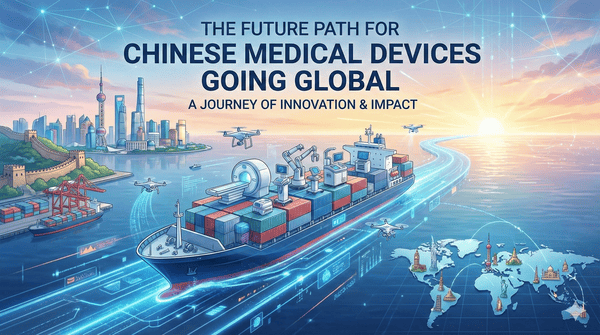
I’ve seen too many factories turn “going global” into a price race. But the ones who last are the ones willing to make things more expensive, harder, and slower. Going global is not about shipping products overseas. It’s about keeping the brand alive.
2 a.m.
I’m standing at the warehouse gate, waiting for the truck.
My phone won’t stop buzzing:
the client is pushing the delivery date,
the forwarder wants to change the port,
and the compliance documents got rejected again.
The most painful line is:
“Can you go cheaper? The next supplier quoted lower.”
In that moment, I realized something:
people think the hardest part of going global is MDR, certifications, and registrations.
But I’ve watched plenty of projects die for a much simpler reason:
you turned going global into a price war.
What’s even more counterintuitive is this—
「The real opportunity isn’t in being cheaper. It’s in daring to be more expensive.」
Sounds controversial?
Keep reading. It gets sharper.
1. Don’t rush to “sell overseas” — first decide who you really are
What did we sell before?
Gloves, masks, basic consumables.
Easy to scale.
Fast cash flow.
And what are we selling now?
CT systems, surgical devices, surgical-robot-related equipment, surgical lights, operating tables, OR pendants…
And you’ll notice something: buyers ask less about “How much?”
and more about:
Can you supply long term?
How does after-sales work?
If it breaks, who fixes it?
Do you have local cases?
Once you enter the deep water, buyers are not buying one machine.
They’re buying peace of mind.
「Premium is not stacking specs. It’s taking risk off the customer’s shoulders.」
2. Regulations aren’t a wall — they’re a “sieve”
A lot of people hear “MDR” and immediately panic.
“Too complicated.”
“Too expensive.”
“Too slow.”
All true.
But here’s a different angle:
high standards like MDR are essentially cleaning the market for you.
If you do the documentation, validation, and systems properly,
you will be slower,
and you will be more expensive.
But that’s exactly why low-end competitors can’t get in.
They can only fight in grey zones and compete on price.
And in the end, nobody makes money.
Once you pass that gate, what you gain is not an order.
It’s entry qualification.
「Regulations are not there to stop you from earning. They’re there to stop others from entering and taking your margin.」
3. Distributors don’t fear you being expensive — they fear you being “replaceable”
When people talk about channels, one word pops up: distribution.
But channels are never just about “who sells your product.”
The real question is:
why can’t the customer live without you?
If you only sell equipment, it’s easiest for the channel:
sell you today, switch tomorrow.
Because everything is “similar enough.”
That’s why mature players build a closed loop:
equipment + consumables + maintenance + training + spare parts.
Not to “tie up” customers.
But to reduce substitution.
When you complete the value chain, channels are willing to bet long term.
「A channel is not someone who helps you sell. A channel is someone who helps you resist being replaced.」
4. Trust isn’t “talked into existence” — it’s spoken for you by locals
I’ve seen teams start going global like this:
build a website,
run ads,
shoot fancy videos.
All important.
But in medical devices, the trust path is more realistic:
What do local doctors say?
Do local engineers dare to take your maintenance jobs?
Will local KOLs attach their names to your case studies?
So the most effective play is often very “un-glamorous”:
find a battle-tested local veteran.
Someone who understands the process,
handles communication,
and resolves disputes.
One more detail people underestimate:
emerging markets care more about durability.
Not how flashy you look.
But whether you can survive unstable voltage, rough transport, and delayed maintenance.
「Trust isn’t you saying you’re good. It’s locals being willing to vouch for you.」
5. The final winning edge: service system + industrial aesthetics
When everyone can deliver “similar specs,” two things create distance.
First: service system.
Do you have a clear spare-parts strategy?
Do you provide remote support?
Do you offer response-time commitments?
Do you have a training system?
Second: industrial aesthetics.
Don’t underestimate “looks” and “usability.”
Doctors use it every day.
Nurses wipe it every day.
Engineers open it up every day.
One button in the wrong place gets complaints for a year.
One gap that’s hard to clean triggers infection-control concerns.
You are building medical equipment.
Not a booth prop for photos.
「A premium brand is built on details that genuinely take care of people.」
【Twist / Peak】You think you’re selling equipment — but you’re selling “certainty”
Many failures aren’t because the product is bad.
They fail because they keep gambling:
gambling customers won’t return it,
gambling regulations won’t block it,
gambling after-sales won’t explode,
gambling the market will keep giving chances.
But overseas markets don’t buy “gambles.”
They buy systems.
When you use compliance, service, systems, and real cases to reduce customer risk,
you no longer need low prices to buy trust.
「Price can buy one deal. Systems earn long-term business.」
【Ending】
The future of China’s medical devices going global won’t be a contest of “who can quote better.”
It’s an endurance race:
who dares to invest,
who dares to make it hard,
who can build trust overseas.
If I had to sum it up in one line:
「Going global isn’t shipping products abroad. It’s becoming a brand that deserves to be chosen long term.」
If this helped, tap “Like” and “In-View.”
What is the biggest bottleneck in your going-global journey right now—regulations, channels, or trust?
Tell me in the comments.