C-Arm Access Problems? The OR Table Is Often the Real Cause
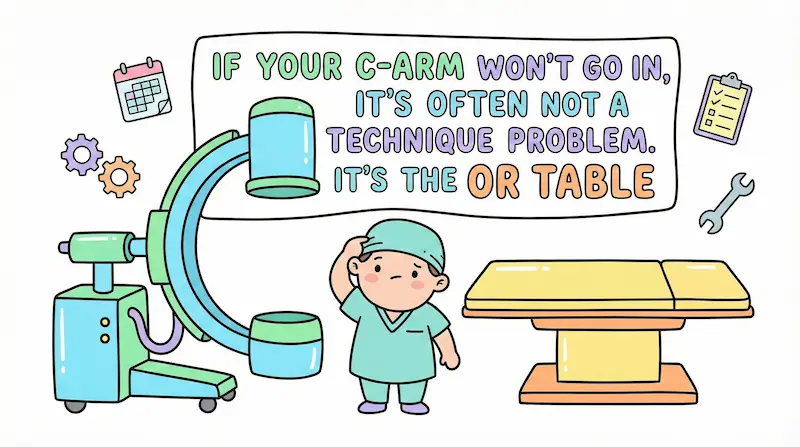
I once witnessed an awkward moment in the OR: the C-arm stopped halfway, the image couldn’t fully cover the target area, and the team kept repositioning the equipment. Later I realized the issue is often not the C-arm itself, but the operating table’s longitudinal translation range and tabletop material. This article explains why carbon fiber tabletops are a better match for C-arms.
It was an orthopedic case.
Lights were set.
Anesthesia was stable.
The moment the C-arm rolled in, it got stuck.
Not because the floor was uneven.
Not because the machine was old.
It was simply “almost there,” but never quite there.
The surgeon frowned slightly and said, quietly:
“One more time.”
My first thought was:
Did we position the patient incorrectly?
Later, I learned a more counterintuitive truth:
「When C-arms don’t work smoothly, it’s often not a people problem. It’s that the operating table doesn’t provide enough space.」
1. What C-arms fear most is not complexity, but “locked space”
On site, you often see a chain reaction:
First, the C-arm can’t reach the ideal position, so you “shoot at an angle.”
You get something, but it’s not optimal.
Second, incomplete coverage means repeated adjustments.
Each adjustment extends the procedure time.
Third, once the rhythm breaks, everyone feels the pressure.
Surgeons want results.
Nurses want safety.
Purchasing needs an answer: why is the C-arm “still hard to use”?
What’s most often overlooked are two hard metrics of the OR table:
- How much longitudinal translation (front-to-back travel) the tabletop supports
- How radiolucent the tabletop material is for X-ray imaging
「C-arm image quality is often decided halfway earlier, at the moment you ask: can it smoothly get into position?」
2. Why “long travel translation” matters more than you think
Many people assume C-arm performance is mainly about the C-arm itself.
But in an OR, the C-arm is more like a passive camera operator.
Whether it can stand in the right spot depends on whether the “stage” makes room.
If the table’s translation range is limited, what happens?
- You try to bring the target anatomy into the best imaging window
- The tabletop cannot move far enough
- So you compensate by swinging the C-arm, shifting the equipment, or forcing angles
That’s not a skill issue.
That’s a structural limitation.
Long travel translation delivers very practical benefits:
- The target area enters the C-arm’s usable range more easily
- Less trial-and-error pushing and repositioning
- Less time loss caused by repeated moves
Surgeons care most about this:
Faster imaging alignment.
A smoother workflow.
Purchasing cares most about this:
Better performance with the same C-arm.
Fewer complaints from the department.
Higher utilization of expensive imaging equipment.
「Long travel translation is not a nice-to-have. It unlocks a workflow that would otherwise keep getting stuck.」
3. The value of carbon fiber is not just “radiolucency.” It’s “less hassle.”
When purchasing first hears “carbon fiber tabletop,” the questions are usually:
Is it more premium?
Is it more expensive?
Is it worth it?
Bring it back to the OR, and the answer becomes clearer.
If the tabletop is not sufficiently radiolucent, you often see:
- Suboptimal contrast
- Edges that look less crisp
- Surgeons asking for another angle, another position, another shot
And it leads right back to:
“One more time.”
Why carbon fiber works better with a C-arm is straightforward:
- More X-ray friendly, less imaging interference
- Cleaner images, fewer repeats
- Combined with table translation, faster and more accurate positioning
It is not just “better specs.”
It is “a smoother process.”
「What truly costs money is rarely the purchase price. It’s the repeated attempts, the waiting, and the explanations.」
4. One practical checklist question for surgeons, and one for purchasing
If you are a surgeon, ask this directly when evaluating a table:
“With common orthopedic/trauma cases, can the C-arm reach position smoothly? How many repositioning attempts are typically needed?”
You are not looking for a brochure.
You are looking for real workflow smoothness.
If you are in purchasing, reframe the question like this:
“Is our C-arm workflow problem truly a C-arm issue, or is the operating table limiting it?”
Many budget debates end with a surprising conclusion:
The C-arm was not the problem.
The supporting setup was.
What impressed me most was one hospital, the same C-arm model.
After switching to a carbon fiber tabletop and a table with longer translation travel, the change was obvious:
Easier to push in.
Faster to align.
More stable imaging.
Less talking in the room.
Not because the team suddenly became more professional.
But because the workflow no longer required brute force.
「The most frustrating kind of mismatch is not “far off.” It’s being “just a little off,” every single time.」
Maximizing C-arm operating space comes down to two things:
- A sufficiently long translation range to open up the usable imaging window
- A carbon fiber tabletop that supports cleaner imaging and easier positioning
If your team has experienced any of these—
the C-arm won’t go in, coverage is incomplete, repeated adjustments, a dragged rhythm—
share the most common sticking point in the comments.
If you found this useful, tap “Like” and “In Favor.”
If you want to check which carbon fiber table configuration fits your current C-arm model (translation travel, tabletop size, typical cases), leave a comment or message me your requirements. I can share a more specific recommendation and pricing direction.
「An operating table is not just something the patient lies on. It determines whether a surgery can run smoothly.」