
Basket Stretcher Materials: Why Choice Matters in Helicopter Rescue
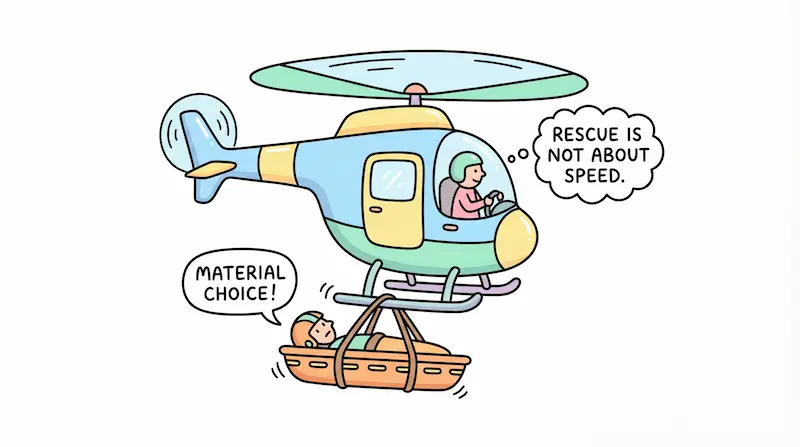
In helicopter and water rescue, stretcher material is not a spec-sheet detail. It can decide whether the system still works under saltwater, impact, dragging, and cold. ABS/composites and steel each win in different environments.
we still remember that mission.
As the rotor wash pushed down, spray slapped my face.
The moment the stretcher touched the ground, seawater rushed into every gap.
I kept staring at one thing: the buckles, the welds, the joints.
Because I’ve seen the most humiliating failure:
the patient was secured, but the stretcher gave up first—under “saltwater + impact + dragging.”
Here’s the counterintuitive part.
When most people choose a stretcher, they ask about load capacity first.
But in helicopter and water rescue, load capacity is rarely the first killer.
「What decides success is whether the material can still function normally in harsh environments.」
Field rescue is not gentle.
Mud gets into structures.
Rocks hit the frame.
Seawater corrodes metal parts.
Cold makes materials brittle.
You think it’s a simple carry.
In reality, it’s dragging, knocking, dropping, soaking, and swinging.
And every jolt transfers to the patient.
So the real question is not “which material is more premium.”
It’s “which material is more reliable in your scenario.”
【Main Part 1】
First, define the scenario: what helicopter + water rescue actually tests
I’ve boiled it down to three kinds of “invisible punishment”:
- Salt spray and seawater
Corrosion is continuous.
It’s not a one-time soak. It’s repeated wetting and drying.
- Impact and dragging
Onboard, ashore, over rocks, across rails.
The stretcher edges take the hits.
- Weight and operational stress
At the helicopter door, those few seconds matter.
More weight means harder coordination and higher risk.
That’s why “ABS vs. steel” is such a heated debate.
They are optimized for different kinds of reliability.
「Material selection is not about who is stronger. It’s about who stays dependable in your conditions.」
【Main Part 2】
If your basket stretcher is ABS/plastic or composite: this is how you sell it
When buyers hear “plastic,” the first reaction is often: less durable.
But for water rescue, plastic/composites have a brutally practical advantage:
corrosion resistance.
In salt environments, corrosion is not just visible rust.
It starts quietly in fasteners, joints, and seams.
The scariest part is how slowly it shows up.
By the time you notice, it might be on a mission.
If your product is ABS or plastic/carbon-fiber composite, focus on three points:
- Corrosion resistance for coastal, lake, rainforest, and humid-hot environments
Explain it as lower maintenance burden and more stable long-term performance.
- Lightweight for faster, safer helicopter loading
Not to “save effort,” but to reduce steps, reduce exposure time, and reduce mistakes.
- Easier cleaning and disinfection
Water rescues often involve oil, sand, and blood.
Surface treatment and cleanability directly affect turnaround time.
A simple line works well:
「Plastic isn’t weaker. It’s less afraid of water, salt, and repeated punishment.」
But I have to say something that might upset people:
If your missions often involve hard, repeated impacts—
rocky terrain, tight stairwells, industrial fall rescues—
then “lighter” is not always better.
What you need is:
to take hits without deforming,
to keep structure true under shock,
to keep critical joints from loosening.
That is the logic behind steel.
If your basket stretcher is metal (steel): this is how you sell it
Steel’s real value is not “it looks tougher.”
It’s impact resistance and structural stability.
In scenarios with frequent lifting, dragging, and collisions,
steel gives teams confidence.
Don’t just say “strong.”
Describe the actions that happen in the field:
- The frame takes a hit on steps and is less likely to crack
- Dragging over obstacles is less likely to twist the structure
- Load points stay stable, reducing swing and lowering the risk of secondary injury
Then lock it in with one sentence:
「In real rescues, steel means you can pull hard—and still trust the stretcher.」
So ABS vs. steel is not about which is “better.”
It’s about who you are rescuing, where you are rescuing, and how you are rescuing.
For water, coastal, and humid environments, corrosion resistance and low weight often matter more—ABS/composites tend to win.
For rugged ground, frequent impact, and heavy dragging, impact resistance and structural stability matter more—steel often wins.
Explaining material clearly is not marketing fluff.
It is risk management for procurement.
And it prevents “mission-site failure” for rescue teams.
One line I always keep in mind:
「Rescue equipment is not bought to look good. It’s bought to still work when conditions are at their worst.」
If this helped, tap “Like” and tell me in the comments: is your basket stretcher mainly used in “water/humid” missions or “hard-ground/impact” missions? Next time, let’s talk about “lifting point design—why two stretchers that look similar can perform very differently.”
Equip Your Rescue Team: Browse our complete stretcher catalog — basket, scoop, and ambulance models. Also see our transport monitors for in-transit patient monitoring.