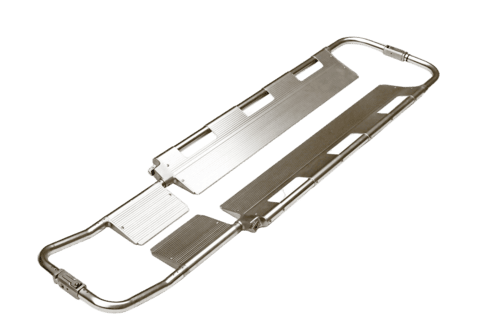
I’ve always thought the scoop stretcher is one of those devices that doesn’t get enough credit. You don’t think about it until you need it. And when you need it — when you’ve got a patient on the ground with a suspected spinal injury and every movement carries risk — the difference between a good scoop stretcher and a marginal one becomes very real, very fast.
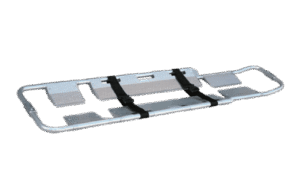
The AM-SC003 is stainless steel, and I want to be specific about why that matters. Most scoop stretchers on the market are aluminum. Aluminum is lighter — that’s the argument for it. But aluminum flexes under load, especially when you’re lifting a heavier patient at the midpoint where the two halves connect. Flex equals movement. Movement equals risk to an unstable spine. Stainless steel is stiffer. Heavier, yes — the SC003 is 8 kilograms net versus maybe 5 or 6 for an aluminum equivalent — but those extra kilos buy you structural rigidity that directly translates to patient stability during the lift. In spinal immobilization, rigidity isn’t optional.
The mechanism is straightforward. The stretcher splits longitudinally into two halves. You slide each half under the patient from either side — no log-rolling, no lifting, no twisting. The clutch hinges at both ends lock the two halves together, and you lift the patient as a unit onto a long spine board or directly onto a transport stretcher. The length adjusts to the patient’s height, which matters because a scoop that’s too short leaves the head or feet unsupported, and a scoop that’s too long is unwieldy in tight spaces.
The narrow-frame design at the foot end is a detail I appreciate — it lets the operator stand closer to the patient during the lift, which gives you better leverage and control. At the head end, the wider frame gives the second operator room to manage the cervical spine and communicate with the patient. These ergonomic details aren’t in the spec sheet, but they’re the things you notice after your tenth lift of the shift.
Model Comparison
| Specification | AM-SC001 | AM-SC003 | AM-SC005 |
|---|---|---|---|
| Material | Aluminum alloy | Stainless steel | — |
| Expanded size | 167×43.5×7 cm | 168×44×8 cm | 167×43×6 cm |
| Folding size | 120×44×8 cm | 120×44×9 cm | 120×43×9 cm |
| Load limit | 180 kg | 180 kg | — |
| Net weight | 7.5 kg | 8 kg | 9 kg |
| Special | Split-type rigid, no patient lifting | Split-type rigid | Split-type rigid |
We designed this for ambulance services, hospital emergency departments, and any setting where spinal precautions are protocol. The stainless steel surface is fully cleanable with standard disinfectants, no corrosion issues, no pitting. The SC003 folds to 120 by 44 by 9 centimeters for storage, and it’s rated for 180 kilograms. That covers the clinical reality — and in bariatric cases, pair it with a heavy-duty spine board. For pre-hospital spinal immobilization where you need to get the patient off the ground without rolling them, this is the tool I reach for.
Frequently Asked Questions
What specifications should I review for this model?
Key specifications including dimensions, capacity, power requirement and material composition are provided in the model datasheet. Contact us with your project requirements for the complete specification sheet.
What documents are available for import?
Datasheet, user manual, packing information and applicable conformity documents are confirmed per destination market. Registration requirements vary by country and are reviewed project by project.
Can I request a sample or reference installation?
Sample availability and reference installation details are confirmed based on the product category and order volume. Contact us with your specific requirements.