
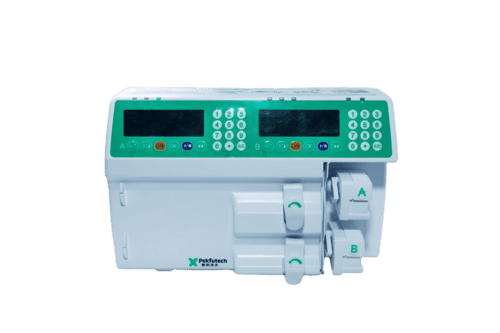
One of our early vet clinic customers in Brazil told me something that stuck: “The difference between a human syringe pump and a vet syringe pump is that animals don’t stay still.” He was running an ICU for exotics — parrots, rabbits, a rescued sloth — and he needed pumps that wouldn’t alarm-out every time the patient twitched. Human pumps are calibrated for adult patients lying quietly in a hospital bed with an IV line taped securely to a stationary arm. Veterinary pumps need to handle the reality that a recovering dog might decide to stand up and turn around three times before lying back down, pulling the line with every movement. The SPA112 and SPA122 were designed for that reality.
The SPA series is our veterinary syringe pump platform, available in single-channel (SPA112) and dual-channel (SPA122) configurations. The dual-channel model lets you run two independent infusions simultaneously — useful for anesthesia protocols where you’re delivering both an induction agent and a maintenance drip, or in multi-patient ICU situations where space is tight. The pumps accept standard syringes from five milliliters up to fifty or sixty milliliters, with automatic syringe recognition that identifies the loaded syringe size and adjusts flow parameters accordingly. No manual calibration required between syringe changes, which reduces setup errors when the on-call vet is half-awake at three in the morning and a critical patient needs medication right now.
The safety architecture is where we invested the engineering budget. Each pump runs on dual independent CPUs — two processors cross-checking each other’s calculations for every infusion cycle. If one CPU computes a flow rate and the second CPU disagrees, the pump halts and alarms. This redundancy is the same principle used in human-grade infusion pumps, and we built it into the veterinary line because the consequences of an over-infusion or under-infusion are just as serious whether the patient is human or animal. Accuracy is rated at plus or minus two percent across the full flow range — for a five-milliliter syringe at low flow rates, that’s sub-milliliter precision over an hour of infusion.
Infusion modes cover the clinical scenarios veterinary teams actually encounter: rate mode for straightforward continuous delivery, rate-time mode for scheduled protocols, rate-VTBI mode for volume-targeted infusions, and time-VTBI mode where the duration takes priority over the rate. The cumulative volume display tracks total delivered volume up to nine thousand nine hundred ninety-nine point nine milliliters. KVO — keep vein open — is adjustable from zero point one to five milliliters per hour, keeping the line patent between scheduled boluses without overloading the patient’s fluid balance.
The alarm system covers everything from occlusion and syringe empty to low battery and the subtler syringe displacement detection — when a plunger isn’t seated correctly. The battery runs approximately eight hours on the single-channel SPA112 and four hours on the dual-channel SPA122, covering most power-outage scenarios and intra-hospital transports. The housing is IPX4 rated — protected against splashing water from any direction, a practical consideration in a vet clinic where fluids are constantly handled near active equipment. If you’re running an animal ICU, anesthesia suite, or emergency clinic and need syringe pumps that handle the chaos, the SPA series is built for it. Tell me your typical patient species and I’ll help you decide between single and dual channel.
Frequently Asked Questions
What specifications should I review for this model?
Key specifications including dimensions, capacity, power requirement and material composition are provided in the model datasheet. Contact us with your project requirements for the complete specification sheet.
What documents are available for import?
Datasheet, user manual, packing information and applicable conformity documents are confirmed per destination market. Registration requirements vary by country and are reviewed project by project.
Can I request a sample or reference installation?
Sample availability and reference installation details are confirmed based on the product category and order volume. Contact us with your specific requirements.