
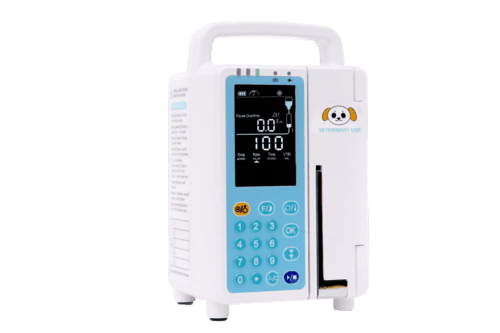
There’s a calculation that every vet does, dozens of times a day, that human nurses almost never have to think about: body weight dose conversion. A human infusion pump assumes a narrow range of adult body weights. A veterinary infusion pump has to handle everything from a two-kilogram cat to an eighty-kilogram mastiff, often within the same shift. The IPA112 was designed around this reality from the start. The built-in body weight dosing mode lets you enter the animal’s weight and the target dose rate, and the pump calculates the flow — no manual math, no decimal-point errors at hour fourteen of an overnight ICU shift.
The IPA112 is our veterinary volumetric infusion pump for IV fluid therapy. Unlike a syringe pump, which pushes a fixed volume from a syringe barrel, a volumetric pump uses a peristaltic mechanism to drive fluid through standard IV administration sets. This means you can hang a liter bag of lactated Ringer’s and the pump will deliver it accurately over the prescribed period, with automatic flow rate calculation and continuous pressure monitoring. It’s the device you reach for when a dehydrated dog needs maintenance fluids over eight hours, or when a post-op patient requires consistent IV support through the night.
The pump supports multiple infusion modes: standard rate mode, time-rate mode for duration-based delivery, volume-rate mode for volume-targeted infusion, and the body weight mode I mentioned. The body weight mode accepts weight in kilograms and dose in milliliters per kilogram per hour, then automatically calculates and maintains the correct flow rate. This eliminates the most common source of dosing errors in veterinary fluid therapy: a tired clinician doing mental arithmetic on a calculator app at two in the morning. The pump handles the math, displays the result, and tracks cumulative volume throughout the infusion.
Compatibility with standard IV sets is deliberate. The IPA112 uses an open system architecture, meaning you’re not locked into proprietary administration sets from a single manufacturer. The pump is calibratable to different set brands, which saves clinics real money over the life of the equipment. In a multi-vet practice where supply chains vary from month to month, being able to use whatever standard IV sets are available in the local market is not a minor convenience — it’s the difference between the pump being usable today and the pump sitting idle while you wait for a shipment of proprietary consumables.
Safety features include real-time dynamic pressure monitoring with automatic occlusion detection — the pump tracks line pressure continuously and alarms on a kinked line, blocked catheter, or infiltration into surrounding tissue. Ultrasonic air-in-line detection is built in: if an air bubble passes through the line, the pump stops and alarms before it reaches the patient. This matters especially for small-animal patients where even a small air embolus can be clinically significant. Audible and visible alarms cover occlusion, air-in-line, door open, infusion complete, low battery, and system malfunction. The pump weighs approximately two kilograms, runs on AC power with an internal battery backup covering eight-plus hours, and has a compact footprint that stacks neatly in an ICU bay alongside syringe pumps and monitoring equipment. If you’re running fluid therapy for dogs, cats, or exotics and you want a pump that understands veterinary dosing logic natively, the IPA112 is the right tool. Send me your typical patient weight range and therapy protocols, and I’ll confirm compatibility.
Frequently Asked Questions
What specifications should I review for this model?
Key specifications including dimensions, capacity, power requirement and material composition are provided in the model datasheet. Contact us with your project requirements for the complete specification sheet.
What documents are available for import?
Datasheet, user manual, packing information and applicable conformity documents are confirmed per destination market. Registration requirements vary by country and are reviewed project by project.
Can I request a sample or reference installation?
Sample availability and reference installation details are confirmed based on the product category and order volume. Contact us with your specific requirements.