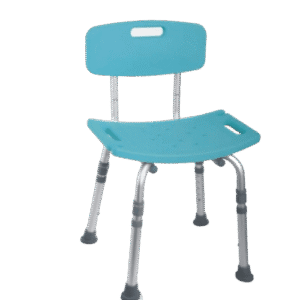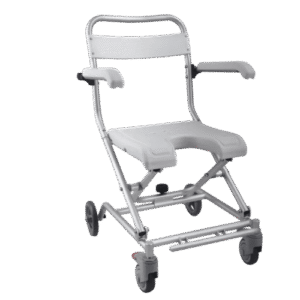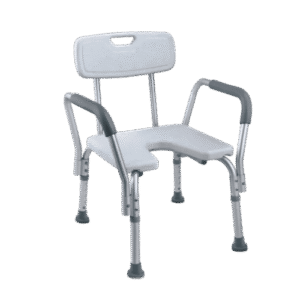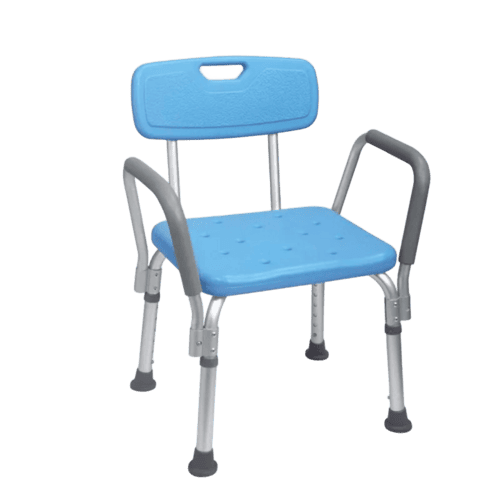
Not every bathroom can accommodate a full-sized shower commode with four casters and a bucket tray. I’ve walked into apartments in Hong Kong and Tokyo where the entire bathroom is smaller than an American walk-in closet — and an elderly resident is still trying to bathe safely in that space. The AM-FS7985LA is the chair I designed for those bathrooms: compact, no wheels, no bucket, just a stable seat with armrests that fits where bigger chairs won’t.
The 7985LA is the most stripped-down chair in our washroom line, and that’s not a weakness — it’s the point. Four fixed aluminum legs with oversized rubber feet. No casters to add width or complexity. No commode bucket to extend the rear profile and catch on narrow doorframes. The assembled footprint is roughly fifty-three by fifty centimeters — about ten centimeters narrower in depth than the wheeled models, which is the difference between fitting through a sixty-centimeter bathroom door and scraping the frame on both sides. In older buildings where doorways weren’t designed with mobility equipment in mind, that clearance is everything.
The seat is a U-shaped HDPE panel with drainage holes — same basic design as our other shower chairs, same anti-slip texture, same removable-for-cleaning construction. It’s not padded, and let me be direct about why: padding on a chair that lives permanently in a wet shower stall is a maintenance liability. Foam absorbs moisture through microscopic cracks in the cover, and once moisture is inside, you’re not drying it out. Unpadded HDPE rinses clean, dries in minutes, and doesn’t harbor anything. For a ten-minute shower, the comfort tradeoff is negligible.
The armrests are padded — that’s where the comfort investment went, because armrests are what the user pushes against to stand up. A hard plastic armrest under wet palms is slippery. A foam-padded armrest with textured PU cover provides grip and reduces the upward force needed to rise. The armrests flip up for lateral transfers. Five-level height adjustment on the legs, spring-loaded pins, no tools. The whole chair weighs about five kilograms assembled — light enough to lift into and out of a bathtub if the shower is a tub-shower combo.
The 7985LA exists because I kept hearing the same thing from distributors in dense urban markets: “Your chairs are great, but they don’t fit in our bathrooms.” A wheelchair-accessible bathroom is a luxury where square footage costs more than medical equipment. The 7985LA is built for the bathroom that wasn’t designed for disability — the compact apartment shower stall, the narrow wet room, the public housing bathroom that measures one-point-five meters by one-point-two. If the chair fits, it works. If it doesn’t fit, it doesn’t matter how many features it has. This is not a commode and not for bariatric users — one hundred kilogram capacity. It’s a washroom chair. One job: keep someone safe while they shower in a small space. Measure your doorway width and send it over.
Frequently Asked Questions
What specifications should I review for this model?
Key specifications including dimensions, capacity, power requirement and material composition are provided in the model datasheet. Contact us with your project requirements for the complete specification sheet.
What documents are available for import?
Datasheet, user manual, packing information and applicable conformity documents are confirmed per destination market. Registration requirements vary by country and are reviewed project by project.
Can I request a sample or reference installation?
Sample availability and reference installation details are confirmed based on the product category and order volume. Contact us with your specific requirements.