OR Trip Hazards: How Ceiling Supply Units Improve Workflow
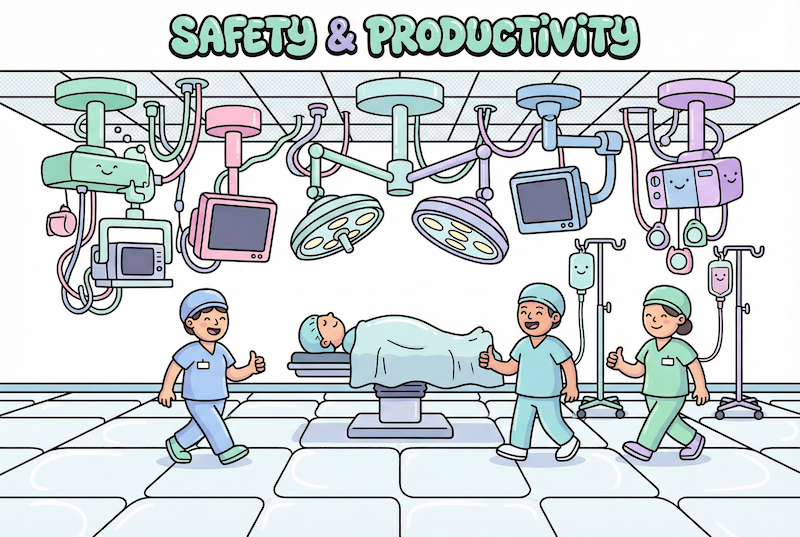
The most underestimated safety risk I have seen in an OR is not equipment failure. It is the mess of cables and hoses on the floor. Nurses pushing carts, circulating, counting instruments, and cleaning are essentially walking through a “hidden minefield.” “Efficiency does not come from people pushing harder. It comes from smarter space design.” A ceiling-mounted supply unit can remove both the risk and the chaos in one move.
The day I stepped into that operating room, I did not look at the equipment first.
I looked at the floor.
Cables for the electrosurgical unit.
Suction tubing.
Monitor leads.
Foot pedals.
It was like an invisible net spread across the ground.
A circulating nurse pushed a cart in, and the wheels caught for a second.
Someone said instinctively:
“Slow down. Watch the cables.”
I froze for a moment.
In an OR, are we really relying on “reminders” to stay safe?
「The root cause of OR efficiency problems is not a lack of professionalism. It is poor space design.」
What You Call “Busy” Often Means You Are Doing Extra Work You Should Not Have to Do
A nurse’s exhaustion does not always come from difficult tasks.
It often comes from pointless repetition.
For example:
The cables get tangled, so you untangle them.
A cart passes by, so you take a detour.
The floor needs cleaning, so you lift a bundle of lines first.
A device needs repositioning, so you confirm which cable belongs to which machine.
None of this shows up in the surgical record.
But it quietly drains energy and patience.
For biomedical and equipment teams, it is the same story.
A fault may be minor, but troubleshooting on-site becomes painfully slow when everything is intertwined.
Time is wasted on finding cables, sorting cables, and stepping around cables.
「Being busy is not about workload. It is about friction hidden inside the workflow.」
The Real Risk of Floor Cables Is Not Just “Tripping”
Everyone knows cables on the floor can cause trips.
But the bigger issue is the chain reaction that follows.
1) Narrowed pathways
Moving an anesthesia machine or instrument trolley turns into “avoiding hazards.”
When things get urgent, mistakes become more likely.
2) Harder cleaning
Mopping, disinfection, and cable handling become awkward and inconsistent.
It is not that people do not want to clean well.
It is that the environment makes “clean and fast” almost impossible.
3) More connecting and unplugging
More cables often mean more ports, adapters, and manual handling.
The more manual steps, the higher the chance of human error.
4) Chaos during emergencies
On normal days, it feels manageable.
But when a rapid setup is needed, when positioning changes quickly, or during resuscitation,
floor lines are usually the first thing to spiral out of control.
「Most safety hazards are not sudden. They are always there. People just get used to them.」
A Ceiling Supply Unit Is Not “Fancy.” It Solves a Structural Problem
When people first hear “ceiling supply unit,” they often think it is a premium upgrade.
Something that looks more advanced.
In real clinical work, it is closer to a tool for restoring order.
It reorganizes what used to be scattered across the floor into a rational work zone.
The logic is simple:
Bring power outlets, medical gas terminals, network ports, and equipment mounting into the overhead workspace.
Then the floor clears up.
Traffic flow becomes smoother.
Nurse movement becomes predictable.
Equipment maintenance becomes true maintenance, not on-the-spot firefighting.
「It is not that people become better. The environment finally stops holding them back.」
More Concrete: How a Ceiling Supply Unit Helps Circulating Nurses “Walk Less and Do More”
Let me break it down into small, familiar moments.
1) Smoother cart movement
Instrument carts and other mobile equipment move more freely around the anesthesia area.
One less detour means one less collision risk.
2) Clearer connections and handoffs
Common outlets and terminals are consolidated on the supply unit’s work surface.
No more crouching behind machines to find a socket.
No more repeatedly checking “which cable is for which device.”
3) Easier floor cleaning
Cleaning staff no longer need to lift and weave around bundles of lines.
Mopping and disinfection become continuous actions.
It becomes easier to maintain stable hygiene standards.
4) Faster response in urgent moments
When an extra device is needed, the connection points are right in front of you.
No more digging through a “cable mountain” on the floor.
In emergencies, every second matters, and these seconds add up.
「OR efficiency often improves when small hassles are eliminated at the source.」
What Equipment Teams Care About Most: Maintainability and Control
For biomedical and equipment departments, the value is not only “tidiness.”
It is control.
- Standardized terminal positions reduce improvised wiring
- Cleaner routing makes faults easier to locate
- Less pulling, crushing, and wear reduces hidden failures
- A more standardized layout makes onboarding and handover easier
What makes maintenance hardest?
An uncontrolled environment.
Today it is arranged one way, tomorrow another way.
Every visit feels like opening a mystery box.
A ceiling supply unit helps turn a “mystery box” into a standardized system.
「The more equipment you add, the more you need system thinking to manage complexity.」
The Turning Point: You Think You Are “Improving Nursing Performance,” but You Are Actually Burning Nursing Value
Many ORs handle efficiency pressure by pushing people harder:
Be more skilled.
Be faster.
Be more careful.
But the truth is:
Nurses are already professional.
What slows the OR down is the friction people should never have to carry.
When a nurse’s attention is consumed by untangling cables and avoiding hazards,
the true value of nursing is diluted.
A ceiling supply unit is not about making work “easier” in a lazy sense.
It is about giving time back to nursing.
And giving attention back to the patient.
「The best management is letting professionals focus on professional work.」
If you ask me where OR burden reduction should start,
I would say: start with the floor.
Move the cables off the ground.
Give the pathways back to people.
Give order back to the workflow.
「Efficiency is not forcing people to the limit. It is designing the system to run smoothly.」
If you have ever been tortured by floor cables in an OR,
what was the most outrageous situation you experienced?
If this was helpful, tap “Like” and “In Preview/Reading”, and leave a comment with your story.
Next time, I will share: how to configure ceiling supply units to truly match different OR workflows.