7 the Best LED Surgical Lights for Modern Clinics: 2026 Buying Guide
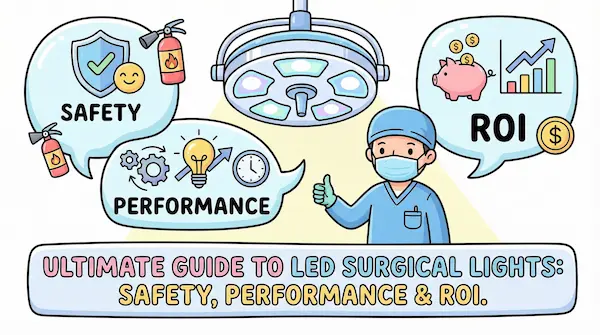
LED surgical lights is not “just brightness.” It is a risk-control tool for visibility, accuracy, and workflow. This guide explains why LED outperforms halogen, what Color Temperature and CRI really mean, and how to think about ROI when buying.
The first time I truly noticed a surgical light was not during a product demo.
It was in a live case.
The room was quiet.
The surgeon asked for more light.
Then less.
Then a tiny adjustment to the angle.
And I remember thinking: why does a “lamp” need this much attention?
Here is the controversial part.
「In many ORs, the surgical light is treated like a commodity, but it behaves like a clinical instrument.」
When visibility is unstable, everything feels harder.
When visibility is consistent, the whole team works smoother.
Most people buy surgical lights the same way they buy office lighting.
They compare price, look at lux, and move on.
But the OR does not forgive “almost good.”
Small compromises show up as fatigue, delays, and repeated adjustments.
And those costs are rarely written on the invoice.
If you are evaluating LED surgical lights for a hospital, ASC, or distributor channel, the question is not “How bright is it?”
The question is “How reliably can it deliver clarity, hour after hour, case after case?”
Why LED Beats Halogen (and Why That Matters in Real Cases)】
Let’s start simple.
Halogen can look bright.
But brightness is only one piece of surgical visibility.
LED surgical lights are often preferred because they improve three practical outcomes:
Medical Lighting Standards & Safety” When selecting surgical lighting, it is crucial to adhere to international safety protocols. According to the International Electrotechnical Commission (IEC), specifically the IEC 60601-2-41 standard, LED surgical lights must meet strict requirements for illumination intensity, shadow dilution, and heat management to ensure patient safety during complex procedures. At Ascendid Med, our products are designed to align with these global benchmarks.
1) Cooler light, more stable comfort
High heat around the surgical field is distracting.
It can affect team comfort and can increase the need for frequent repositioning.
Modern LEDs are designed to deliver strong illumination while reducing radiant heat toward the field.
In real workflow terms, this means fewer “micro-interruptions” caused by discomfort and constant tweaking.
2) Better shadow control, fewer “visibility drops”
In surgery, hands, instruments, and heads will block light.
That is normal.
What matters is how the light compensates.
Quality LED surgical lights use multi-LED arrays, optical design, and overlapping beams to reduce shadow impact, so the field stays readable when the team moves.
「Shadowless is not a marketing word. It is what keeps your focus from breaking.」
3) Energy efficiency that adds up
LED systems generally consume less power than older halogen setups for comparable illumination performance.
Energy savings alone may not justify an upgrade.
But combined with reduced maintenance and better workflow stability, it becomes part of a real ROI story.
The Two Specs That Decide “True Visibility” — Color Temperature and CRI】
Many buyers stop at lux.
But lux is not the full picture.
Two specifications strongly influence how tissues, vessels, and subtle color differences look in real life:
What is Color Temperature?
Color Temperature is measured in Kelvin (K).
It describes whether the light appears warmer (more yellow) or cooler (more white/blue).
In the OR, Color Temperature affects how the surgical field “reads” to the eye.
Too warm can reduce perceived contrast.
Too cool can feel harsh and may not match the team’s preference.
A practical approach: choose a range that supports different specialties and user habits, ideally with adjustability.
Because the “right” Color Temperature is not universal.
「Good lighting is not about one perfect setting. It is about giving the team control without breaking consistency.」
What is CRI (Color Rendering Index)?
CRI measures how accurately a light source reveals colors compared to a reference standard.
In surgical environments, higher CRI supports more natural tissue appearance and can help with visual differentiation.
This can reduce hesitation and repeated “double-checking” moments.
The key is not chasing a single number.
The key is selecting a system built for accurate, stable color rendering over time.
If you want an easy internal rule:
Lux helps you see.
CRI helps you see correctly.
【Body Part 3: Safety, Performance, and ROI — A Clear Buying Mindset】
When procurement teams talk about ROI, they often look only at purchase price.
That is understandable.
But OR ROI is typically driven by three “quiet” factors:
1) Reduced interruptions
Every time the light is repositioned, refocused, or adjusted because shadows appear, the flow slows down.
Even if each adjustment is short, it creates cumulative friction.
2) Lower maintenance burden
Halogen systems rely on bulbs that require scheduled replacement and can fail unexpectedly.
LED systems are typically designed for longer operational life, which can reduce downtime planning and spare part logistics.
3) Better consistency across rooms
If rooms deliver different visibility experiences, teams adapt by habit, not by standard.
Standardization helps training, staffing flexibility, and quality perception.
「In the OR, consistency is not comfort. Consistency is safety.」
【FAQ】
How long do surgical LED lights last?
High-quality surgical LED lights are designed for long service life, often measured in tens of thousands of hours.
Actual lifetime depends on design, thermal management, usage patterns, and maintenance environment.
When evaluating suppliers, do not only ask for a lifespan claim.
Ask what supports it: heat control design, power supply stability, and service policy.
What is the best lux for LED surgical light?
There is no single “best lux” for every facility and specialty.
Different procedures, working distances, and team preferences change what “enough” means.
Many surgical lights support adjustable illumination, allowing clinicians to match brightness to the case and reduce glare.
A practical buyer mindset: prioritize adjustable range, uniformity, and shadow management rather than chasing the highest peak lux number.
「Peak brightness impresses in a brochure. Stable visibility wins in a real case.」
Here is the twist I wish more people heard earlier:
You are not buying a light to make the room brighter.
You are buying a light to make decisions easier.
That is why LED is not just an “upgrade.”
It is a visibility system that supports safety, performance, and predictable outcomes for operation room ,
And that is why two hospitals can buy lights with similar lux numbers and get very different results.
Because the real difference is not the headline spec.
It is how the light behaves when the team moves, when shadows appear, and when hours pass.
「A surgical light is not a cost item. It is a risk-control investment disguised as equipment.」
not only for led surgical lights ,but also for operation table
and ventilator
If you remember one thing from this guide, make it this:
Choose LED surgical lights for consistent visibility, not for a single impressive number.
Look at shadow control, Color Temperature options, CRI, maintenance logic, and how the system supports long-term workflow.
「The best OR lighting is the kind you stop noticing—because it simply works.」
Get a Wholesale Quote for Our CE Certified LED Surgical Lights.
If this was helpful, tap “Like” and leave a comment: what matters most in your facility—shadow control, CRI, adjustability, or maintenance cost? Next time, we will discuss how to choose the right configuration for different OR sizes and specialties.