
How Much Does It Really Cost to Set Up an Operating Room? A 2026 Budget Breakdown
Honestly, I’ve gone back and forth on whether to write this.
Because any article with dollar signs in the title starts to look like a price list. And that’s not what this is. But then I thought about it differently — in fifteen years of doing this, almost every hospital that’s ever reached out to me has asked the same question. Not “how much is the surgical light.” Not “what’s your best price on an anesthesia machine.”
Key Stats at a Glance
| General Surgery OR Setup | $80,000 – $130,000 |
| Orthopedic OR Setup | $120,000 – $180,000 |
| Neurosurgery OR Setup | $150,000 – $220,000+ |
| Surgical Light Range | $2,500 – $25,000 |
| Operating Table Range | $5,000 – $40,000 |
| Equipment Categories Covered | 8 major systems |
They ask: how much money do I actually need to open an OR?
And I get why. When you’re a hospital administrator in Manila or Nairobi or Dhaka, you’re not buying one piece of equipment. You’re trying to make a room that saves lives. The budget isn’t a line item. It’s the difference between doing eight surgeries a day and doing zero.
So here’s what I know. Not from a spreadsheet. From watching projects land smoothly and watching them blow up. Same mistakes, different countries, for fifteen years.
First, what kind of OR are we talking about?
You’d be surprised how many people skip this question.
A general surgery OR is not an orthopedic OR. An orthopedic OR is not a neurosurgery hybrid room. The equipment changes. The infrastructure changes. And the budget — the budget changes dramatically.
I’ve boiled it down to three tiers, based on what I’ve actually seen hospitals pay when they buy FOB from mid-to-high-tier Chinese manufacturers — ISO 13485, CE-marked, the real stuff:
| OR Type | Equipment (FOB China) | Total project (installed) |
|---|---|---|
| General Surgery | $15,000 – $30,000 | $40,000 – $70,000 |
| Orthopedic | $28,000 – $55,000 | $65,000 – $130,000 |
| Neurosurgery / Hybrid | $40,000 – $100,000+ | $100,000 – $250,000+ |
These numbers assume the room has walls and a floor and basic electrical. If you’re starting from bare concrete, add 30–50%. That’s not padding. That’s civil works, HVAC, and laminar flow engineering.
Now let’s look at each one. Because the mistakes people make are different at each tier.
General surgery OR: the one most hospitals start with
I always tell people: a general surgery OR handles about 70% of what a district hospital actually does. Abdominals. C-sections. Basic laparoscopy. ENT. You don’t need the most expensive table on the market. You don’t need the brightest light ever made. What you need is stuff that works every single day and doesn’t give you surprises.
Here’s the actual equipment list, with real FOB China price ranges — these are based on our own factory pricing:
| Equipment | What to look for | FOB China |
|---|---|---|
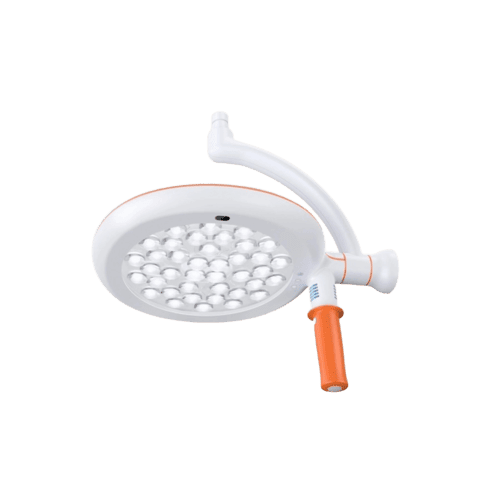
| Surgical light (LED dual-head) | ≥ 100,000 lux, adjustable color temp, shadow dilution ≥ 90% | $3,000 – $6,000 |
| Operating table (electro-hydraulic) | ≥ 250 kg load, Trendelenburg ±25°, longitudinal slide | $2,500 – $4,500 |
| Anesthesia machine (mid-range) | ≥ 3 gases, volume + pressure modes, CO₂ absorber | $4,500 – $9,000 |
| Ceiling pendant (single-arm) | Gas + power + data, ≥ 150 kg per arm | $1,000 – $1,500 |
| Patient monitor (5-param) | ECG, NIBP, SpO₂, TEMP, ETCO₂ sidestream | $1,000 – $2,000 |
| Electrosurgical unit | Cut + coag, ≥ 300W, monopolar + bipolar | $600 – $1,500 |
| Surgical suction | ≥ 40 L/min, dual bottle, oil-free | $300 – $850 |
| Defibrillator | Biphasic, AED mode, pacing option | $1,500 – $3,500 |
| Instrument trolley (×2) | SS304, ≥ 60×45 cm tray | $180 – $350 each |
| Mayo stand | Height adjustable, removable tray | $100 – $250 |
| IV pole (×2) | 4-hook, 5-caster | $50 – $100 each |
| Operating stool (×2) | Pneumatic height, conductive casters | $80 – $200 each |
| Subtotal | $15,000 – $30,000 |

The anesthesia machine is where the range really stretches. A basic two-gas unit for C-sections sits at the low end. Add precise tidal volume control and agent monitoring for laparoscopic work, you’re in the middle. AIMS integration and advanced ventilation modes push you to the top. Same machine category, very different price.
Orthopedic OR: one decision that costs more than everything else
I’ve seen this mistake so many times I can spot it before the purchase order is even written.
A hospital buys a general surgery table — nice one, electro-hydraulic, all the features. Then they try to do spine cases on it with a C-arm. And the surgeon can’t see the screw placement because the steel frame is scattering the image. So they reposition. And reposition again. An hour per case, gone.
They saved maybe $3,000 on the table. They’re losing $500 an hour in OR time. The math doesn’t math.
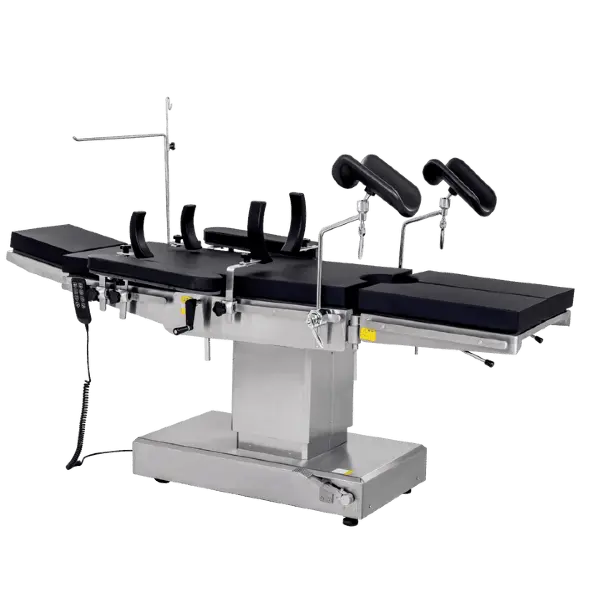
Here’s what an orthopedic OR actually needs that a general OR doesn’t:
| Equipment | What changes | FOB China |
|---|---|---|
| Operating table | Carbon fiber top, ≥ 300 kg, full radiolucency, traction capability | $6,000 – $12,500 |
| Surgical light | Dual-head works; add satellite for deep cavity | $3,500 – $7,000 |
| C-arm | Usually separate procurement; budget $25k–$60k | (separate) |
| Arthroscopy tower | Camera + light source + shaver + fluid management | $8,500 – $18,000 |
| Pendant (dual-arm) | Second arm for imaging cables and monitors | $2,500 – $3,500 |
| Anesthesia machine | Mainstream EtCO₂ preferred for prone cases | $7,000 – $13,000 |
| Subtotal | $28,000 – $55,000 |
The orthopedic table isn’t a luxury upgrade. It’s a clinical requirement. If you’re doing joints, spine, or trauma, you need carbon fiber. You need traction attachments. You need independent leg positioning. Buy the right table the first time, or spend twice as much fixing it later.
Neurosurgery / hybrid OR: the tier where you can’t wing it
I’ll be honest — this one is hard to give a clean number for. A neuro OR often pulls double duty as a hybrid room for vascular and endovascular work. The equipment list grows fast. And it’s not really a “shopping list” kind of project. You need a clinical engineering team involved from day one.
But here’s what the equipment picture looks like, for the parts that Chinese manufacturers actually supply well:
| Equipment | Key requirement | FOB China |
|---|---|---|
| Surgical light (dual + satellite) | ≥ 160,000 lux, deep-cavity, HD camera integration | $5,000 – $15,000 |
| Operating table (neuro-specific) | Full carbon, head fixation, ≥ 350 kg, micro-positioning | $10,000 – $20,000 |
| Surgical microscope | Zeiss/Leica typically; not in-scope for China sourcing | (OEM) |
| Anesthesia machine (high-end) | Advanced ventilation, agent monitoring, AIMS, low-flow | $10,000 – $20,000 |
| Pendant (dual + monitor arm) | Heavy-duty, ≥ 200 kg per arm, full cable management | $2,500 – $3,500 |
| Patient monitor (12-param) | ECG, NIBP, IBP, SpO₂, EtCO₂, BIS, NMT, cardiac output | $3,000 – $7,000 |
| Navigation system | Optical/EM; Medtronic/Brainlab | (OEM) |
| ESU + ultrasonic aspirator | Precision cutting + CUSA-type | $3,500 – $10,500 |
| IONM | EMG, SSEP, MEP | $7,000 – $21,000 |
| Subtotal | $40,000 – $100,000+ |
You’ll notice the microscope, navigation, and IONM are marked OEM. Those are typically Zeiss, Leica, Medtronic, Brainlab — not the kind of thing you source from China. What Chinese manufacturers do well at this tier is the infrastructure: lights, tables, pendants, anesthesia workstations, and monitors. The OEM stuff sits on top of that.
The part that kills your budget — and it’s not equipment
So what actually blows up an OR budget?
I used to think it was the big-ticket items — the anesthesia machine, the table, the lights. But after watching enough projects, I realized it’s never the equipment. It’s everything that isn’t equipment. The invisible stuff.
I have a rule I tell every client now. Take your equipment budget and multiply by 2.5 to 3.0 — the cheaper your equipment, the more the fixed costs dominate. That’s your real number.
Where does the extra go? Here:
| What | What’s in it | Typical cost |
|---|---|---|
| Room engineering | Laminar flow HVAC, HEPA, positive pressure, antistatic flooring, lead lining if imaging | $10,000 – $40,000 |
| Medical gas pipeline | O₂, N₂O, medical air, vacuum, AGSS — copper pipe, zone valves, alarms | $8,000 – $25,000 |
| Electrical + UPS | Isolated power, line isolation monitor, equipotential grounding, battery backup | $5,000 – $15,000 |
| Installation + commissioning | Mounting, gas connection, calibration, integration testing | 10–15% of equipment |
| Certification + acceptance | IEC 60601 testing, radiation shielding, infection control sign-off | $3,000 – $10,000 |
| Staff training | Equipment operation, emergencies, maintenance — 3–5 days on-site | $2,000 – $6,000 |
| First-year consumables | Breathing circuits, CO₂ absorbent, electrodes, O-rings, filters, bulbs | $2,000 – $6,000 |
For a general surgery OR, that’s roughly $25,000–$40,000 on top of equipment. The gap between what you thought you’d pay and what you actually pay?
That’s not a mistake. That’s normal.
Buying from China vs buying local — the part nobody talks about
Let me give you a real comparison. Mid-range general surgery OR set. Chinese manufacturer — ISO 13485, CE-marked, FDA 510(k) on applicable devices. FOB equipment cost: around $22,000.
Same functional specification from a European or US midline brand? $80,000–$120,000. Same regulatory paperwork. Same clinical capability. Three to five times the price.
But here’s what I’ve learned — the invoice price isn’t where the real savings live. The real savings come from three things that most buyers don’t think about until they’re already in deep:
Installation. A good Chinese manufacturer sends an engineer for 3–5 days, included. European OEMs charge $1,500–$3,000 per day for the same person doing the same thing. On a one-week install, that’s $10,000–$15,000 just for labor. That’s half your equipment budget, gone.
Spare parts. When the LED driver in your surgical light fails — and it will fail eventually, every light does — a Chinese factory ships a replacement in 48 hours. European OEMs route through regional distributors. I’ve watched hospitals in Africa and Southeast Asia wait three to six weeks for a part that costs $200.
Customization. Your OR ceiling is 20 centimeters lower than European standard. You need a shorter pendant arm. Chinese manufacturer: adjusts it in the production spec, no surcharge. European OEM: “custom order,” 15–20% markup. I’ve placed both kinds of orders. There’s no technical reason for the surcharge. It’s just how their supply chain is built.
The trade-off is real, and I won’t pretend it isn’t. You have to do more homework yourself. You can’t just buy the brand and trust. You need to verify the ISO 13485 certificate, look up the Notified Body number, ask for installations in your region, visit the factory or send an inspector. I wrote about how to evaluate a Chinese supplier in detail — those principles apply here too.
Five ways I’ve watched OR budgets blow up
Same patterns, different countries. After fifteen years, I can almost predict them.
1. The gas pipeline
I call this one the pipeline surprise because it happens to almost everybody the first time.
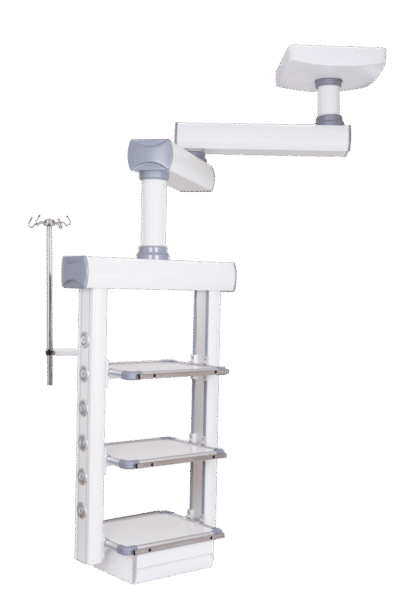
Your surgical pendant needs O₂, N₂O, medical air, vacuum, and AGSS. That’s not five outlets on the wall. That’s copper pipe running 30 to 50 meters from a central manifold or cylinder bank. Brazed at every joint. Pressure-tested section by section. Zone valves and alarms along the way. The piping alone runs $10,000–$20,000 before a single piece of equipment is mounted.
Most hospitals budget for “gas connections.” They discover they need a pipeline.
2. Certification delays
IEC 60601 compliance testing for a finished OR isn’t complicated. But you need a certified biomedical engineer, and in a lot of countries, that means waiting 2–4 weeks for a slot. Every week that room sits empty is a week of lost surgical volume. A hospital doing five to eight cases a day loses more money from a month of delay than the equipment cost in the first place.
I’ve seen it happen. The test itself costs a few thousand dollars. The waiting costs ten times that.
3. Sea freight damage
I watched an anesthesia machine arrive with a cracked vaporizer mount once. Container was stacked wrong at the port. Standard shipping insurance covers loss — not functional damage, unless you specifically add all-risk coverage.
Budget 1.5–2% of equipment value for proper marine insurance. Keep 3–5% as a contingency buffer on the first shipment from a new supplier. You probably won’t need it. When you do, you’ll be very glad it’s there.
4. Mixing brands
Operating table rails. Clamp interfaces. Weight ratings. None of this is standardized across manufacturers.
I watched a hospital save $2,000 buying traction attachments from a third party. They spent $4,000 on custom adapters and two weeks of engineer back-and-forth. The “savings” cost them double and delayed their first case by fourteen days.
I call this the brand mix tax. If you’re buying a table, buy the attachments from the same manufacturer. The discount from mixing brands is fake.
5. No service contract
A surgical light doesn’t need much maintenance. Until an LED driver dies mid-case.
A service contract with a local biomedical firm costs $2,000–$5,000 a year for an OR equipment set. Skip it, and you’re paying $500–$1,000 per emergency call-out, plus rush shipping on parts. One call a quarter wipes out the savings. I’ve done this math too many times. It always comes out the same way.
What the timeline actually looks like
So how long does this all take? From purchase order to first patient: 14 to 22 weeks.
But here’s where people go wrong — and this might be the single most expensive scheduling mistake I see.
They wait for the equipment to arrive before they start working on the room.
The civil works — gas pipeline, electrical, HVAC — take every bit as long as manufacturing plus shipping. If you sequence them one after the other, that’s 8–12 weeks of dead time. An empty room. No surgeries. No revenue. Just waiting.
I call this the parallel trap. The fix is simple but it requires discipline: start the room the day you sign the purchase order. Run infrastructure and manufacturing in parallel. That 14–22 week timeline? That’s the parallel version. The sequential version is 22–34 weeks. Same equipment. Same room. Half a year longer.
So what’s the real number?
Let me put it all together with a real example. District hospital, developing market. Equipment from a mid-tier Chinese manufacturer, ISO 13485, CE-marked. The room has walls and a floor. It needs gas pipeline and electrical upgrades.
| Line item | Cost |
|---|---|
| Equipment | $22,000 |
| Shipping + marine insurance (2%) | $440 |
| Import duties + clearance (assume 5%) | $1,100 |
| Room engineering (HVAC, flooring, electrical) | $15,000 |
| Medical gas pipeline | $12,000 |
| Installation + commissioning (12%) | $2,640 |
| Certification + acceptance | $5,000 |
| Staff training (4 days on-site) | $3,000 |
| First-year consumables buffer | $2,500 |
| Contingency (10%) | $6,370 |
| Total | $70,050 |
$22,000 in equipment. $70,000 to open the doors.
Notice something? The room engineering and gas pipeline alone — $27,000 — already exceed the entire equipment budget. That’s the thing most first-time buyers don’t see coming. The equipment isn’t the expensive part. The room is.
What I actually tell people
An OR is not a shopping cart. It’s not a list of items you check off and then you’re done. It’s a room where equipment, gas, power, certification, and clinical workflow all have to land at the same time. Miss one, and the whole thing stalls.
I’ve been on the manufacturing side of this for fifteen years. I’ve watched hospitals in over twenty countries go through this process. Some of them opened on time. Some of them didn’t. The difference was never the equipment quality. It was the planning.
So here’s what I live by:
Take your equipment estimate. Multiply by about 3. That’s your budget — not the cautious version, the real one. If you come in under it, fantastic.
Buy your core equipment from one manufacturer. Light, table, pendant, anesthesia machine. One installation team. One service contact. One spare parts channel. When something doesn’t work during commissioning — and something always doesn’t work — you don’t want three vendors pointing fingers at each other.
Start the room the day you sign the PO. The civil works and gas pipeline take as long as manufacturing plus shipping. If you run them sequentially, you just doubled your timeline.
Check the paperwork before you send money. ISO 13485 certificate. CE Declaration of Conformity. FDA 510(k) letter if applicable. Look up the Notified Body number. This takes fifteen minutes. It could save you from customs rejecting the shipment at the port.
Put the service contract in year one. Cheaper than emergency call-outs. I’ve done the math. It’s not close.
If you’re mapping out an OR project and want a second pair of eyes on your equipment list, send me a message. I’m not going to pitch you anything. Just the kind of conversation I wish more people had before they opened a purchase order.
Note: All prices in this article are my personal estimates and do not represent actual industry pricing. The real cost of any piece of equipment depends entirely on the specific product, its configuration, features, and design requirements. There is no one-size-fits-all price — you’ll only get a real number once the specs are on the table. Surgical light, operating table, and pendant ranges are based on our own factory pricing (FOB China). Anesthesia machine and patient monitor prices are industry estimates. All ranges assume mid-to-high-tier equipment, ISO 13485 certified, CE-marked, as of 2026. Actual costs vary by configuration, destination, import duties, and local installation requirements. This is planning guidance — not a quote.
Last updated: August 12, 2026. Prices and equipment availability confirmed by model, configuration, and destination market.