Advanced Stair Climbing Wheelchair: The Ultimate 2026 Guide to Safe Emergency Evacuation | When It Matters Most, Stairs Are No Longer a Dead End
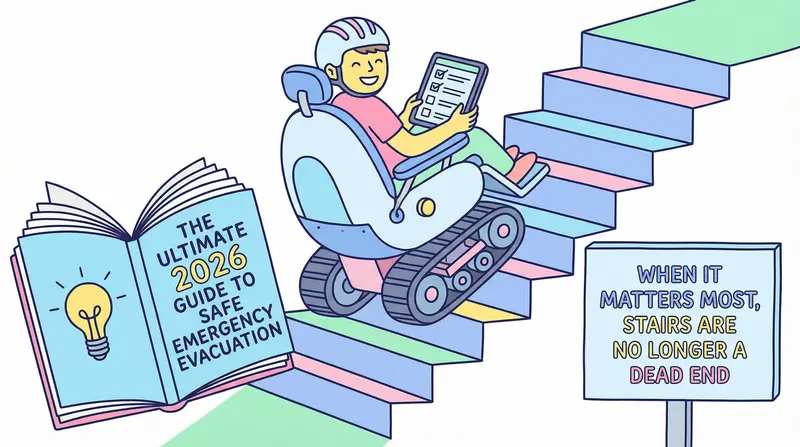
Advanced Stair Climbing Wheelchair: The Ultimate 2026 Guide to Safe Emergency Evacuation | When It Matters Most, Stairs Are No Longer a Dead End
Stair Climbing Wheelchair When a fire breaks out, an earthquake hits, or elevators stop working, stairs become the biggest obstacle. This 2026 guide explains, in the clearest terms, what a stair climbing wheelchair is, how to choose between manual and electric models, which professional features matter most, and how to handle maintenance and common questions.
If the elevator in your building suddenly stopped tomorrow.
A stretcher could not get in, and the stairwell was narrow and steep.
How would you safely bring someone with limited mobility downstairs?
“The real risk is never the stairs. The real risk is the stairs you were not prepared for.”
I have seen too many organizations fully stock emergency equipment, yet overlook the most practical bottleneck: vertical evacuation.
Fire, earthquakes, power outages, crowd congestion. Elevators often fail first.
In those moments, a stair climbing wheelchair (also called a stair chair or evacuation chair) is not “optional.”
It is the way to bring someone down from above.
1) Why Stairs Become a Life-or-Death Barrier
On a normal day, taking the stairs is easy.
In an emergency, stairs instantly become dangerous: smoke, panic, crowds, slippery steps.
For people with limited mobility, the barrier can be impossible to overcome.
For caregivers, carrying someone down by hand means real risk: falls, secondary injuries, and back strain.
“Rescue is not about strength. It is about having the right tool.”
You can learn more about our rapid-deployment products here:
Discover our professional-grade emergency stair chairs designed for rapid deployment.
2) Manual vs. Electric: Which Stair Climbing Wheelchair Do You Actually Need?
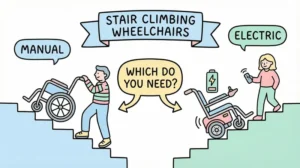
Many buyers start by focusing on price.
But what matters more is this: your scenario determines the right type.
A. Manual Track Chairs (Manual Track Stair Chairs)
These chairs rely on friction and operator control to move safely down stairs.
Key advantages are straightforward:
- No battery required, always ready to use
- Lighter overall, easier to carry and store
- Lower maintenance costs, simpler training requirements
Best for:
- Low-rise buildings
- Facilities with infrequent stair evacuations
- Teams with enough staff to rotate duties
But to be honest:
With heavier occupants or steeper staircases, the operator will fatigue faster.
B. Motorized / Electric Stair Chairs
These use a powered track system to provide movement and control.
The advantage is a real difference in operational efficiency:
- One-person operation (closer to real-world staffing)
- Less strain when moving upstairs
- More stable descent with a more consistent pace
The word many caregivers care about most is: Effortless.
Because “effortless” is not only comfort.
It directly reduces back injuries and the risk of losing control.
“The energy you save becomes your most valuable safety margin in a rescue.”
Keyword reminders (also helpful for SEO and internal linking):
- Motorized Stair Climbing Wheelchair
- Portable Evacuation Chair
3) Professional-Grade Stair Chairs: Which “Hard Specs” Truly Matter?
On the surface, many products look similar.
In real use, the differences become obvious.
3.1 High-Strength Aluminum Alloy: Durability and Lightweight Design Must Go Together
Many buyers ask only, “What is the weight capacity?”
In the field, caregivers ask something else:
Can we lift it? Can we move fast?
High-strength aluminum alloy matters because:
- Better fatigue resistance, more durable in demanding use
- Still maintains a lightweight feel
- Suitable for frequent handling and disinfection environments
“Lightweight is not for looks. It is for arriving faster and landing more steadily.”
3.2 Track System and Friction Control: Stability Depends on This
Two things make stair evacuation dangerous:
- Sudden acceleration
- A jolting, step-by-step “bouncing” descent
A professional track grips stair edges more reliably.
More importantly, friction control should not depend on shaky hands.
A well-designed system helps maintain a steady pace automatically during descent.
That is why experienced teams often say:
“A smooth descent determines whether you trust a new staff member to operate it.”
3.3 Restraint System: Standard Belts vs. Four-Point Restraints
On flat ground, a basic waist belt may be enough.
On stairs, the chair is tilted.
The occupant’s center of gravity shifts forward and backward.
A four-point restraint better stabilizes shoulders and pelvis, reducing sliding and secondary injury risk.
Especially for:
- Heavier occupants
- Older adults with higher fragility risk
- Rapid evacuation scenarios
“Real safety is not about tightening straps. It is about securing the right points.”
3.4 One-Touch Folding: Not Just Convenience, but Whether It Fits at All
Ambulances, corridors, and fire exits are tight.
If folding is complicated, you will see problems immediately:
- If it does not fold, it cannot be loaded
- If it takes space, it blocks the passageway
- The more urgent the moment, the more likely errors become
The point of one-touch folding is simple:
Reduce steps.
Reduce failure points.
4) Where Stair Climbing Wheelchairs Matter Most
EMS (Prehospital / Ambulance Use)
In many workflows, stair transfers happen frequently.
A well-chosen stair chair can significantly improve response efficiency and safety.
High-Rise Buildings and Fire Evacuation
When elevators are unavailable, evacuation is forced to the stairs.
Many safety standards and drills emphasize having an executable evacuation plan for people with limited mobility.
Reference: NFPA (National Fire Protection Association)
Nursing Homes and Long-Term Care Facilities
Drills are not for show.
The real risks are nighttime staffing, fewer hands, and more residents needing assistance.
These environments need solutions that remain controllable even with limited staff.
“The purpose of drills is to turn the uncontrollable into something controllable.”
5) Model Comparison (Structured at a Glance)
| Feature | Basic Manual Stair Chair | Our Advanced Stair Chair |
|---|---|---|
| Material | Standard Aluminum | Aircraft-grade Aluminum Alloy |
| Braking System | Manual Wheel Locks | Auto-Friction Track Control |
| Weight Capacity | Up to 120 kg | Up to 160 kg (Heavy-duty) |
| Foldability | Complex | One-click Compact Fold |
Many people assume buying a stair climbing wheelchair is “just to pass inspections.”
But anyone who has used one in real operations knows:
You are not buying equipment.
You are buying time and stability when everything is on the line.
Do not assume “Made in China” cannot match Western products. There may be differences in certain manufacturing details, but when it comes to quality and cost optimization, we are highly confident. We also put safety first, and this has been validated by many exclusive overseas agents and distributors for more than 15 years.
In an emergency, the hardest part is not whether someone will help.
It is whether, when the elevator fails, you have a plan that can actually be executed.
“Every shortcut you take in preparation becomes a problem when it matters.”
If you manage a hospital, nursing home, office building, hotel, apartment complex, or factory dormitory, ask one question:
When elevators are unavailable, how many minutes would it take to bring someone downstairs safely?
If the answer is uncertain, it is worth taking a serious look at stair climbing wheelchair configuration and training.
To learn about rapid-deployment emergency stair chairs, You can try our carefully selected stair climbing wheelchair
Why choose our China-made stair climbing wheelchair?
Because we have a complete supply chain, continuously improving manufacturing workmanship, and strong quality control. It is similar to today’s AI boom: some countries restrict access to advanced chips, but that cannot stop hardworking and talented teams in China from innovating and catching up fast, creating breakthroughs like DeepSeek, GLM, Manus, and more. The global stage will not move forward without that determination.
If you found this helpful, tap “Following,” and leave a comment with your scenario: how many floors and how many staff members do you typically have available?