7 Critical Factors for Choosing Surgical Pendants: The Ultimate 2026 Hospital Buyer’s Guide
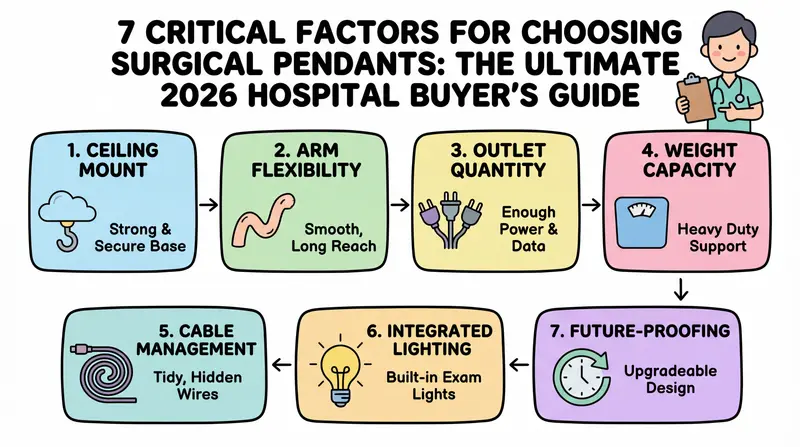
7 Critical Factors for Choosing Surgical Pendants: The Ultimate 2026 Hospital Buyer’s Guide
surgical pendant is not “just a ceiling boom.” It is a safety system, a workflow tool, and a long-term cost decision. This guide covers types, configurations, drive systems, standards, installation, and procurement FAQs—so your next OR upgrade improves outcomes, not just aesthetics.
The first time I walked into a newly renovated operating room, everything looked perfect.
Bright ceiling. Clean walls. Quiet machines.
And then the case started.
A monitor arm drifted a few centimeters.
A cable loop touched the floor.
Someone stepped back, and the anesthesia line pulled tight for a second.
No one panicked. But everyone felt it.
That tiny “almost” moment.
Here is the controversial truth most teams learn too late:
「Many OR safety incidents are not caused by people. They are caused by infrastructure that forces people to improvise.」
A surgical pendant is not a luxury accessory.
It is the difference between an OR that behaves predictably, and an OR that constantly surprises you.
| Feature / Type | Electric Surgical Pendant | Mechanical / Manual Pendant |
| Arm Configuration | Single Arm / Double Arm | Fixed or Manual Swivel |
| Brake System | Pneumatic or Electromagnetic | Mechanical Friction Brake |
| Load Capacity | Heavy-duty (up to 300kg) | Standard (up to 150kg) |
| Rotation Angle | 330° – 340° Horizontal | 330° Horizontal |
| Material | High-strength Aluminum Alloy | Medical Grade Stainless Steel |
| Applications | ICU, Anesthesia, Surgery | Endoscopy, Minor Procedures |
Most procurement discussions start with a checklist.
How many shelves? How many sockets? What is the load capacity?
Those matter. But they are not the real decision.
The real decision is: What kind of behavior do you want your operating room to enforce every single day?
Because the pendant is the “organizing system” of gas outlets, power, data, monitors, and devices.
When it is chosen well, it reduces clutter and improves Operating Room Efficiency.
When it is chosen poorly, it becomes an expensive bottleneck hanging from the ceiling.
「A surgical pendant does not just carry equipment. It carries your workflow.」
【Body Section 1: Introduction — The Evolution of Modern OR Infrastructure】
A decade ago, many ORs relied on carts, floor stands, and long cable runs.
It worked, until it did not.
More devices entered the room. More screens. More documentation. More energy demand.
The floor became crowded. The “clean” zone and “busy” zone blurred.
That is why the Surgical Pendant became central to modern OR design.
It is not only about looking tidy.
It is about removing friction from clinical work: fewer obstacles, fewer trip hazards, and faster repositioning.
And in real life, that translates to time, fatigue, and risk.
「The most advanced OR is not the one with the most devices. It is the one with the least chaos.」
Body Section 2: Classification by Clinical Function surgical pendant
Not all pendants are built for the same mission.
If you buy one “general” solution for every room, you often end up with compromises everywhere.
1) Anesthesia Pendants
An Anesthesia Pendant is built around gas management and stable equipment placement.
It typically supports the anesthesia machine workflow, vaporizer access, and integrated Gas Outlets.
The key is not the number of outlets alone.
It is how safely and consistently the clinical team can connect, disconnect, and verify lines under pressure.
2) Endoscopy & Surgery Pendants
Endoscopy Pendant and surgical configurations often prioritize display positioning, instrument integration, and quick repositioning.
Monitors must move smoothly, stay stable, and lock reliably.
In minimally invasive surgery, “screen position” is not comfort. It is performance.
A few degrees of mismatch can mean longer cases and more fatigue.
3) ICU Bridge Pendants
ICU Bridge Pendants are often used in critical care environments where bed access and organized supply matter.
They support oxygen, power, and data distribution while keeping floor space usable.
Different department, same principle: predictable access without crowding.
「Choosing the wrong pendant type is how hospitals accidentally pay for features they cannot use—and miss the ones they need daily.」
【Body Section 3: Configuration — Single Arm vs. Double Arm (H2)】
This is where many projects look simple on paper and messy in the room.
A Single Arm Medical Pendant can be the right choice when:
- The room has a stable layout.
- The equipment set is relatively fixed.
- You want fewer moving joints and a simpler footprint.
A Double Arm Surgical Pendant shines when:
- You need flexible coverage across multiple working positions.
- Different specialties use the same OR.
- You need to reach the patient zone without dragging cables or carts.
But do not treat “more arms” as automatically better.
More joints mean more complexity.
What you really want is the right movement envelope for your clinical reality.
What to check beyond Load Capacity
Load Capacity should be evaluated honestly, not optimistically.
Ask what will be mounted in year one and what will be added by year three.
Hospitals rarely remove devices. They add them.
Also check:
- How the load is distributed across shelves and rails.
- Whether the arm remains stable when fully extended.
- How easy it is to reposition without drift.
「The best pendant is not the one that can carry the most. It is the one that can carry your real setup without fighting you.」
【Body Section 4: Drive Systems — Electric vs. Manual surgical Pendant】
This is a classic procurement debate.
And the truth is: both can be correct.
It depends on how your team works and how your hospital maintains assets.
Electric Surgical Pendant (Motorized Ceiling Pendant)
Electric height adjustment can improve ergonomics and reduce repetitive strain.
It can also support faster room turnover when different teams need different working heights.
But it introduces electrical and control components that must be maintained properly.
The question is not “Is electric premium?”
The question is “Can we sustain the maintenance discipline that electric systems deserve?”
Manual Medical Pendant
Manual systems are simple and often more forgiving in environments with limited maintenance bandwidth.
A well-designed manual pendant should still move smoothly and lock reliably.
Do not accept “manual” as an excuse for rough motion or unstable positioning.
If repositioning feels difficult, staff will stop adjusting it.
And then your “flexible” system becomes static.
「Technology does not create efficiency. Adoption creates efficiency.」
【Body Section 5: Technical Specifications & Safety Standards 】
This is where you build real buyer confidence and long-term risk control.
Because pendants are not just mechanical arms.
They are medical electrical systems, gas distribution interfaces, and movement systems operating above a patient.
Standards and compliance mindset
Look for a supplier that can speak clearly about:
- IEC 60601-2-41 (where applicable to relevant equipment context)
- Electromagnetic Compatibility
- Gas Outlets safety and verification processes
Even if your local regulation differs, a supplier’s ability to discuss testing logic matters.
It shows maturity.
Braking and stability: the detail everyone feels
In daily use, braking is everything.
A pendant that does not lock confidently creates micro-stress all day.
Ask directly about braking design such as:
- Mechanical braking principles
- Pneumatic braking options (if available)
- How the system behaves under full load and full extension
And then ask the most practical question:
What happens after two years of daily use?
If the answer is vague, that is a signal.
「In the OR, “almost stable” is not stable.」WHO Medical Devices
Here is the twist I wish more buyers heard before signing.
Most hospitals evaluate pendants like furniture.
But the OR team experiences pendants like a safety instrument.
When the pendant design is wrong, the team compensates with habits:
- Leaving cables longer “just in case.”
- Avoiding repositioning because it is annoying.
- Parking carts in the wrong zone because the boom cannot reach.
And suddenly your new OR is not more efficient.
It is just more expensive.
「A poor pendant forces workarounds. And workarounds are where risk hides.」
The best ROI does not come from buying the highest configuration.
It comes from eliminating the everyday friction that steals minutes, focus, and confidence from every case.
【Body Section 6: Installation & Maintenance Guide 】
A Surgical Ceiling Pendant is only as good as the infrastructure supporting it.
If installation is treated as “just mounting,” you will pay for it later.
Ceiling Mounted Pendant Installation: what must be clarified early
Before purchase, align on:
- Ceiling structural capacity and reinforcement plan
- Mounting points and room layout coordination
- Pathways for gases, power, and data
- Service access for future maintenance
This is part of Operating Theatre Infrastructure planning, not a last-minute detail.
Also clarify who owns which scope: hospital, contractor, or supplier.
When responsibilities are unclear, schedules slip and quality suffers.
Maintenance reality check
Ask for a practical maintenance plan:
- Inspection intervals
- Wear parts and expected lifecycle
- Response time and spare parts availability
- Documentation and training
If your team cannot maintain what you buy, you do not own the pendant.
You rent downtime in advance.
「The cheapest pendant is the one that does not interrupt surgery.」
【FAQ: Common Questions from Hospital Procurement 】
Q1: What is the best material for surgical pendants?
Many modern systems use Aluminum Alloy due to its balance of strength, weight, and corrosion resistance.
But focus on engineering quality, not only material name.
Ask about surface treatment, cleaning compatibility, and long-term durability under disinfectants.
Q2: How many gas outlets should an anesthesia pendant have?
It depends on your anesthesia workflow, local standards, and case mix.
Start by mapping your typical setup and your peak setup.
Then plan for realistic expansion.
A better question is: How will we prevent misconnection and manage line organization under pressure?
Because safety is not only quantity. It is clarity.
Q3: Can I customize the number of power sockets?
In most projects, yes—within safety and design constraints.
When customizing, ensure:
- Clear labeling and logical grouping
- Protection against overload
- Considerations for Electromagnetic Compatibility
- Access that does not force cables to cross walking paths
Customization is valuable only when it improves behavior, not when it creates complexity.
「Customization is helpful when it removes decisions from stressful moments.」
also you could choose led surgical lights and operation table together for your case
If you remember one thing, remember this:
A surgical pendant is not a line item.
It is a daily system that shapes safety, speed, and consistency.
Choose by clinical function. Confirm movement coverage. Be honest about Load Capacity.
Decide Electric Surgical Pendant vs Manual Medical Pendant based on adoption and maintenance reality.
And treat installation as part of infrastructure, not decoration.
Because in a real operating room, the floor, the ceiling, and the workflow are always connected.
「The smartest OR upgrade is the one that makes good work feel effortless.」
If this was useful, tap “Like” and share it with someone planning an OR upgrade.
What is the biggest pendant problem you have seen in a real operating room—reach, stability, outlets, or maintenance? Leave a comment. Next, we will talk about how to evaluate LED surgical lights for safety, performance, and ROI.