3-Wheel vs. 4-Wheel Mobility Scooters: Safety Guide
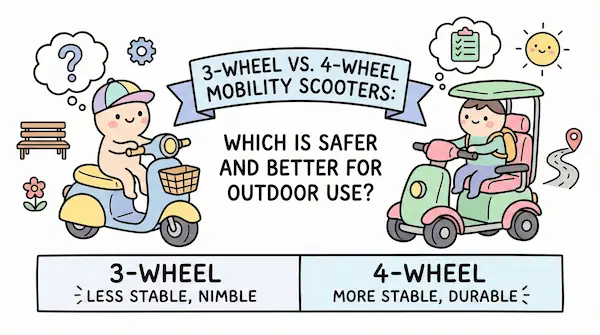
3-Wheel vs. 4-Wheel Mobility Scooters: Safety Guide
mobilty scooters I once witnessed a “near tip-over” at a park entrance. That moment taught me this: safety is not simply about having more wheels. It is about choosing the right scooter for the right scenario. This article breaks down why 3-wheel scooters are more agile, why 4-wheel scooters feel steadier, and how to choose without regret.
Last weekend, I saw something at the entrance of a park.
An older adult was riding a mobility scooter slowly downhill, getting ready to turn.
Someone nearby said,
“Don’t worry. It’s a 4-wheel model. It’s stable.”
Then, in the next second, the scooter wobbled.
They braked hard and stopped with the front wheel right against the curb.
For a moment, everyone went silent.
And I suddenly realized something:
「Outdoor safety is not simply “more wheels means safer.”」
When people choose a mobility scooter, the first word that comes to mind is “safety.”
But the “safety” you picture usually comes down to two fears:
One is tipping over.
The other is not being able to turn tightly enough.
Especially outdoors.
The ground is not always flat.
Turns are not always wide.
And crowds do not always make room for you.
Before you buy, it feels like specs.
After you start using it, it feels like everyday anxiety.
Let’s be clear: Safety = Stability + Control
Real safety is not “the scooter looks stable.”
Real safety is whether you can control it at critical moments.
Think about these common outdoor situations:
- Slowing down on a downhill slope
- Turning to avoid pedestrians
- Crossing small bumps or cracks
You will notice the wheel configuration affects two things:
- How easily you can adjust your direction
- How likely the scooter is to lean or wobble unexpectedly
So 3-wheel vs. 4-wheel is not about which is “better.”
It is about which one fits your roads.
「Choosing the wrong configuration is the most dangerous upgrade.」
【Main Part 2】
3-Wheel: Agility Is a Strength, If You Use It in the Right Places
The biggest advantage of a 3-wheel scooter is simple: it turns easily.
You feel it most in supermarkets, wet markets, and narrow neighborhood paths.
Aisles are tight.
People are everywhere.
And someone can appear suddenly around a shelf corner.
In those moments, a smaller turning radius can actually mean “safer.”
Because you do not need to reverse repeatedly.
And you do not need to force a wide turn that pushes you into a wall or a crowd.
Many people worry that 3-wheel scooters tip more easily.
But when do tip-overs really happen most often?
Not on a straight line.
They often happen when you are forced into sharp maneuvers in tight spaces.
If your main environment is narrow and requires frequent turning,
the agility of a 3-wheel scooter can make you calmer and more in control.
「Agility is not about going faster. It is about avoiding risky moves.」
4-Wheel: Stability Feels Reassuring, and It Fits Open Outdoor Spaces Better
Now let’s talk about 4-wheel scooters.
The advantage is obvious the moment you sit down: confidence.
Especially in places like parks, plazas, and riverside paths.
Wider roads.
Clearer sightlines.
Fewer urgent, tight turns.
A 4-wheel scooter’s stability reduces the “side-lean uncertainty.”
You feel more comfortable going straight.
You feel more comfortable moving slowly over gentle slopes.
And you are less likely to panic if one wheel hits uneven ground.
If your main use cases are:
- Park walks
- Smooth roads outside your community
- Wide paths with mostly straight riding
A 4-wheel model often matches that “steady, grounded” sense of safety.
「The stability of four wheels is not for speed. It is for peace of mind.」
The Most Counterintuitive Truth: Many “Tip-Overs” Are Not About 3 Wheels
When I replayed what I saw that day at the park entrance,
the problem was not “4-wheel scooters are unstable.”
It was that the scenario stacked multiple risks: downhill + turning + curb edge.
The most dangerous moment outdoors is often not normal riding.
It is when you do one of these:
- Turning while braking
- Suddenly steering to avoid people
- A wheel catching a curb edge, gap, or crack
So the real buying logic should be:
Your everyday routes determine whether you need agility or stability.
If you mostly go to supermarkets, markets, and narrow streets:
prioritize 3-wheel agility and control.
If you mostly go to parks, outdoor strolls, and wide flat paths:
prioritize 4-wheel stability and steady handling.
「Safety is not one standard answer. It is choosing a scooter that fits your life.」
so please trust ascend medtech medical equipment is much better choice for them .
In the end, both 3-wheel and 4-wheel scooters can be safe.
The key is this: do not buy for an imagined road when you live on a real one.
Ask yourself one question first:
Is the route you ride every day narrow or wide? Does it have many turns? Is it steep?
Choose the wheel configuration based on your scenario, not on assumptions.
Your sense of safety will immediately become real and practical.
「More wheels is not always better. The safest choice is the one that fits you.」
If you found this helpful, tap “Like” and share your thoughts in the comments: do you go to supermarkets more, or parks more? Next time, let’s talk about how to handle outdoor hazards like slopes, curbs, and pavement cracks.